Comparing AI Revenue Impact Across DTC Brand Size Segments
Small brands gain operational leverage from AI, but need transaction data to prove revenue impact.

AI’s revenue impact on DTC brands depends on the number of products offered, traffic volume, and operational maturity. Comparing brand tiers shows why the same investment can produce operational savings at one scale and measurable conversion gains at another. Realistic expectations start with the data a brand already has, the buying decisions it can help shoppers make, and the revenue it can reliably measure.
Why AI revenue impact is not uniform across DTC brand tiers
The democratization argument assumes that access to the same AI tools gives every brand the same opportunity to benefit. The inputs those tools need accumulate unevenly. Structured product data, review volume, session volume, and customer transaction history determine how much useful evidence AI has to work with. A brand can buy access to a tool without having the data floor that makes its predictive outputs reliable. Scale therefore changes the value of the tool, even when its capabilities are the same.
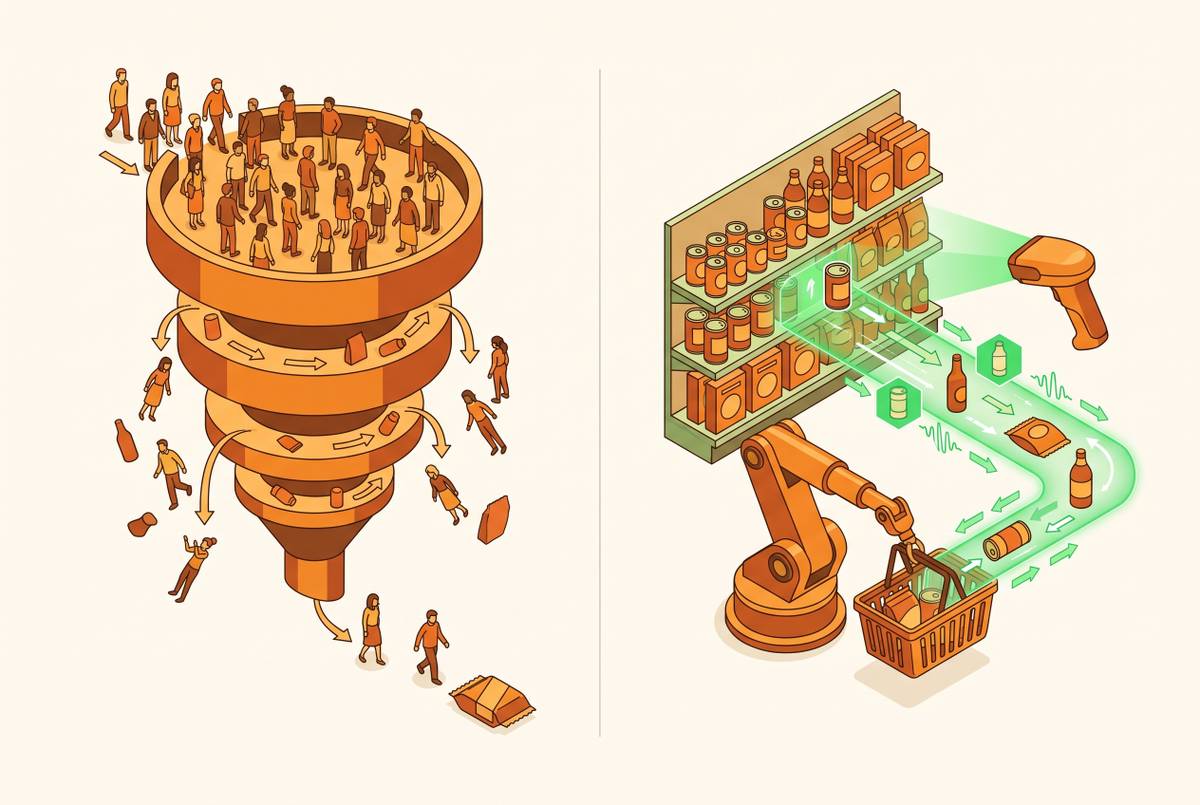
This difference matters as buyer-side agents and merchant-side infrastructure develop at the same time. ChatGPT, Perplexity, and Google Gemini research and shortlist products on a shopper’s behalf, while merchant-side AI operates within storefronts. Buyer agents aggregate requests, including a query for wireless earbuds under a price ceiling with a specific battery life, even when no product exactly matches. They then shortlist products using machine-readable structured data. What matters in that comparison is what the agent can read, rather than the full visual and narrative experience a shopper might encounter on the website.
Advanced schema correlates with higher answer-engine citation rates, but controlled studies have found no measurable causal uplift in AI search citations from adding schema alone. A large share of ecommerce sites also ship incomplete or invalid Product schema. Traditional search rankings offer another incomplete signal because a majority of URLs cited by ChatGPT do not rank in Google’s top 100, while Perplexity has significantly higher overlap with Google rankings. Agent-readiness is necessary across tiers, but neither schema nor SEO performance establishes what revenue it will deliver.
The commercial consequence is that discovery moves upstream of the website. The agent determines which competitors enter the comparison and which readable attributes matter. Brands that depend on storytelling and brand experience therefore face a specific margin risk when those distinctions are absent from the shortlist.
What AI actually delivers for small DTC brands
Small brands have to meet the same technical requirements for agent-readiness as larger businesses, but they often have too little data for reliable predictive modeling. Access to enterprise-grade tools does not resolve that constraint. With fewer sessions and transactions, predictive outputs have less evidence behind them. At this tier, a credible AI case starts with what the available evidence can support.
Qualitative conversation intelligence remains useful below the predictive data floor. An on-site AI assistant can reveal what shoppers ask for, including combinations of needs that no existing product fully satisfies. Those conversations can show patterns in what shoppers want that keyword tools miss. Their value lies in identifying the language and requirements behind a purchase decision, rather than predicting behavior across a large customer population.
Operational leverage is the clearest immediate benefit. A full AI marketing agent stack can produce content that would otherwise call for agency retainers and more work than a founder-led team could handle. That expands the amount of work a small team can complete without making predictive modeling any more reliable. Increased throughput and increased sales are different outcomes, so the former should not be presented as proof of the latter.
Blended Marketing Efficiency Ratio should be the main metric, with a multi-touch attribution platform to support it. One to two incrementality tests a year for major channels can help show whether that activity brings in more revenue or just gets credit for it. This approach keeps the commercial assessment anchored in overall efficiency without requiring every AI interaction to carry a precise channel-level revenue claim.
What AI actually delivers for mid-market DTC brands
Mid-market brands reach the point where session volume and transaction history can support predictive modeling and meaningful incrementality tests. That makes AI’s revenue contribution more measurable, but not uniform across the tier. Product complexity, the number of products offered, and the quality of the conversion environment still shape the opportunity. Enough traffic to test an assistant is not the same as a clear reason for shoppers to use one. The strongest fit is where choosing the right product requires expertise that an on-site conversation can supply.
Dialog’s 2026 documented ideal customer profile targets mid-market and enterprise brands with at least 25,000 monthly visitors on Shopify, with substantially higher thresholds on other platforms. Its documented target includes skincare routines, technical equipment, and premium goods with large catalogs. These are purchases where shoppers need help assessing fit. A brand’s traffic and buying complexity provide a more concrete test of whether an on-site assistant matches its needs.
The Walmart/Shopify checkout tests point to the owned storefront as the place where the conversion advantage materializes, rather than in-chat checkout. That distinction puts control of the conversion environment at the center of the mid-market opportunity. AI-referred traffic has moved from a negligible channel to one that outconverts non-AI traffic, and those visitors stay longer and view more pages. However, their different behavior also makes a simple conversion comparison insufficient evidence of incremental lift. A higher-converting cohort may include shoppers who were already more ready to buy.
Brands therefore need to measure results carefully before they spend more. Full cross-platform attribution with ML models and quarterly incrementality testing is appropriate at this tier, with Marketing Mix Modeling for brands with significant monthly media spend. ChatGPT, Copilot, Gemini, and AI Overviews each need separate server-side tagging logic. Without that foundation, a brand can improve the shopping experience while still misreading which activity produced the revenue. The opportunity is measurable conversion improvement on the owned storefront.
What AI actually delivers for enterprise and scaling DTC brands (with substantial revenue)
Enterprise brands have the volume for AI-mediated shopping to represent material revenue in absolute terms. Shopify reported dramatic growth in AI-attributed orders and AI-referred traffic between January 2025 and March 2026, with orders outpacing traffic. Amazon reported that hundreds of millions of customers used its Rufus shopping assistant in 2025 and that those users were substantially more likely to complete a purchase. These examples establish the scale at which AI-assisted shopping is operating. They do not establish a conversion forecast that every enterprise DTC brand can apply to its own customers.
At this scale, the strategic risk is commoditization. A buyer agent can place a brand against competitors chosen on the basis of readable product attributes. Richer, more structured product data helps a brand get cited, while brand equity and visual storytelling alone may be left out of the comparison. The more a brand depends on those distinctions, the more consequential their absence becomes. Large revenue does not protect a business from being reduced to the attributes an outside agent can interpret.
Owned brand intelligence matters because it gives the brand a way to explain product fit through its own facts. This is not a substitute for structured data or a guarantee that an outside agent will cite the brand. It addresses a different problem, namely the loss of context when the purchase is mediated elsewhere. At enterprise scale, the question is therefore not just how many transactions AI touches. It is also whether the brand’s own product knowledge remains part of the decision.
Enterprise data volumes support full Marketing Mix Modeling, continuous incrementality testing, and predictive LTV modeling. Yet these brands also have the most complex attribution environments, with separate server-side tagging requirements across AI channels. The Personal Agent Protocol, dated October 6, 2026, and Shopify’s Universal Commerce Protocol set out standards for how buyer agents authenticate and transact. Brands that adopt these standards early have an advantage in how AI-mediated discovery works, but they still need to be ready both to handle transactions and to measure them. Neither can stand in for the other.
Why AI traffic measurement is broken across all tiers and what to do about it
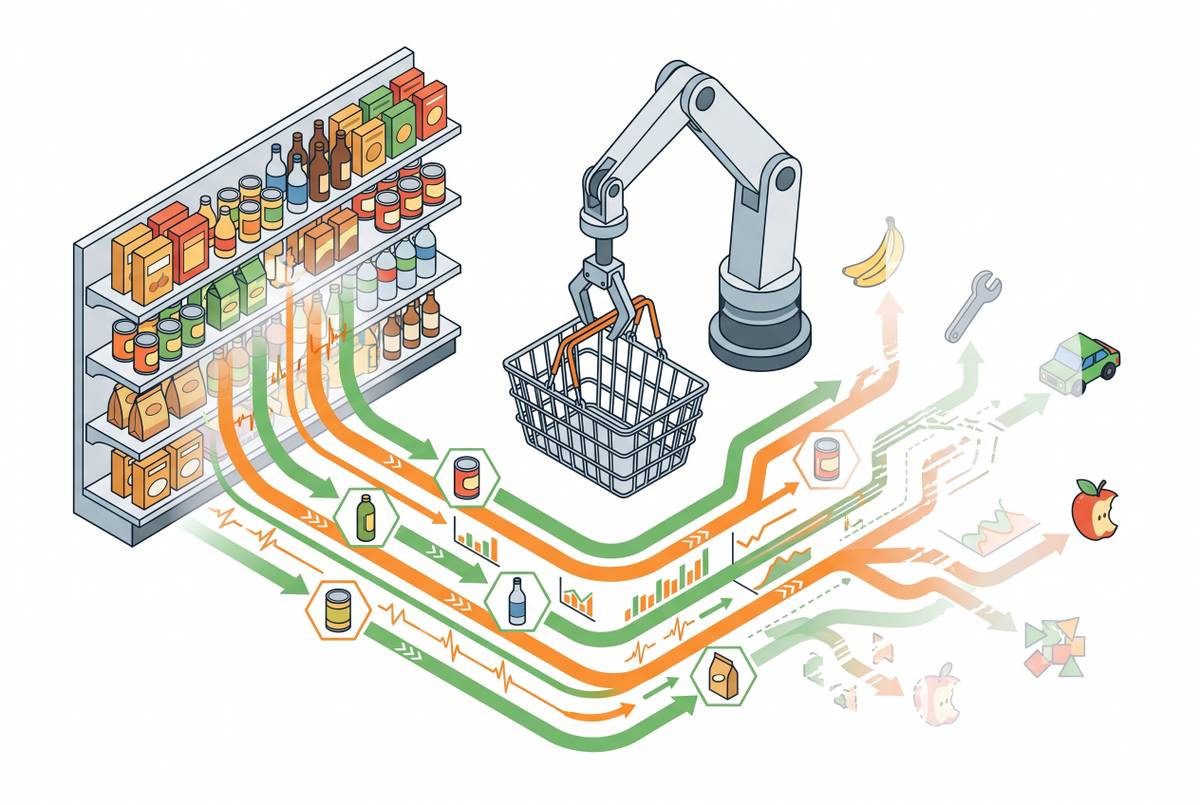
AI shopping agents are driving revenue that many analytics dashboards do not correctly identify. GA4 misclassifies a large share of AI referrals as direct traffic, so a meaningful portion of reported “Direct” activity is AI-sourced across ecommerce. This is not simply an untidy channel label. It means brands are assessing investment against an incomplete account of where purchases originate. The measurement gap precedes the choice of an attribution dashboard.
The technical problem has two related forms. Some AI referrals reach the site but lose their proper classification, while agent-driven activity can create no browser session, no cookie, and no JavaScript events at all. Standard GA4 tagging misses that activity entirely. Server-side tracking through webhook-level order capture is the only way to reliably capture those orders. This requires a change in data architecture.
The exposure differs by tier because brands use the resulting data differently. Small brands that treat blended MER as their primary metric are partly insulated because they are not relying on channel-level attribution for the whole assessment. Mid-market and enterprise brands are more exposed when budgets depend on assigning revenue to individual channels. Missing AI activity can distort that allocation even when total sales are recorded.
Reliable capture is also separate from credible evidence of lift. Engaged-shopper cohorts need to be compared against the brand’s own baseline, rather than treated as proof that the assistant caused every observed purchase. Incrementality testing helps distinguish added revenue from the selection bias inherent in higher-intent groups. Vendor-reported conversion claims that omit their methodology should therefore be treated as indicative. Honest reporting requires both an account of what was captured and a defensible comparison for what changed.
How to set realistic AI revenue expectations based on your brand's current scale
The starting point for AI investment is the set of inputs a brand possesses and the gaps that remain. Revenue tier helps group brands at first, but what they can put to work depends on how complex their catalogs are, how much traffic they have, and how well their operations have developed. A tool marketed to a particular size of business is not evidence that the business has the data to benefit from it. Expectations should follow the mechanism being improved, whether that is production capacity, understanding shopper demand, or helping a customer choose. Each mechanism calls for a different commercial test.
For small brands, the practical priority is operational leverage and qualitative conversation intelligence. On-site questions can show what shoppers want before predictive modeling becomes reliable, while marketing agents can produce more than a founder-led team could handle. Brands should measure those gains without promising that every improvement in efficiency will bring in more revenue. Blended MER, a multi-touch attribution platform, and one to two annual incrementality tests for major channels provide the appropriate measurement approach. The constraint is limited data.
Mid-market brands should fix attribution before they spend more on AI. Server-side tagging and a reliable baseline come first, followed by on-site AI aimed at conversion in the owned storefront. The Walmart/Shopify checkout tests back that focus on the owned storefront over in-chat checkout. Quarterly incrementality testing then helps show how much lift is real and how much comes from AI-referred cohorts being more ready to buy. Marketing Mix Modeling becomes appropriate where monthly media spend is significant.
Enterprise brands that adopt the Personal Agent Protocol and Shopify’s Universal Commerce Protocol early are better prepared to handle agent transactions. Full Marketing Mix Modeling and continuous incrementality testing are the measurement standard, while channel-level attribution still needs server-side tagging to be reliable. These investments belong with owned brand intelligence because scale increases both the revenue opportunity and the cost of losing product context. Buying is becoming asking, with shoppers consulting AI before, during, and after visiting a brand’s site. Across every tier, the durable priority is to make the brand’s own facts part of those answers and measure the resulting business impact against its own baseline.