Customer Intelligence From AI Conversations as a Merchandising Input
AI conversations reveal what shoppers actually need to decide, not just where they click.
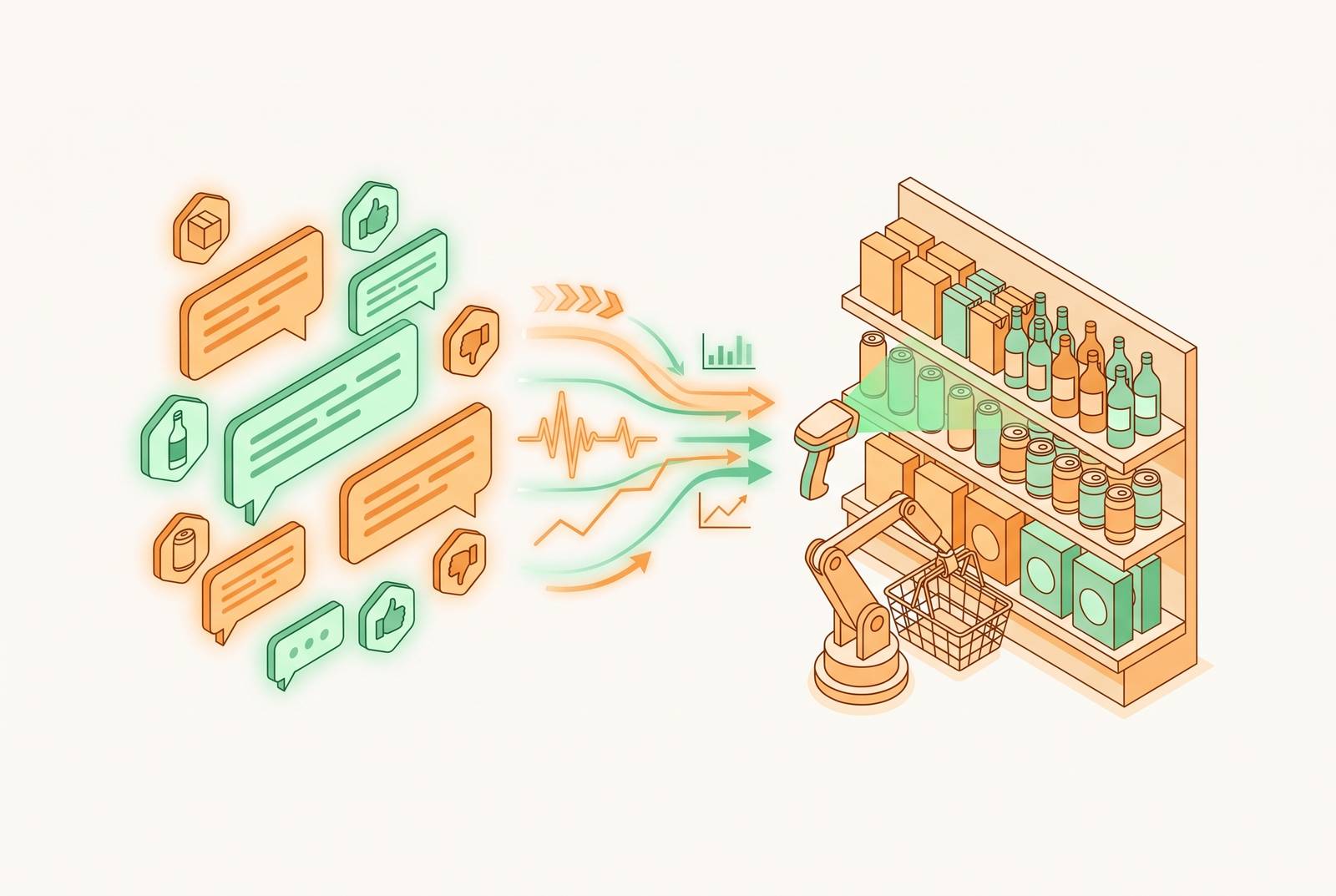
On-site AI conversations give DTC brands more to work with in merchandising than clicks and session paths alone. The questions, hesitations, and language in those conversations reveal what shoppers need to make a choice. Treating the records as customer intelligence rather than a support archive turns that evidence into better product sequencing, copy, product organization, and decisions about assortment gaps.
Why on-site AI conversations are a different kind of data than anything DTC brands have collected before
Traditional DTC analytics record actions, including clicks, add-to-carts, and session paths. Those actions show how shoppers move through a store, but they leave much of the reasoning behind that movement unstated. A product visit does not explain what the shopper hoped to find there. Nor does an abandoned comparison explain which difference mattered. The conversation log is structurally different because it can contain the shopper’s own account of the choice they are trying to make.
Consider a shopper asking “which of these is better for sensitive skin if I also run hot at night”. The shopper is comparing products to meet a personal need and is unsure which attributes matter together. It reveals a missing way to describe or distinguish products. It also exposes a copy failure if the available descriptions do not answer that combined need. A heatmap or funnel report cannot recover those requirements from page movement alone.
The value therefore lies in the relationship between the words. Sensitive skin and running hot at night are conditions that the shopper wants one choice to satisfy. For merchandising, showing each attribute on its own may leave the shopper unsure how the products compare.
Ownership makes this evidence practical to use. An on-site AI sales agent produces first-party conversation records that the brand controls, can segment, and can act on directly. That differs from signals generated in third-party AI shopping channels such as ChatGPT, Perplexity, and Gemini. The brand does not have to treat its own conversations as a distant indication of changing discovery behavior. They are an available data asset tied to questions about its own products, with a direct role in how those products are presented.
The three merchandising signals buried in every conversation log
The first signal is a demand gap: a need that the current product presentation or assortment does not clearly satisfy. The sensitive-skin and temperature question shows how a combination of attributes can be missing. It may point to products that exist but are difficult to compare through the current product organization. Or it may show a need that no product in the assortment meets. The question identifies the gap to investigate, but it does not by itself establish that a new product is the answer.
This distinction separates demand discovery from an automatic call to expand the assortment. A shopper can fail to find a suitable choice because the product is absent or because the relevant attribute is absent from its description. When the attribute is missing from the description, the evidence can guide product-information enrichment and product comparison. In the former, it becomes an input to decisions about assortment gaps rather than proof that every unanswered request warrants an addition.
The second signal is an objection pattern, such as repeated sizing uncertainty around the same product. Questions about ingredients and doubts about compatibility can point to objection patterns too. These hesitations identify what is preventing confidence in a choice, which can reveal failing copy or a structurally incomplete page. They are not evidence that price is necessarily wrong. A repeated size-chart question, for example, makes sizing confidence the issue to address rather than leaving the brand to infer a general reluctance to buy.
The third signal is language alignment, which is the match between the brand’s wording and the way shoppers describe the benefit or concern. Phrases such as “takes the guesswork out” and “worried it wouldn't work for my situation” express more than a product category. They describe what shoppers hope to get or the risk they have in mind. That makes them a more precise starting point for product descriptions and ads than an assumed account of what customers value. Demand gaps concern what is missing, objections concern what blocks a choice, and language alignment concerns how that choice is understood.
Iowa’s Tippie College of Business research on role coherence shows how much preference information natural language can carry. The research finds that seller-side systems can learn about willingness-to-pay and preference structure from buyer agents’ natural-language persona descriptions. Its setting is AI-mediated buying. Even so, it establishes a relevant distinction between explicit answers and the richer preferences conveyed through language. A conversation can show how needs fit together without fitting them into the predefined fields of a survey or form.
Why keyword analytics and session data cannot produce these signals on their own
Session analytics show abandonment without reliably identifying its cause. A shopper who leaves a product detail page after a brief visit could be price-sensitive, confused by the size chart, unconvinced by the ingredient list, or simply interrupted. The session record cannot distinguish those explanations. A conversation can distinguish them when the shopper expresses the concern. Keyword analytics likewise keep the terms but may lose the conditions and comparisons that explain what those terms mean.
A copy test can compare versions, but deciding which versions to test takes some knowledge of what matters to the shopper about the product. Conversation data supplies evidence for that choice before the test is designed. If shoppers keep asking about compatibility, there is more reason to test it than a benefit chosen only on the team's judgment. The conversational layer therefore adds a source of hypotheses rather than replacing the tools used to evaluate them.
The ACES research identifies another limit of a static view of product performance. Its framework shows that AI agents can concentrate demand on a few “modal” products while ignoring others, and that model updates can shift that concentration. A fixed view of which products get attention cannot explain how the choices agents make change over time. Continuous auditing of which products are questioned, compared, and passed over in conversation makes that pattern a merchandising concern. Product sequencing is therefore not just a question of what receives clicks, but also of which choices enter or disappear from the comparison.
The same enrichment work has an external discovery payoff. Objection language and shopper descriptions of benefits can feed PDP copy, size guides, FAQ modules, and ad creative, replacing assumed relevance with relevance expressed in live conversations. The ACES research shows that seller-side agents can make significant gains in AI-mediated market share when they make targeted, query-conditional tweaks to descriptions. That supports the logic of aligning descriptions with actual questions, without establishing a guaranteed on-site conversion lift. Clearer product information serves both on-site assistance and external AI discovery, including commerce protocol contexts, so brands can work on one shared account of what the product means.
How to measure whether conversational data is actually moving merchandising outcomes
Measurement begins with the product change. Each change needs a connection to the conversation evidence that prompted it. A sizing clarification derived from repeated sizing questions has a different basis from a general rewrite of the same page. Tagging the change to its conversational source preserves that distinction.
The notes behind that intervention should make the intended effect clear through the relationship between the question and the change. When the source is an unresolved comparison, the relevant enrichment should help explain the product difference in question. When the source is objection language, the copy change should address that objection. This provides a basis for interpreting the intervention’s result because the measured change has a defined reason.
A pre/post window then gives the brand a way to compare outcomes for the affected products. The specified measures are PDP conversion rate and AI-channel citation. They answer different questions, since conversion concerns the purchasing outcome while citation concerns whether the product appears in AI-channel answers. Keeping the measures attached to the products that changed is essential to the method. A store-wide result is less informative about whether the particular enrichment addressed the particular gap.
For shopper-language copy, A/B testing can complement that pre/post comparison. The advantage is a stronger prior, because the proposed language has already appeared in real shopper usage before becoming copy. That validates its relevance as a hypothesis. The test still has to show whether the new wording works better.
The resulting ROI signal is brand-specific and accountable to the work performed. It connects a recorded concern, a product-level response, and the outcomes observed over a defined window. A pre/post comparison provides a more useful basis for evaluation than an undifferentiated platform attribution claim. The standard is whether traceable merchandising work changes the outcomes it was intended to improve.
Where to start with conversation logs as a merchandising input
Most brands with an on-site AI agent already have conversation logs. The first operational change is to treat those records as a merchandising input. The brand then reviews the records to find what keeps shoppers from choosing products across conversations, as well as to understand each exchange.
First, identify the products that generate the most conversational volume and classify what shoppers ask about them. These are the PDPs where enrichment has the fastest measurable opportunity because the questions already identify active points of uncertainty. Query volume establishes where to begin, while the content of those queries establishes what to change. A product that draws many questions may still be a good product. It is a product for which shoppers are repeatedly seeking help that the existing presentation may not provide.
Next, separate the findings into demand gaps, objection patterns, and shopper language, then route them into the merchandising work they support. Missing attributes inform product organization and comparison, while unanswered needs inform assortment-gap decisions. Repeated objections belong in the relevant PDP copy, size guides, or FAQ modules. Shopper descriptions of benefits also provide material for ad creative. Patterns in which products are considered and passed over inform product sequencing rather than requiring every finding to become a copy edit.
Finally, close the loop by tagging each change to its conversational source, setting its pre/post window, and tracking PDP conversion rate and AI-channel citation for those products. The sequence matters because measurement is most useful when it follows a clear diagnosis and a specific response. The practical edge comes from making this a continuous merchandising input, so that the language shoppers use to choose products shapes how the next shopper encounters them.