AI Shopping Assistant Accuracy and Hallucination Risks in E-Commerce
A fresh data problem disguised as an AI accuracy issue.
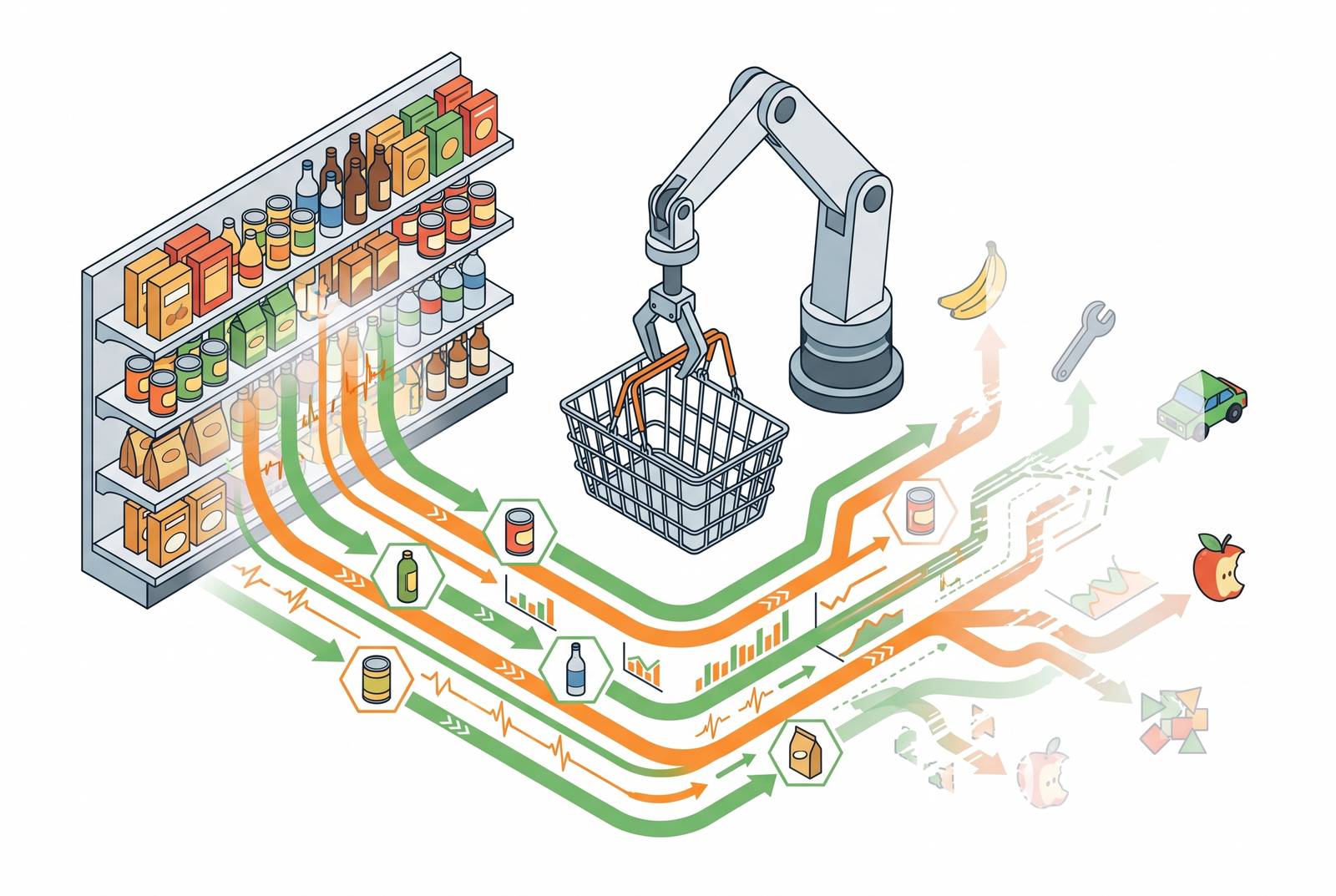
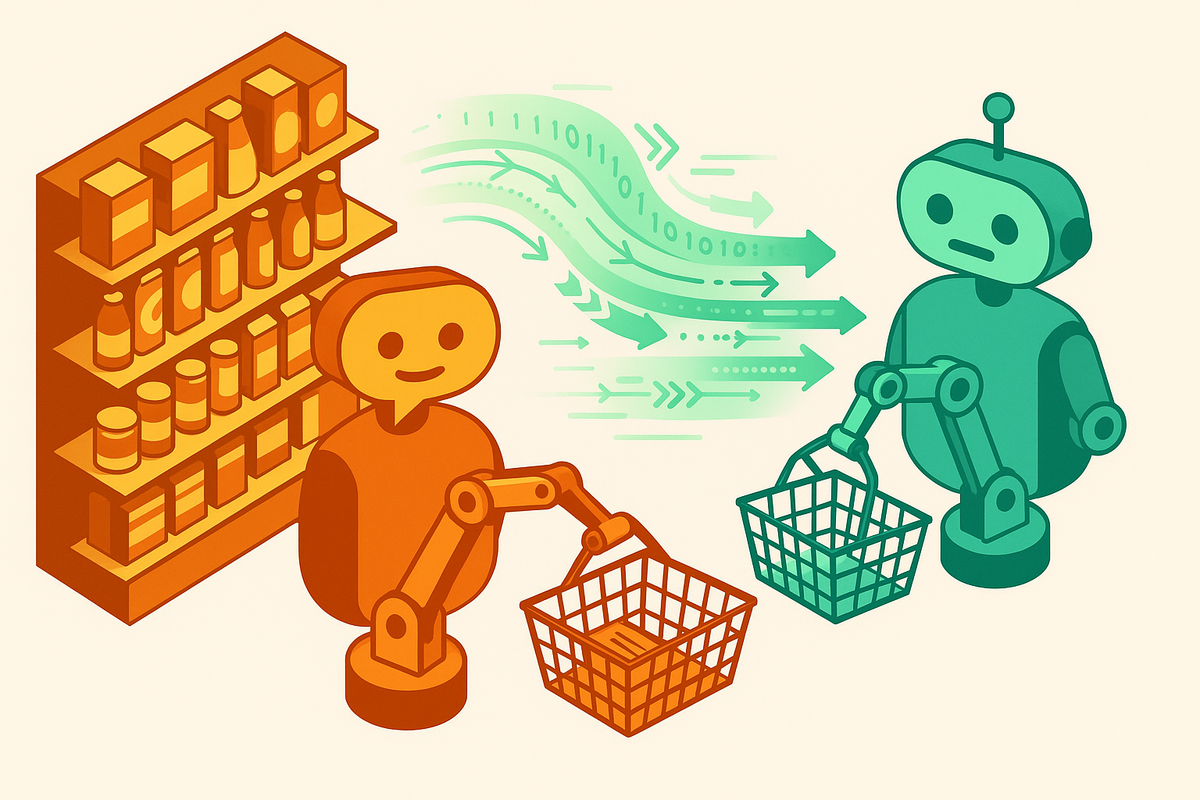
Hallucination, in the context of an AI shopping assistant, means the system generates an answer that sounds plausible but has no basis in the product data, policy documents, or inventory records it was supposed to draw from. The model is not confused, and it has not malfunctioned. It has done what a language model does when it lacks the facts it needs: it produces the most statistically likely continuation of the conversation, regardless of whether that continuation corresponds to anything true. A shopper asking whether a jacket comes in navy and whether it ships internationally gets an answer that reads as confident and specific, because the model's job is to sound confident and specific, not because the brand actually ships that jacket to the shopper's country.
Four distinct failure patterns recur across e-commerce deployments. Promotional fiction happens when the assistant quotes a discount code or bundle offer that no longer exists. Inventory phantoms happen when the assistant confirms that an out-of-stock item is available. Policy misinformation happens when the assistant invents a shipping timeline, a return window, or a warranty term, and it conflicts with what the brand actually offers. Specification fabrication happens when the assistant invents a feature, a dimension, or a compatibility claim about a product it was never given enough detail to describe accurately. Different categories, same root failure: the assistant had nothing accurate to consult, so it built an answer out of plausible fragments instead.
Shopify's own guidance to merchants names this directly: AI chatbots can retrieve inaccurate information when the store policies feeding them are out of date. That is a precise, unglamorous way of saying what matters most about hallucination in a commercial setting. The problem does not begin in the model. It begins in whatever the model was handed to work with.
The failure modes that reach customers
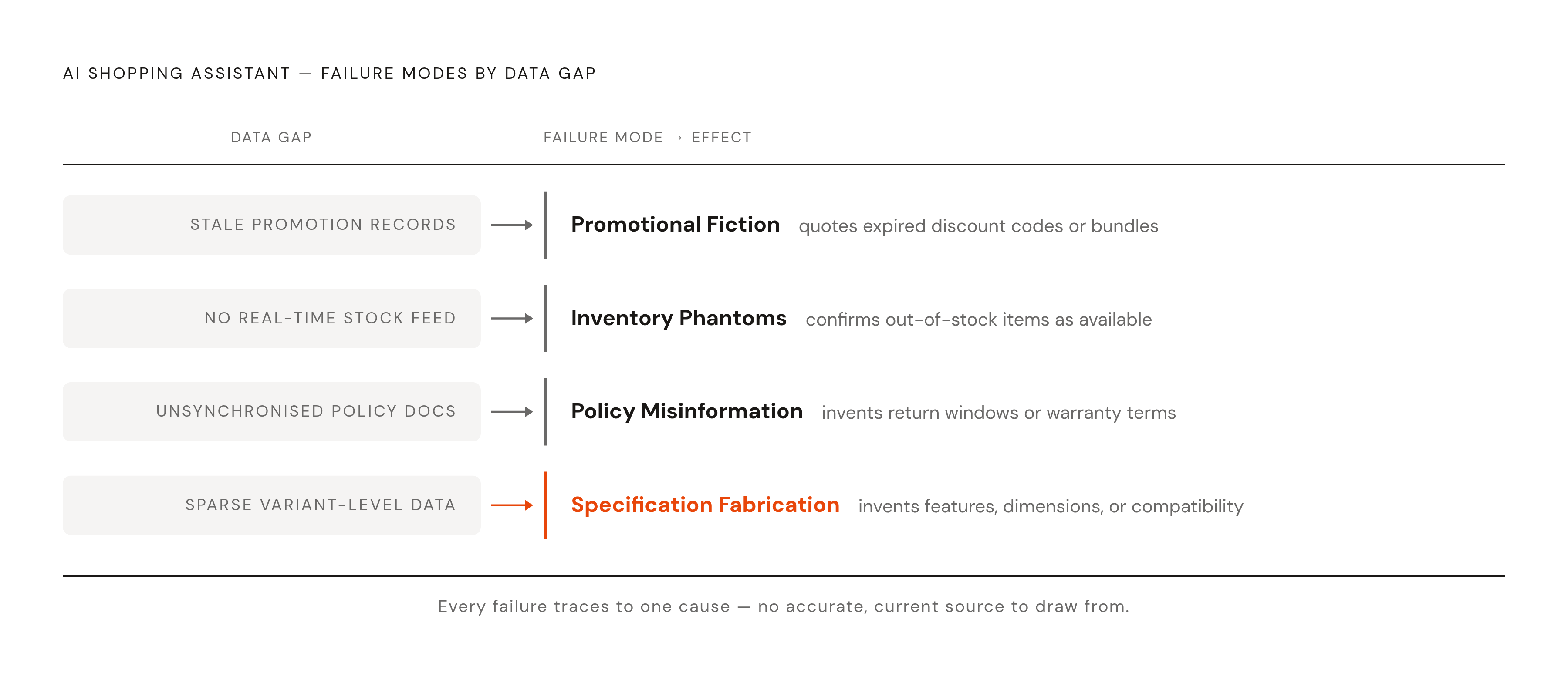
Every documented hallucination failure in e-commerce can be traced to the same structural gap: the assistant had no accurate, current, and sufficiently detailed source to pull from, so it generated an answer that filled the silence convincingly. The four failure modes are four symptoms of one condition.
A brand retires a discount code or a seasonal bundle, but when the data feeding the assistant still reflects the old promotion, the assistant generates promotional fiction from that stale record.
Inventory phantoms are the most direct path from hallucination to abandoned revenue. The entire value of a shopping assistant, convenience and speed, gets inverted into friction and distrust at the exact moment the shopper was ready to buy.
Policy misinformation carries a different kind of weight because it escalates past a single disappointed customer into a service and legal matter. An assistant that states a 60-day return window when the brand's actual policy is 30 days, or that confirms a warranty term the brand never offered, creates an obligation in the customer's mind that the brand did not create. You hear a chatbot's words with the same weight as a page in the company's official policy documentation.
Specification fabrication is the quietest of the four failure modes but often the most damaging in categories where buyers are making decisions based on technical fit. If a customer asks whether a given accessory is compatible with a specific device model, they deserve a precise answer. When the underlying product data is thin, the assistant does not refuse to answer. It infers a plausible-sounding answer from whatever partial information it has, and the customer only discovers the error after the product has arrived and failed to work as described.
Why hallucination rates mislead brands about the real risk
The Stanford 2026 AI Index Report found that hallucination rates across 26 top models on the AA-Omniscience benchmark range from 22% to 94%, with the rate for a single model shifting dramatically depending on how a false claim is framed, such as whether it is presented as a third party's belief rather than the user's own belief, and that spread is the real finding. A gap that wide, within the same model, driven by nothing more than how a question is phrased, tells an operator that hallucination rate is not a stable property of a model that can be looked up and trusted going forward, but a function of context, framing, and the information the model has on hand at the moment of the query.
A brand that reasons "we chose a top-tier model, so we are covered" is solving the wrong problem. Model selection matters for fluency, reasoning quality, and general capability. It does not substitute for the data the model is supposed to be grounded in.
You can see that distinction once you trace each failure mode back to its specific data gap. Specification fabrication traces back to product data that is sparse, inconsistent across SKUs, or built entirely from manufacturer copy that skips variant-level detail. A product listed with nothing more than a name, a color, and a size gives the model almost nothing to work with when a shopper asks a compatibility or use-case question, and the model fills that gap with inference rather than declining to answer.
Implementation experience across e-commerce deployments confirms the pattern directly: assistants that rely on old PDFs or static FAQs recommend out-of-stock items, show wrong pricing, and guess at specifications, because they have no accurate source available to consult at the moment of the query. The shape of each fabrication mirrors the shape of the gap that produced it. That is the useful part of the diagnosis, because a gap can be closed. Hallucination driven by missing or stale data is a solvable operational problem.
What hallucinations cost in trust
A hallucinated answer costs a brand more than the transaction it corrupts. It resets how much the shopper is willing to trust anything the brand's AI presence tells them afterward, and that recalibration carries forward into every subsequent interaction the shopper has with that brand's assistant.
Peer-reviewed research applied Expectation Violation Theory to AI shopping assistants and found that shoppers who got a hallucinated recommendation reported much higher expectation violation than shoppers who got an accurate one. The gap between an accurate AI interaction and a hallucinated one is not a matter of degree. It changes the shopper's relationship to the channel itself.
That shift plays out in how shoppers respond once they notice a discrepancy between what an AI assistant tells them and what the brand states elsewhere. A contradiction does not resolve in the brand's favor by default. A contradiction introduces doubt that the shopper then has to resolve somewhere else, often outside the brand's control.
Regulatory and legal exposure is accumulating around this same dynamic. The FTC has made clear that AI systems deployed by a business must not mislead consumers, treating a chatbot's misstatement the same as any other deceptive claim. The EU AI Act introduces accountability requirements for deployers of AI systems, not just their developers, so responsibility falls on the brand that put the assistant in front of customers. The Air Canada ruling reinforces the same principle in a different jurisdiction: a court held that a chatbot's incorrect statement about a refund policy was binding on the airline, because a customer has no reasonable way to distinguish a statement from the company's AI from a statement from the company itself.
A disclaimer does not fix any of this. If a line of fine print tells the shopper that AI responses may be inaccurate, that does not undo the expectation violation the shopper has already experienced. Only fixing the underlying data, or having the assistant honestly flag its own uncertainty before the shopper acts on bad information, can do that work. And because AI assistants increasingly field a high volume of shopper queries as a brand's primary conversational touchpoint, the damage from a hallucination is never contained to the single shopper who received it. It compounds across every subsequent interaction the brand has staked on that same assistant.
The data properties that give an AI assistant accurate answers
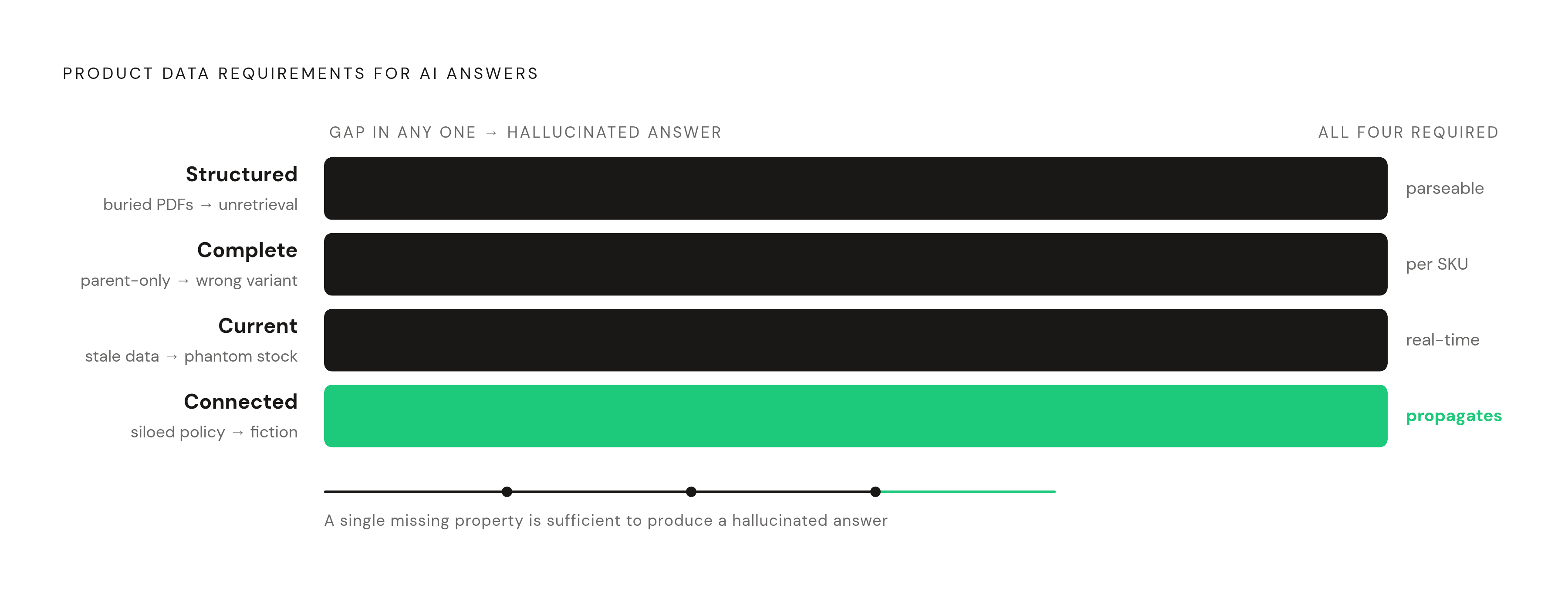
An AI shopping assistant can only be as accurate as the data it draws from, and that data needs four specific properties to support reliable answers: it has to be structured, complete at the variant level, current, and connected to live operational systems like inventory and policy management.
Structured data means product information formatted so the assistant can parse and retrieve it reliably, rather than information buried inside PDFs, narrative marketing copy, or FAQ pages written for human skimming rather than machine retrieval. Most AI assistants rely on an architecture called Retrieval-Augmented Generation, so responses are grounded in documents retrieved at query time, not in what the model learned during training. RAG is a meaningful improvement over an ungrounded model, but it is not a complete fix on its own: if the documents being retrieved are themselves stale, incomplete, or poorly structured, RAG will retrieve bad information efficiently and present it just as confidently as it would present good information.
Completeness at the variant level addresses a gap that occurs constantly in product catalogs. A listing that covers the parent SKU accurately, color, name, category, but never specifies size-by-size fit, washability, temperature range, or compatibility details for each individual variant, leaves the assistant without the facts it needs for the questions shoppers actually ask. The assistant does not refuse the question. It fabricates an answer that sounds consistent with what little information it has.
Currency addresses the inventory and promotional side of the problem directly. Pricing, stock levels, and active promotions need to reflect something close to real time, because a stale snapshot is the direct and traceable cause of both inventory phantoms and promotional fiction. Connection addresses the policy side: return windows, shipping timelines, and warranty terms need to be versioned and synchronized with whatever the assistant is drawing from, so that a policy change made in one system propagates immediately to the assistant rather than sitting unreconciled for weeks.
A well-built assistant also knows how to say it does not know something. When the underlying data genuinely has no answer to a shopper's question, the right response is to disclose that uncertainty and offer a next step, such as connecting the shopper to a human agent, rather than generating a plausible-sounding guess. Layered safeguards reinforce this at the system level: validating responses against source material before they reach the shopper, scoring confidence and escalating uncertain answers to a human, and cross-referencing claims against live systems in real time. None of these safeguards replace good data. They reduce the odds that a data gap, when one exists, turns into a fabricated answer a customer actually sees.
The shift to AI-mediated discovery and the stakes for data quality
Shopping discovery is moving from a search-and-browse process to one mediated by AI assistants that summarize, compare, and recommend before a shopper ever lands on a brand's own site, and that shift changes what bad product data costs a brand. A brand that cannot ground its assistant, or that is poorly represented in the data feeding outside AI agents, does not simply underperform. It gets described inaccurately, or not described at all, by whatever those systems piece together from incomplete information.
Stord's State of AI in E-Commerce Report found that consumer use of generative AI for online shopping rose to become the larger share of shoppers by 2025, roughly double what it had been the year before. So AI-mediated shopping has moved well past the experimental phase, and now accounts for a substantial share of how discovery actually happens. Agents operating on behalf of shoppers, reading product data through systems like ChatGPT, Google AI Mode, Perplexity, and increasingly Gemini, are making shortlist decisions before a human shopper ever visits a product page directly. If a brand's product data is incomplete, outdated, or poorly structured, it is effectively invisible at that stage, or represented by whatever fragments the system can assemble from what little is available.
The content standard that supports accurate AI-mediated discovery is not the standard that supported search-engine optimization. Agents need use-case context, compatibility detail, and care instructions written in language that mirrors how real shoppers phrase their needs, not keyword-dense headlines built to rank in a search index. That is a different writing discipline, and brands that have optimized years of product copy for search engines are often sitting on data that reads well to a human skimmer and poorly to a retrieval system trying to answer a specific question.
The on-site evidence for getting this right is already strong: reliable chatbots that answer accurately have been shown to increase conversion rates substantially, and the same mechanism runs just as powerfully in reverse. A hallucinating assistant drives abandonment at the exact moment a shopper was closest to buying, and it suppresses lifetime value by souring the shopper's trust in every interaction that follows.
Three concrete steps follow directly from the argument above. Audit every data source the assistant draws from and flag anything living in a PDF, a static FAQ, or a manually maintained document, since these are the highest-risk inputs precisely because they are the least likely to stay current. Enrich every sellable variant with its own complete attribute set, covering size, color, compatibility, and use-case context, rather than leaving that detail attached only to the parent SKU, since this is where specification fabrication is most common and most preventable. Connect the assistant to live inventory and pricing feeds, since a real-time or near-real-time connection eliminates inventory phantoms and promotional fiction at the source rather than patching over them after a customer has already been given a false answer.