AI Agent Commerce vs Traditional Conversion Funnel
AI agents are making traditional conversion funnels obsolete for e-commerce.
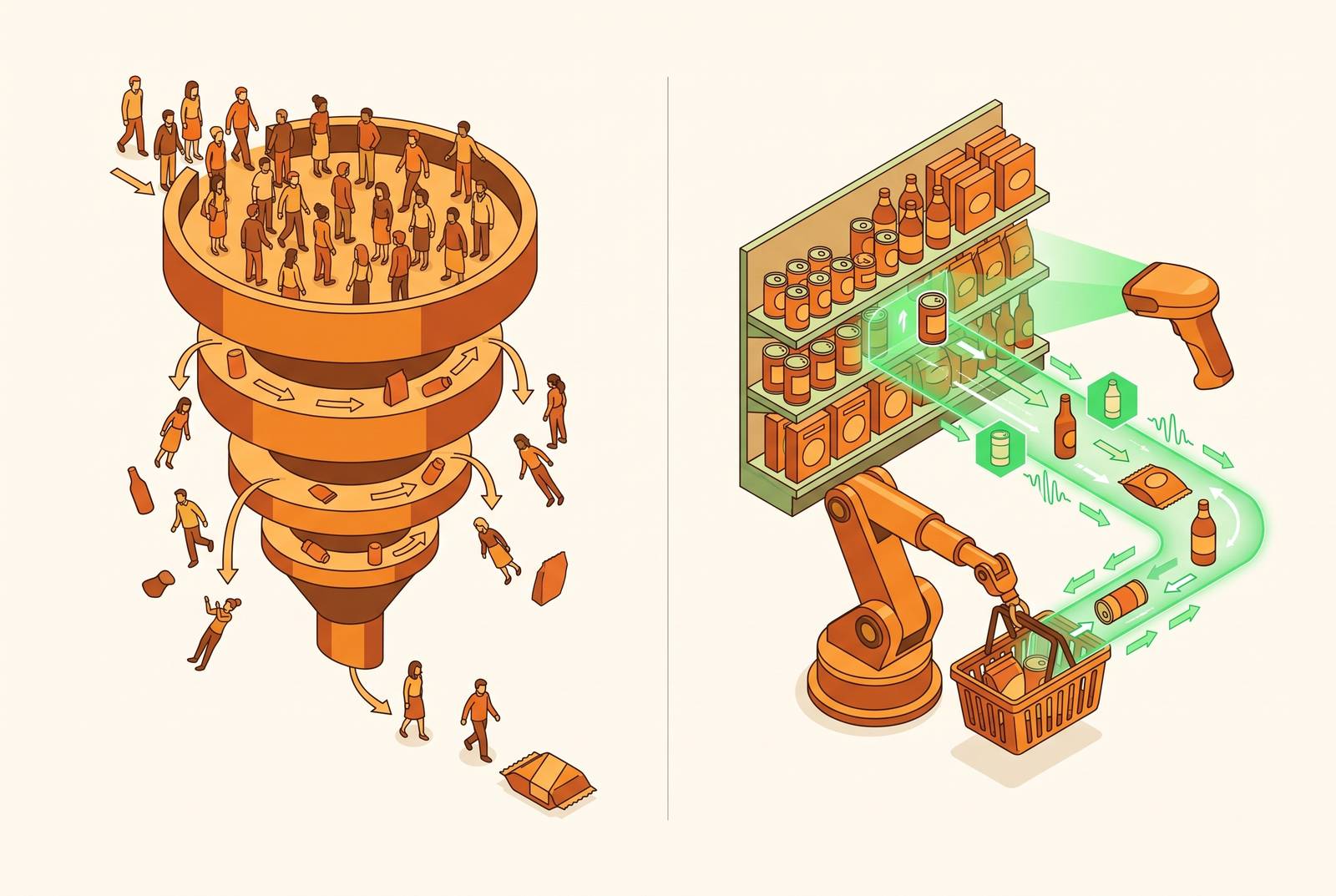
The conversion funnel assumes a person is doing the shopping: noticing an ad, clicking through, reading a product page, comparing tabs, deciding. AI buyer agents break that assumption, and the break runs deep into the structure itself. When an agent handles the search, the comparison, and the checkout, most funnel stages either collapse into a single machine step or vanish from a brand's view entirely. DTC operators who built their acquisition stack on the old model now have to compete somewhere else entirely, and most haven't noticed the ground moved.
When an AI buyer agent handles a shopping task end-to-end, the awareness, consideration, and cart stages either collapse into a single machine step or disappear from a brand's view entirely. Discovery happens off-platform, without a paid placement to bid into; consideration runs internally inside the agent, which weighs structured catalog data and review sentiment rather than landing on a product page; and checkout can complete inside the agent interface itself, leaving no cart, no abandoned-cart sequence, and no behavioral trail to retarget against. For DTC brands built on paid acquisition and retargeting, the mechanism this breaks isn't just measurement, the funnel stages those channels were designed to serve no longer happen, so no amount of better attribution restores them.
Nearly all of DTC e-commerce still runs on paid acquisition, on-site design, and retargeting built for a person clicking through screens one at a time. That setup already took a hit in 2021, when iOS 14.5 gutted tracking signal and attribution got harder to trust. Signal loss was a measurement problem at bottom: the funnel stages still existed, brands just measured them worse. Agentic commerce cuts closer to the bone: the stages themselves are disappearing, and no amount of better tracking brings back a stage that no longer happens.
What an AI buyer agent actually does when it shops
An AI buyer agent closes the loop on a shopping task with little to no human input along the way. Someone says "find me waterproof hiking boots under $150 that arrive by Friday," and the agent searches, compares prices, reads and sums up reviews, checks stock, and checks out. No tabs, no scrolling, no second-guessing at the cart.
What the agent reads is different in kind from what a person reads. It parses structured product data: price, availability, review sentiment, merchant trust signals. It has no eyes for a hero image or a well-turned headline. Google's old ranking logic ran on backlinks and domain authority; an agent cares about catalog completeness, how current the pricing and inventory data are, and how closely a listing matches the shopper's plain-language request.
None of this is experimental anymore. OpenAI shipped Operator and Instant Checkout tools in 2025. Perplexity runs "Buy with Pro" with PayPal across thousands of merchants. Visa built Intelligent Commerce as transaction infrastructure made specifically for agents. Google launched its Agent-to-Agent protocol the same year. Stripe's Agent Toolkit lets agents process payments directly, and hundreds of AI agent startups have already launched on top of it.
A widely cited survey found under half of consumers would hand over an entire shopping trip to a digital assistant, and that finding gets used constantly as a reason to wait. That reasoning misses how this actually breaks: an agent doesn't need full delegation to change a brand's exposure. Partial task handling, just the comparison step or just the checkout step, is enough to rewire where and how a brand competes. Waiting for full delegation before acting means waiting for a line that never needs crossing.
How agentic commerce collapses the awareness and discovery stage
Paid social, search ads, influencer deals: that's the toolkit brands built to buy attention at the top of the funnel, betting on a click. None of it works the same way when an agent is doing the looking, and most brands haven't reckoned with what that means yet.
An agent produces a shortlist, usually three to five brands, pulled from training data, live feeds, and citations. There's no auction to bid into, no CPM, no placement to buy. More shoppers now start product research with an AI assistant instead of a search engine, which means the discovery surface has already moved out from under brands that never noticed it move.
What earns a spot on that shortlist depends on different signals than SEO does. Structured, enriched product data the agent can actually parse matters. Third-party citations, reviews and expert write-ups, matter enormously to a platform like Perplexity that leans on Reddit threads and expert blogs. Google Merchant Center feed quality, full Schema.org attribute coverage, and complete GTIN data matter too.
Here's the part that should worry brands still running a conventional SEO playbook: a large share of brands that rank well on Google get zero citations from AI systems. Ranking on Google and getting cited by an AI assistant are two different contests with two different scoreboards, and citation counts swing wildly from platform to platform. Only a minority of brands hold steady AI visibility from one answer to the next. Discovery in agentic commerce runs volatile and unevenly spread out, and a DTC brand that built its acquisition engine on paid media has no lever built for getting onto an agent's shortlist. Catalog quality is the new bid. Most brands are still bidding with the old currency, and it doesn't clear.
What happens to the consideration stage when the agent does the comparing
A shopper used to visit several product pages, read the copy, watch a demo video, scroll reviews, maybe keep four tabs open at once. Brands fought for that attention with photography, storytelling, site design.
An agent runs that comparison internally instead. It weighs price, structured attributes, availability, and review sentiment, then hands back a recommendation, often without the shopper ever landing on a product page. Each platform weighs things differently. Amazon's Rufus reads review sentiment and Q&A inside Amazon's closed ecosystem and has reportedly already reached hundreds of millions of customers, adding up to billions in incremental sales. ChatGPT Shopping pulls from Google Shopping feeds. Microsoft Copilot checks pricing against Bing. Google Gemini reads intent off product highlights and local inventory data.
Research from McKinsey found that a large share of lost deal consideration traces back to product data that's simply missing from an AI's response. Being absent from an agent's data layer works the same as being off the shelf; it doesn't matter how good the product is if the agent never sees it. Here's the part that should sting DTC brands specifically: the storytelling, the editorial photography, the on-site experience, the stuff that eats most of a DTC marketing budget, carries zero weight in an agent's evaluation. Zero.
Yet the product page hasn't gone extinct. Most consumers still say they'd rather click through to a brand's own site than finish a purchase inside the AI interface. So consideration can run agent-led while conversion still happens on-site. Catalog quality for the agent and on-site experience for the person both need work at the same time, not one at the expense of the other; a brand that polishes only half of that pair is optimizing for a funnel that no longer exists.
How agents compress or bypass intent and the path to purchase
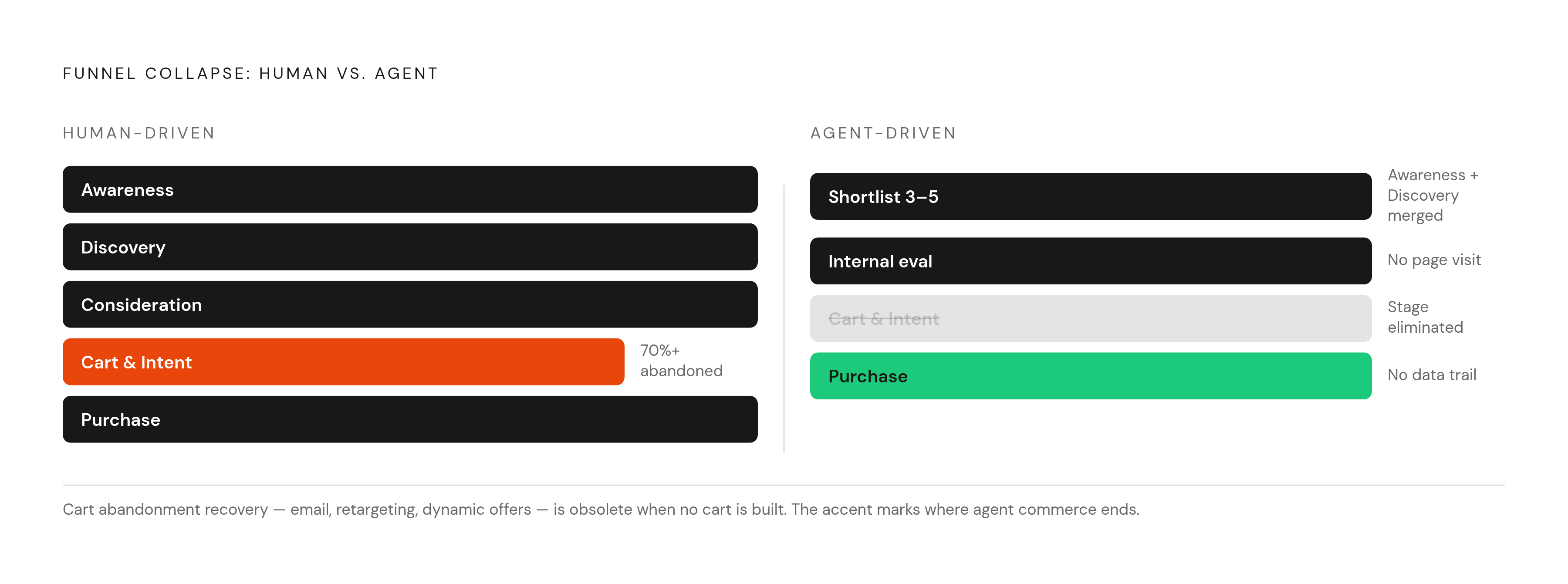
Add-to-cart, abandoned-cart emails, retargeting ads, discount codes nudging someone back: that whole machine exists because most shoppers show intent and never finish. Industry research consistently puts average cart abandonment above 70%. Brands spend heavily trying to claw back that lost share.
Agentic checkout skips most of that machinery by skipping the cart itself. A shopper states intent once, in plain language, to the agent. The agent resolves it and checks out. There's no cart sitting half-full waiting to be abandoned, because no person built the cart by hand in the first place.
The rails for this are live now, not pending. Shopify's Catalog API gives trusted partners, including ChatGPT and Perplexity, direct access to live inventory, pricing, and metadata, so checkout can happen without a shopper ever landing on the brand's own site. Shopify's Agentic Storefronts put checkout directly inside ChatGPT, Perplexity, and Microsoft Copilot. Stripe's agent payment tools and the open Agentic Commerce Protocol make frictionless agent checkout something a brand can plug into today, not something to plan for three years out.
Salesforce reported tens of billions in global AI-influenced Cyber Week sales in 2025, with AI touching a meaningful share of all orders placed. That's the at-scale proof this shift isn't theoretical.
Sit with the real consequence here: if an agent completes the purchase, the brand gets the order, but it gets no behavioral trail to retarget against. The shopper who bought the boots is invisible inside the brand's own analytics, even though the sale is real and the revenue lands. That's also where the retention problem starts, because a purchase completed inside someone else's agent interface leaves behind no first-party data, no email signup, no loyalty touchpoint for the brand to build on.
Why existing attribution models cannot see most of this
Attribution was already broken before agents showed up. A platform's own dashboard might claim a 4x return on ad spend while Shopify's reporting shows something closer to half that for the same campaign, because platform-reported ROAS gets measured by the platform that benefits from it looking good, and it ignores cost of goods, shipping, and returns entirely. iOS 14.5 cut off most IDFA sharing on iPhones, and standard pixel tracking now catches only a fraction of actual conversions.
Layer AI referral traffic on top of that, and the blind spot gets worse fast. AI-attributed orders on Shopify have grown by multiples of their starting point within a year. Shoppers arriving through AI referral convert at a far higher rate than typical Google organic traffic. Yet most brands still have no AI-specific segment set up in GA4 or Adobe Analytics, so this traffic, their fastest-growing and best-converting segment, isn't even visible as its own category.
Worse: an agent-completed purchase often lands as a plain direct order. No referral string, no UTM parameter, no session history to dig into. It's invisible to any standard attribution model, full stop. Trust in the old measurement toolkit was already thin before agentic traffic even entered the conversation; most marketers surveyed in the industry don't even name multi-touch attribution as their most trusted approach to begin with.
There's an honest way through this, but it takes deliberate setup, not a dashboard fix. Track AI-domain referrals as a rough stand-in for agent-assisted shopping behavior. Build engaged-shopper cohorts and measure them against a brand's own historical baseline instead of trusting platform-reported ROAS. Treat orders that look agent-sourced as their own cohort with their own LTV profile, rather than folding them into "direct" and losing the signal. None of this is hard to set up; it's just that most brands haven't set it up yet, which means most brands are flying blind on the exact channel growing fastest under them.
What agentic commerce does to brand loyalty and post-purchase retention
Post-purchase email flows, loyalty points, repeat-purchase discounts: all of it assumes the brand owns a direct relationship with a customer it can name and reach. Agentic commerce puts that ownership in question. When an agent handles the discovery, the comparison, and the checkout, the brand gets the order, but the relationship sits with the agent platform instead.
Retailers have flagged risks tied directly to this shift: losing direct engagement with customers, erosion of brand loyalty, and a growing reliance on third-party AI platforms just to reach a brand's own buyers. None of these are hypothetical. They follow directly from who holds the customer's attention at the moment of decision.
Here's what most brand teams get backwards: they assume loyalty programs and brand storytelling still carry weight once an agent is in the loop. Agents optimize for stated preference and price, not brand affinity, so that assumption doesn't hold. A shopper who lets an agent handle reordering paper towels or protein powder may never consciously pick the same brand twice in a row; the agent switches the moment a competitor's catalog data is cleaner or the price drops by a few percent. That's a cold way to lose a customer, but it's the mechanism at work, and no amount of brand storytelling changes what the agent is optimizing for.
There's an upside worth naming plainly: retailers with AI agent integrations have seen sales growth well ahead of those without one. But that gain goes to brands that show up in structured, machine-readable form. Brands sitting invisible and unstructured don't get a share of it; they just get bypassed.
The loyalty mechanism most likely to survive this shift is a brand running its own AI presence directly on its storefront. The point isn't keeping external agents out; it's that this remains the one surface where the brand still owns the conversation and the data that comes out of it. A brand that owns its own AI conversation keeps the behavioral signal, the loyalty data, the ability to serve a personalized repeat-purchase offer: the raw material retention runs on, no matter how the shopper found the brand in the first place.
What do DTC brands built on paid acquisition and retargeting actually need to change at each funnel stage to compete?
At discovery, the job is becoming citable. That means enriching the catalog with structured attributes, full GTIN coverage, and Schema.org markup that ChatGPT, Perplexity, Gemini, and Copilot can all parse without friction. It means building the kind of third-party citation signal, reviews, expert coverage, that Perplexity in particular weighs heavily. It means keeping the Google Merchant Center feed clean, since ChatGPT Shopping draws from it directly. And it starts with an honest audit: check current citation presence across all four major agent surfaces before spending a dollar trying to improve it.
At consideration, the job is making the product data do the selling, since the agent is doing the comparing, not the reading. Product descriptions need to work as machine-readable spec sheets, not marketing copy; an agent sums up attributes, not brand voice. Inventory and pricing need to stay accurate in real time, because stale data reads to an agent as a disqualifier, not a minor error. And since each platform evaluates differently, Rufus versus Copilot versus Gemini, the fix has to happen platform by platform, not as one generic push.
At purchase, brands need to be checkout-ready inside agent interfaces, through Shopify's Catalog API and Agentic Storefronts, without giving up on the on-site experience. With most consumers still saying they'd rather click through to the brand's own site, on-site conversion work isn't obsolete; it just has to run alongside agent-facing readiness rather than instead of it. The most efficient path is a single brand intelligence layer, trained on catalog, policies, reviews, and voice, that serves both surfaces, instead of running separate disconnected tools for each, platforms like Kinect, a DTC-focused AI sales and catalog intelligence layer, are built to sit at exactly that junction.
At retention, the job is owning the first-party layer that agent-only transactions can't produce. That means running an AI presence on the brand's own site that captures direct engagement and loyalty signal even when the original discovery happened somewhere else. It means building AI-specific segments in analytics so agent-referred cohorts get measured on their own instead of vanishing into "direct." And it means treating the query data from a brand's own AI conversations as real customer intelligence, since what shoppers actually ask reveals catalog gaps and product openings no survey will surface as cleanly.
Timing matters here more than most brands seem to appreciate. Multiple industry forecasts put agentic commerce at a meaningful double-digit share of U.S. e-commerce within the decade. Brands waiting for the category to mature before adjusting will find the shortlists already filled in by competitors who moved first.