AI-Assisted Size and Fit Recommendations for Apparel DTC Brands
AI-powered size matching slashes returns by fixing fit uncertainty before shoppers even buy.
Apparel has the highest return rate of any ecommerce category, somewhere between 20 and 40 percent, and size and fit drive most of those returns. The cost of each return is fully loaded, built from restocking labor, shipping both directions, markdowns on damaged inventory, and the overhead of processing the transaction twice, and across the U.S. retail industry in 2025, the volume of returned merchandise reached into the hundreds of billions of dollars. Those numbers get attention because they appear on a balance sheet. What rarely gets measured with the same rigor is the damage fit uncertainty does before a single item ships.
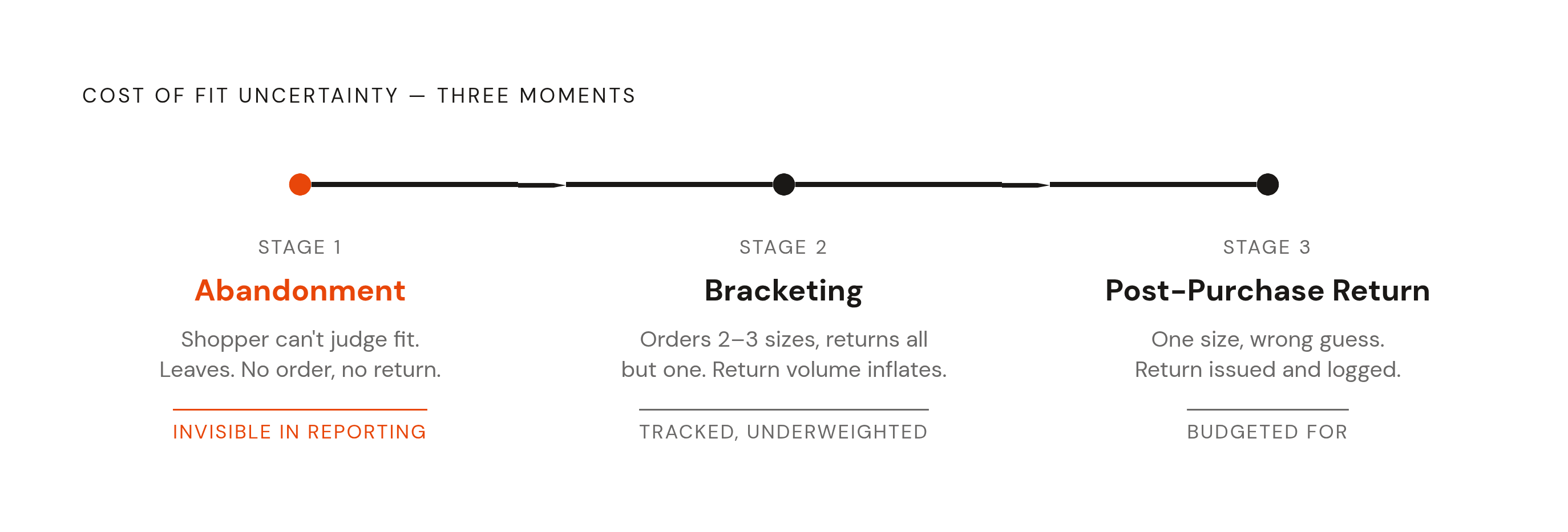
A shopper who can't tell whether a size will fit has three paths available, and a brand pays a different price on each one. The shopper can abandon the cart entirely, deciding the risk of a wrong size isn't worth the purchase. The shopper can bracket, ordering two or three sizes of the same item with the intent of returning all but one, a behavior that inflates return volume even when the final kept item fits correctly. Or the shopper can buy a single size, guess wrong, and return it after the fact, the scenario most brands already track and budget for. Fit uncertainty taxes the brand at three separate moments: before the transaction, during it, and after it. Abandonment leaves no line item, no return authorization number, no obvious trace in the reporting most apparel brands already run, and that is why it tends to be the most underpriced cost on the page.
Why static size charts can't solve a dynamic problem
The size chart was built to answer a question that assumes a stable, average body and a stable, average garment. Neither assumption holds at scale, and the chart format itself is a major source of the confusion it's supposed to resolve. Two incompatible chart types exist across the apparel industry: body measurement charts, which describe the shopper's own measurements, and garment measurement charts, which describe the finished dimensions of the item itself. Most brands never tell shoppers which one they're looking at, leaving a shopper to guess whether the number next to "Large" refers to their waist or the waistband sewn into the product.
That ambiguity plays out differently across brands that have each made a different choice about how much clarity to offer. Wool & Prince publishes both body and garment measurements side by side, clearly labeled, so a shopper gets what they need regardless of which way they prefer to think about fit. That kind of dual-labeling remains the exception rather than the norm, and its scarcity is precisely why fit uncertainty persists even on product pages that technically include a size chart.
Mislabeled size charts are not the only issue, because sizing data fragmentation compounds the problem. Sizing information is typically scattered across ecommerce platforms, ERP systems, PLM solutions, and POS channels, with no unified structure tying them together. A shopper may wear a Medium in one style from a brand and need a Large in a different style from that same brand, since the garment data behind each product was entered, measured, or updated independently. Even a shopper who knows their own body can get lost here. The brand's own sizing data doesn't give that shopper a reliable way to apply what they know, because the number on the chart was never standardized against the garment in front of them.
How the two leading AI fit approaches work
AI fit systems solve this by replacing chart-based inference with direct data modeling, and two distinct technical approaches now lead the category; each resolves the same uncertainty through a different data path. Both start from the premise that a single static chart cannot represent a shopper's actual body or a garment's actual construction, and both replace that chart with a calculation run at the moment the shopper is deciding.
The first approach is network-based, and True Fit is the clearest example of it. True Fit's recommendation engine is built on nearly 20 years of purchase and return data gathered across a global network of retailers, drawing on transaction history from hundreds of millions of shoppers and more than 91,000 brands. The system doesn't ask you to interpret a chart; it compares your behavior and stated preferences against the purchase and return patterns of similar shoppers across that network, and it recommends the size that similar shoppers actually bought and kept.
The second approach builds an individual body model rather than drawing on collective purchase history. Bold Metrics generates more than 50 body measurements from just four to six simple inputs a shopper provides, with no photos and no intrusive data collection involved, then maps that body model, often called a digital twin, against the actual construction data of the garment being considered. Where True Fit asks what similar shoppers did, Bold Metrics asks how this shopper's specific body compares to this specific garment's specific dimensions.
Both approaches share a structural advantage over any size chart: the recommendation they produce is specific to the shopper in front of the screen and the garment on the page, a generic label applied to an assumed average body. That advantage comes with a dependency that's easy to overlook. Bold Metrics' digital-twin model only works if the garment construction data it maps against is accurate and current, since the twin is only as useful as the specs it's being compared to. A brand considering either approach is choosing between two different kinds of data investment: one that depends on scale across a retail network, and one that depends on the precision of the brand's own garment records.
What the return reduction and conversion evidence shows
The performance data behind these tools is brand-specific, and treating a published average as a guaranteed outcome for any individual brand misreads what the numbers actually represent. Bold Metrics reports that its customers see an average 34 percent decrease in return rate, and True Fit retailers see meaningful drops in fit-related returns driven by bracketing specifically. Those figures describe what happened across a customer base, a measure of average outcomes rather than a floor that any given brand is owed by signing a contract.
Conversion gains are a separate, parallel benefit of AI fit tools: if you interact with them, you convert at meaningfully higher rates than shoppers who don't, and AI-referred traffic produced a sharp jump in revenue per visit during the 2025 holiday shopping season. Return reduction and conversion lift are two different line items on the same investment, and a brand evaluating either technology should expect to measure both rather than assume one implies the other.
The honest constraint sits in the cost structure. True Fit's platform pricing scales with order volume, so if a brand operates under a minimum order threshold, the monthly platform cost may not get recouped by the returns it prevents. Running the ROI math honestly means starting from the brand's own current return volume, drawn from its own cost base rather than a benchmark pulled from a larger competitor with a different one. The brands where this kind of investment pays off most clearly tend to sit below a certain revenue threshold, where returns are already the largest controllable cost on the books and the order history needed to run the analysis already exists inside the brand's own systems.
If your return rate already sits below the apparel average, you might reasonably ask whether any of this applies to you. The conversion impact doesn't depend on how high the return rate is to begin with. Removing fit uncertainty at the decision point lifts conversion even if your returns are already well-managed, because the uncertainty that causes abandonment and bracketing exists independently of how many returns ultimately get processed.
How top apparel storefronts prepare fit data before deploying an AI tool
Not every brand that out-converts on fit has adopted an AI sizing tool.
Reformation runs one of the highest review-density-per-SKU rates in the category, and the size and fit guidance surfaced on its product pages is sourced directly from reviewer reports rather than written by the brand itself. That's fit intelligence built from structured customer feedback, and it reaches a level most brand-authored size charts never do. Boyish Jeans out-converts most of the DTC denim category through a combination of fit imagery, deep reviewer photo galleries, and one of the cleanest size-finder tools available in DTC denim, and none of this depends on an AI model under the hood. Allbirds offers what's widely considered the most thorough size guidance in DTC footwear, paired with a Questions section on its product pages that surfaces and resolves fit objections before a shopper ever reaches checkout, so fit intelligence works there as a conversion asset.
A pattern runs through all three. Each one leads its product pages with reviewer language rather than brand copy, so real customer phrasing about how an item fits, alongside real reviewer photos of that item on different bodies, comes ahead of the brand's own generic size notes. So if your brand is weighing an AI fit tool, that pattern matters directly. An AI system trained on fragmented or mislabeled garment data will produce unreliable recommendations regardless of how sophisticated its modeling is. The real prerequisite for a successful deployment is clean, structured, properly labeled sizing data, not the tool itself.
Mizzen+Main stands as the clearest example of what happens when that groundwork gets combined with AI modeling. You enter four to six simple inputs, the system generates more than 50 body measurements as a digital twin, and that twin gets mapped against Mizzen+Main's actual garment construction data to evaluate fit at specific points on the body. The lesson for any brand considering this path runs in a specific order: fix the data first, then evaluate the tool.
How buyer agents shift where fit questions get asked and answered
Fit data is becoming a requirement for a new kind of transaction. AI buyer agents are already shopping on behalf of consumers, and an agent that can't answer "will this fit me?" cannot complete a purchase on the shopper's behalf. That makes fit data an agent-readiness requirement now, beyond its role as a conversion-rate optimization for a human-browsed storefront.
A buyer agent transaction runs differently from a normal storefront visit. A shopper instructs an AI assistant to find a specific product, and the agent queries multiple retailers, compares prices, checks reviews, verifies stock availability, and completes the purchase, all inside a single conversation, with the brand's storefront design playing no role in how that transaction unfolds. Bold Metrics' Agentic Sizing Protocol is a conversational protocol that lets AI shopping agents gather a handful of inputs from the shopper and return a personalized size recommendation in real time, and True Fit launched its own agentic AI shopping experience in February 2026, with early partner access beginning March 1, 2026. Both moves point to the same conclusion: fit resolution is turning into a structured data requirement that an agent-completed purchase simply cannot skip.
Speed matters at this layer in a way it never did on a browsed storefront. Bold Metrics' Virtual Sizer API returns an accurate size recommendation in under 500 milliseconds, fast enough to keep pace with a live conversational exchange, and if the fit response is slow or missing, the agent just moves to a competitor that can answer in time. Consumer adoption of this behavior is real but still partial. A significant share of consumers are comfortable letting AI assist with browsing, but a smaller share are ready to hand over complete purchase control. So the near-term norm is AI-assisted purchasing, and that means fit resolution has to work at the assist layer too, not only inside a fully autonomous agent transaction.
This shift also exposes a second, structural failure in how most apparel product catalogs are built. AI shopping channels don't browse category pages or click through carousels the way you would. They query structured data endpoints directly, and one specific failure point recurs across legacy product feeds: variants, meaning different sizes, colors, or configurations of the same item, get treated as independent entities with no clear parent-child relationship connecting them. That single architectural gap is enough to make a brand's fit data inconsistent or simply invisible at the agent layer, regardless of how good the fit information looks on the brand's own website.
Ranking well on Google offers no protection here. Audit data shows that a majority of well-ranked brands are not cited by AI engines at all, which means structured data quality, not search engine seniority, is what actually determines which SKUs an AI system recommends. For apparel specifically, what these shopping agents evaluate comes down to: machine-readable size and fit data, garment measurements correctly labeled as either body or garment, a variant architecture that correctly connects each size to its parent product, and fit signals sourced from customer reviews. A brand can have excellent fit data sitting on its own product page and still be invisible to the growing share of shopping that now begins as a query to ChatGPT, Google AI Mode, Perplexity, or Gemini, if that data was never structured in a format those systems can read. The product page is no longer the only place this battle gets fought; the data behind the page, in a format a machine can parse, decides whether a brand gets recommended.