Reducing Cart Abandonment With On-Site AI Conversation
AI conversations answer purchase questions before shoppers close the tab.
Somewhere between seven and eight of every ten shoppers who add something to a cart never finish the purchase, and that number has not meaningfully moved in over ten years despite a decade of checkout improvements. Faster load times, one-click payment, mobile wallets, none of it touched the rate. On-site AI conversation, deployed in the narrow window before a shopper closes the tab, is starting to move that number in a way discount codes and retargeting emails never did, and the reason comes down to what abandonment actually is: not a checkout defect, but an unanswered question at the worst possible moment.
Where abandonment is worst by vertical and device
The average hides a wide spread. Cruise and ferry bookings approach a 98% abandonment rate. Fashion runs at 84.61%, travel close behind at 84.56%, beauty and personal care at 82.51%. General retail comes in lower, at 72.23%, and grocery is the best-performing category on record, at 50.03%.
Device tells the same story from a different angle. Mobile abandonment runs at 80.3% against 68.13% on desktop, a gap of roughly twelve points, and a separate report using different methodology found mobile at 78.74%, tablet at 70.26%, desktop at 66.74%. The numbers disagree on the exact figure and agree on the direction: a shopper thumbing through a product page on a cracked screen, half-distracted by a text notification, is the shopper most likely to leave before finishing. Smaller screen, slower typing, shorter attention span, all compounding on top of each other.
The actual reasons shoppers leave
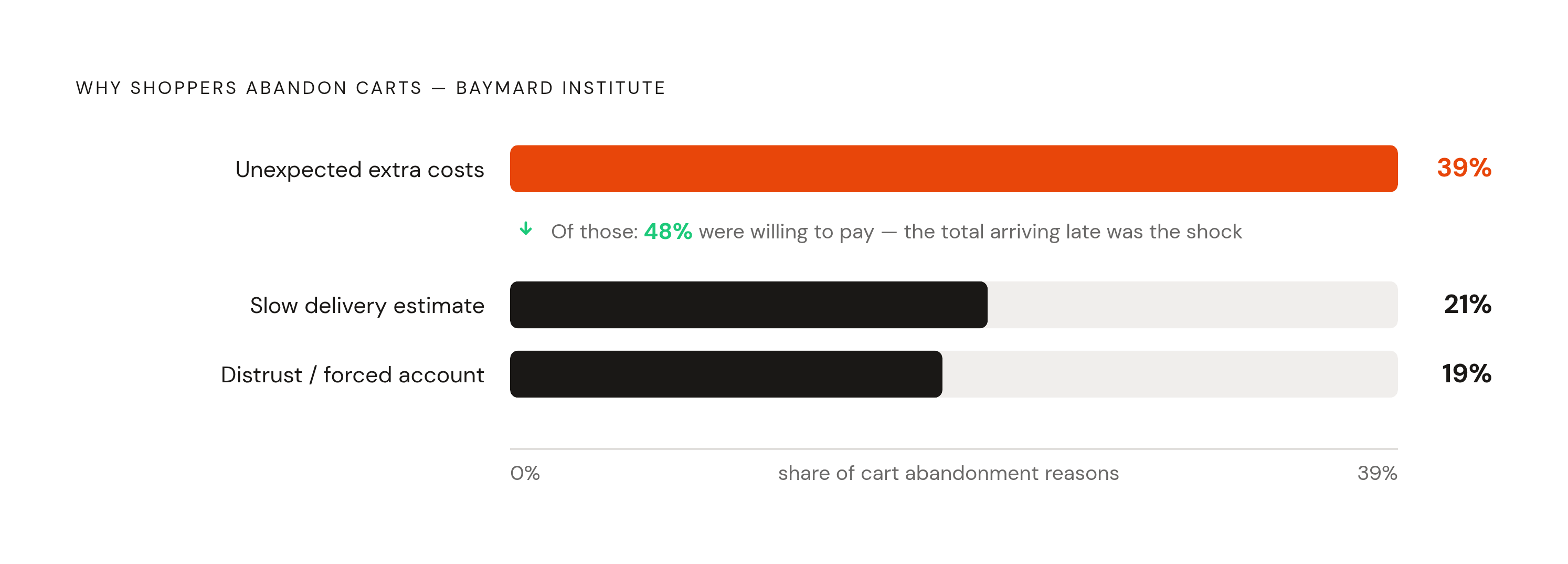
Shoppers give clear answers when asked why they left. Extra costs (shipping, tax, fees that show up late) top the list, cited by 39% of abandoners in Baymard Institute research. Slow delivery estimates account for 21%. Distrust and forced account creation together account for 19% of abandonments according to Baymard Institute research. Line those up and none of them are objections to the product itself. Each is a gap in information or reassurance that appears at exactly the wrong step.
Nearly half of shoppers, 48%, abandon specifically because the total came in higher than expected. The mechanism there is not price sensitivity, it's surprise. A shopper willing to pay a given amount for shipping included might still walk away from that same total if it lands as a shock at step four of checkout. Returns confusion, sizing doubt, compatibility questions, vague shipping windows, none of these are objections. They're questions, and a shopper who gets a real answer in the moment behaves nothing like one who gets silence.
Cart abandonment as a hesitation problem rather than a checkout problem
Most of the industry's standard playbook treats abandonment as cleanup work. Abandoned-cart emails, retargeting ads, a discount popup timed to exit intent: all of it chases the shopper after they've already left. Only 3.6% of placed carts get recovered through automated recovery emails, according to Metorik's 2025 data. The modal outcome, by a wide margin, is that the sale is gone, and no subject-line copy brings it back.
The window that matters is much narrower than any follow-up email can reach. Purchase intent doesn't hold still. It compounds or collapses within minutes, sometimes seconds, the instant a shopper opens a competitor's tab or loses the thread of why they were buying. Behavioral research has identified specific signals that precede the moment a shopper closes the tab: a scroll that stalls and reverses, repeated trips back to the shipping information section, extended dwelling on a returns policy page. Those are the visible tells of hesitation building toward exit, and by the time a recovery email lands hours or days later, the decision has already been made.
The data on on-site AI conversation entering the hesitation window
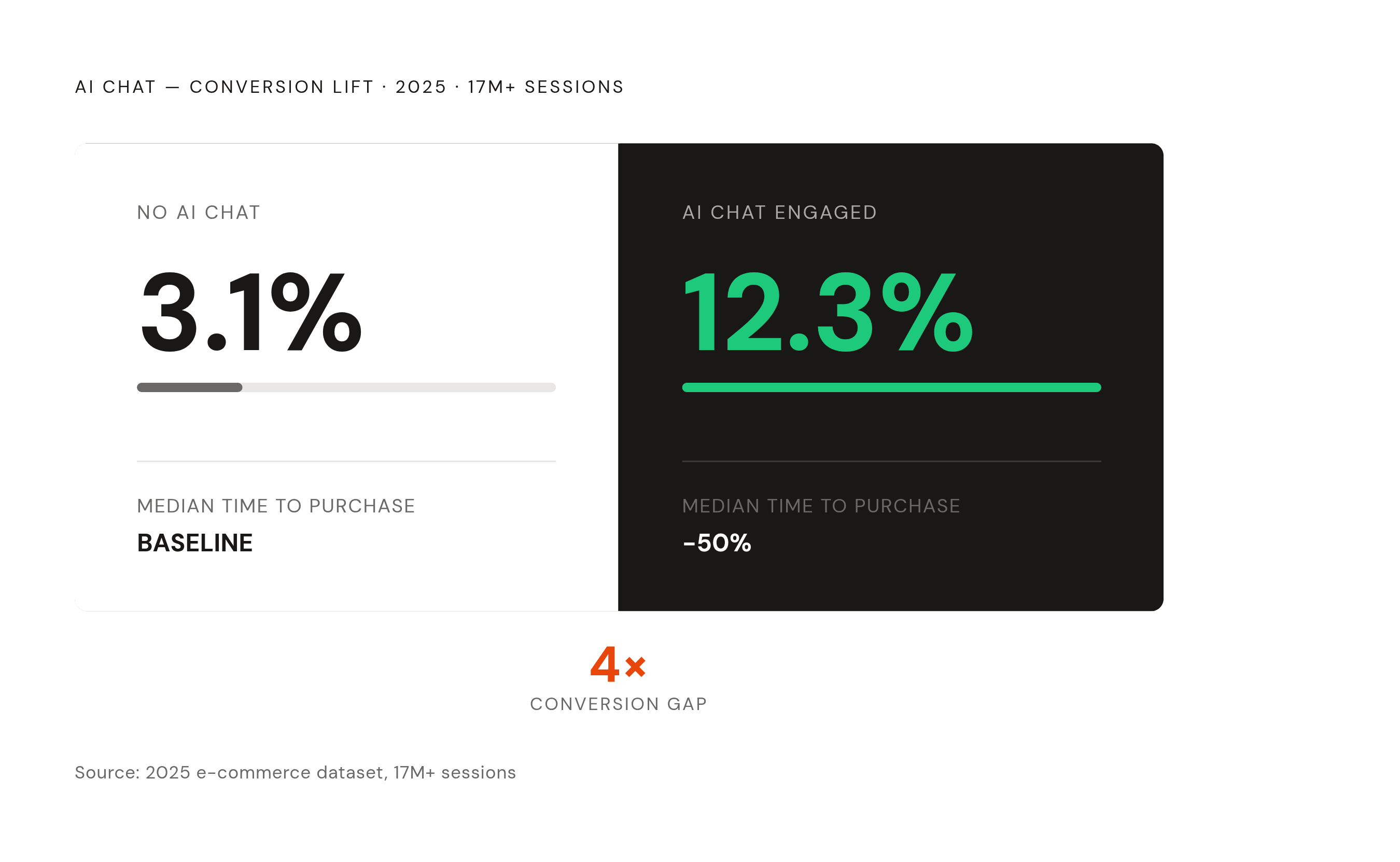
A 2025 dataset covering more than 17 million shopping sessions found that shoppers who engaged with an on-site AI chat converted at 12.3%, against 3.1% for shoppers who didn't. That's roughly a fourfold difference, and it lines up with the hesitation theory: the assistant is answering the question at the moment it forms, before the shopper drifts.
The same dataset found that AI agents cut the median time to purchase roughly in half. Shrinking the gap between "add to cart" and "complete purchase" shrinks the window in which a shopper can talk themselves out of buying, which is exactly where the behavioral signals above say carts go to die.
How the AI shows up matters as much as whether it shows up. When the assistant opens the conversation itself, instead of waiting to be clicked on, engagement and cart recovery both come in meaningfully higher than when the AI waits to be clicked. A 2026 industry report on conversational commerce found that when an AI assistant made a product recommendation, most of the resulting purchases happened the same day. That's not a nudge; it's a compression: a multi-day deliberation cycle collapsed into a single sitting.
AI Conversation and the Specific Friction Types That Cause Abandonment
Take the 39% of shoppers who bail over unexpected shipping costs. An AI assistant can surface the free-shipping threshold mid-browse, with a line as plain as "add $12 more to qualify for free shipping." That single sentence turns a surprise at checkout into a choice made earlier, with full information in hand, and that's the entire gap between the two outcomes.
Returns doubt resolves the same way. Instead of a shopper hunting for a footer link three scrolls down, the AI states the actual return terms, in plain language, on the product page, at the moment the shopper is deciding.
Sizing and fit questions hit hardest in the categories with the worst abandonment numbers: beauty at 82.51%, fashion at 84.61%. A shopper asking "will this work for oily skin?" or "does this run small?" needs a specific, SKU-level answer. ASOS's sizing recommendation tools already do a version of this at scale, using product-specific data to answer exactly that kind of question. Compatibility questions follow the same logic: a shopper torn between two near-identical products doesn't need more spec text, they need a direct recommendation tied to how they said they'll use it.
The catalog quality beneath the conversation, why AI answers are only as good as what the brand has trained it on
None of this works unless the right data supplies it. An AI asked "does this run small?" with no answer available will do one of two things: hedge, or make something up. Both do more damage to the shopper's confidence than silence would have, because a wrong or evasive answer reads as the brand not knowing its own product.
Catalog enrichment is the unglamorous labor that makes the conversation possible. Material, fit, use case, occasion, return terms, compatibility with other SKUs: all of it has to exist in structured form before an AI can give a real answer instead of a shrug dressed in friendly language. If a brand skips this step, the brand agent is just a chatbot with better manners.
The payoff runs past the checkout page. The same enriched catalog that lets an on-site AI answer a shopper's question also affects whether that brand gets mentioned when someone asks ChatGPT, Perplexity, or Google Gemini for a recommendation before ever landing on the site. Catalog quality has become a discovery lever as well as a conversion one.
What a brand agent looks like in practice
The baseline requirement is unglamorous and non-negotiable: the AI has to be trained on the brand's own catalog, its policies, its reviews, its actual tone. A generic chatbot that doesn't know the SKUs on the page it's sitting on cannot resolve the specific hesitation about to cost the sale, no matter how fluent its sentences sound. Fluency is not the same thing as knowledge, and a brand agent that only has the first is worse than no chat widget at all, because it erodes trust instead of building it.
Speed to live determines how much gap exists between the decision to act and any actual result. An implementation that requires a full theme rebuild, weeks of back-and-forth with IT, or a data migration project puts a gap between the decision to act and any actual result, a gap most DTC teams don't have the patience or headcount to survive. The standard to hold vendors to is near-immediate deployment, live the same day it's switched on, not a quarter-long rollout dressed up as an "onboarding process."
Native integration with the existing stack matters just as much: Shopify, WooCommerce, Salesforce Commerce Cloud, Adobe Commerce, plus whatever email, support, and review tools are already running. An AI that inherits existing customer data starts from a position of knowledge. One that starts from zero is rebuilding context the brand already paid to collect once.
And the system has to be able to initiate the conversation. The data above is consistent on this point, proactive engagement outperforms passive chat placement, meaningfully and repeatedly. A widget sitting in the corner waiting for a click is a different product, functionally, from one that recognizes hesitation and steps in before the shopper's hand reaches for the back button.
Measuring On-Site AI Conversation's Impact on Abandonment, with Honest Attribution
Most AI chat tools default to last-touch attribution, crediting any session that touched the chat window with the eventual sale. That inflates the AI's apparent impact substantially, since plenty of those shoppers were buying regardless of whether the chat opened. Any brand that accepts a vendor's default dashboard at face value is measuring the wrong thing.
The honest comparison sets an engaged-shopper cohort against the brand's own baseline: what did shoppers with comparable intent signals convert at when they used the AI, versus when they didn't. That's harder to produce than a vendor's summary report, but it's the only number worth trusting.
Cart abandonment rate before and after deployment, segmented by device given how much worse mobile performs, average order value for AI-engaged sessions against sessions without engagement, resolution rate, and time-to-purchase for assisted sessions against unassisted ones are worth tracking directly. Cart abandonment rate before and after deployment, segmented by device given how much worse mobile performs. Average order value for AI-engaged sessions against sessions without engagement. Resolution rate is the share of questions the AI actually answers without escalating to a human. Time-to-purchase for assisted sessions against unassisted ones. For WooCommerce brands specifically, Metorik's data offers a useful reference point: an average placed cart value of $117, an abandoned cart value of $141, and a recovered cart value of $174. If on-site AI conversation is doing its job, recovered cart values should trend toward that $174 figure, not sit closer to the $117 baseline it started from.
Sources
- 38+ Cart Abandonment Rate Statistics (2026 Updated)
- 35+ Cart Abandonment Statistics Every eCommerce Brand Should Know
- 50 Cart Abandonment Rate Statistics 2026 – Cart & Checkout – Baymard
- What Is a Good Cart Abandonment Rate? Ecommerce Benchmarks (2026)
- 61 Shopping Cart Abandonment Statistics (2026) | SellersCommerce
- usefini.com
- shopware.com
- alhena.ai