Agent-Ready Storefront Architecture Without a Theme Rebuild
Four vendors now let merchants become AI-agent-ready without rebuilding their storefront theme.

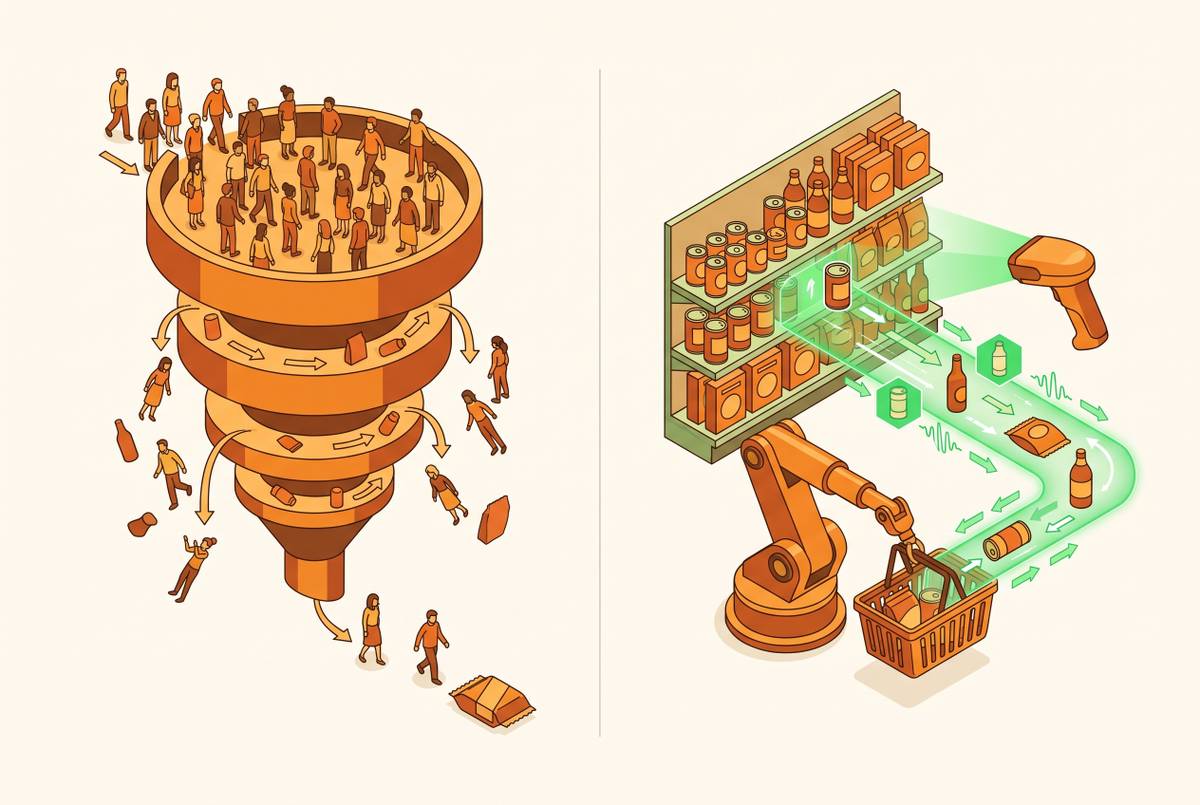
A shopper tells an AI agent to find trail-running shoes under a set budget that arrive by a target date. The agent reads that instruction, checks options across merchants, and completes the purchase inside a wallet, a chat window, or a checkout protocol, without the shopper ever loading a store's homepage. The AI tool now sits between the shopper and the store, making decisions a human never sees and a brand never gets to influence in the moment it matters.
Four vendors provide storefront architecture solutions that make product pages readable and actionable for AI buyer agents without requiring a theme rebuild. Shopify delivers auto-enrollment on AI surfaces plus the Storefront MCP server, released as part of the Shopify AI Toolkit in April 2026, which lets agents browse products, build carts, and transact directly with the store. For merchants on WooCommerce, Salesforce Commerce Cloud, and Adobe Commerce, the relevant work is Schema.org structured data and feed compliance applied at the data layer, leaving the theme untouched. On the customer-intelligence side, tools already in most stacks, Klaviyo, Gorgias, and Judge.me, connect to the signal surfaced by AI conversations without requiring new platforms or redesigned storefronts.
Every lever a direct-to-consumer brand has spent years refining, product photography, on-site copy, merchandising, navigation, now operates downstream of a filter most brands cannot reach. Persuasion happens inside a conversation the brand isn't part of. The store's design and checkout flow get bypassed entirely, because the agent isn't browsing, it's evaluating.
AI-driven traffic on Shopify grew roughly eightfold year-over-year in the first quarter of 2026, and orders from AI-powered searches grew nearly thirteenfold in the same period. New buyers arriving through AI channels convert at nearly twice the rate of buyers from other channels. A channel already converting at that rate, for brands agents can actually read, is a description of where a meaningful share of buying already happens.
The barrier standing between most brands and that channel is mechanical rather than creative. Background crawlers that AI systems use to read the web, GPTBot, OAI-SearchBot, ClaudeBot, PerplexityBot among them, fetch a page's raw HTML without executing JavaScript. Most modern storefronts render their product details, pricing, and descriptions through JavaScript after the page loads. A human visitor sees a fully built page. An AI agent fetching that same URL gets back markup that's close to empty: no product name resolved, no price, no availability. The store looks finished to a person and looks blank to the buyer that increasingly decides on that person's behalf.
The fix for that specific failure is narrow: a configuration extension and explicit allow-listing in robots.txt, so crawlers can retrieve content without needing to execute a script first. It doesn't require a new theme or a new platform. Fixing it requires recognizing that the problem is architectural and treating it as such.
Why AI engines ignore brands that rank well on Google
Ranking well on Google and getting chosen by an AI shopping agent turn out to be close to unrelated achievements. Audit data shows a majority of brands that rank well on Google are not cited by AI systems. Domain authority and backlinks, the currency of a decade of SEO investment, carry far less direct weight with AI recommendation engines than they do in traditional search. They still shape outcomes indirectly, but they no longer function as the primary signal deciding whether a brand gets surfaced.
The reason runs deeper than ranking mechanics. Agents powered by large language models increasingly act as the first filter in a purchase decision, and they evaluate options before a human ever sees a ranked list of results. That places the agentic layer upstream of both SEO and paid acquisition. A brand can win every auction and hold page one on Google and still never reach the shopper, because the shopper handed the decision to an agent before a search results page entered the picture.
Research using the ACES framework, a provider-agnostic method for auditing how AI agents actually decide, adds a layer of complication worth taking seriously. Agents exhibit what the researchers call choice homogeneity: they concentrate demand on a small number of "modal" products and ignore the rest, even when the ignored options are reasonable choices by any human standard. Those preferences are not stable. A model update can reshuffle market share dramatically, so a brand invisible to an agent today can become one of its preferred picks after the next release, and a brand favored today can lose that position just as fast. The same research finds that agents consistently penalize sponsored tags but reward platform endorsements, and sensitivity to price, ratings, and review volume swings sharply from one model provider to another. Position bias appears even in text-only, headless interfaces, varying by provider, which undercuts any assumption that the objectively best product simply wins.
None of this is a reason to wait for the technology to settle. Brands that treat agent bias as a reason for delay are handing the advantage to brands that treat it as a design input, something to measure and account for now, while the field is still unsettled enough that early, careful work compounds. A brand that understands how a given model weighs ratings against price, or how it reacts to sponsored labeling, can shape its own listings and descriptions to perform better inside those specific tendencies. That kind of tuning, done at the level of how a product is described rather than how it's advertised, is one of the first places the architecture discussed next actually pays off.
What the agent-readiness layer consists of
Three components make a storefront legible to an AI agent: structured data the agent can parse, capability signals that tell the agent what the store can actually do, and on-site intelligence that converts the agent-referred shoppers who do show up. All three sit above the theme and below the human-facing storefront experience. They're read by machines before any person loads a page, and none of them require ripping out the existing platform, theme, or checkout flow to install.
The first component, structured product data, is what gets a brand cited and chosen. It's the version of the product page an agent actually reads: clean, enriched, consistent information about what the product is, what it costs, and whether it's in stock, formatted in a way a machine can parse without guessing. For merchants on Shopify, auto-enrollment gets a brand listed on some AI surfaces by default. Listed is not the same as recommended, and getting into Perplexity's full merchant program still requires a separate application beyond that automatic listing.
The second component is capability signaling, the part of the architecture that tells an agent what a store is actually equipped to do once it has found a product worth considering. The Universal Commerce Protocol, co-developed by Google with Shopify, Etsy, Wayfair, Target, and Walmart and announced at NRF in January 2026, covers the full shopping journey from discovery through checkout. Under that protocol, a merchant publishes a capability profile at a well-known URL, so an agent can discover what the store supports and actually transact there. If that profile isn't published, an agent either skips the merchant outright or finds the product but can't complete the purchase.
Storefront MCP is the mechanism by which AI assistants now interact with a store on a shopper's behalf. The shopper doesn't visit the site; they have a conversation, and the store needs to be ready to be the other end of that conversation rather than a page waiting to be clicked through. That's a discoverability shift and a conversion shift happening at once. The Shopify AI Toolkit, released in April 2026, has three parts: a Shopify Plugin that serves as the recommended entry point for Claude Code, a Dev MCP server for developers building Shopify applications, and the Storefront MCP server itself, a separate store-hosted endpoint that lets AI agents browse products, build carts, and interact directly with the store. The Toolkit executes operations immediately on a live store, with no staging environment and no rollback. That makes it a tool for developer oversight, not something a brand operator should run unsupervised.
The third component, on-site intelligence, handles the shoppers who actually arrive after being filtered by an agent somewhere upstream. Those shoppers have already been pre-qualified. They don't need to be sold on awareness; they need their remaining objections resolved so the sale can close. AI features can be added to an existing Shopify store without a full rebuild, by finding the single highest-impact problem on the site and solving it directly, without degrading how the store already performs. Peter Sheppard Footwear added an AI chatbot informed by real-time audits of the store itself, and it resolved pre-sale objections automatically and drove a meaningful increase in revenue. That setup required a unified data layer where the audit tool talked directly to the customer-service interface, not a new theme or a redesigned storefront.
Which vendors connect agent-readiness to an existing stack without a theme rebuild?
Every major e-commerce stack already has a seam where this layer attaches. None of it requires a theme change, a platform migration, or a new checkout flow. The work connects what already exists.
On Shopify, the connections exist at the app layer and through the MCP server directly. Storefront MCP links an agent's browsing and cart-building activity to the product and checkout APIs the store already runs on. On WooCommerce, Salesforce Commerce Cloud, and Adobe Commerce, the relevant work is Schema.org structured data and feed compliance, and that work happens in the data layer, not the presentation layer. The theme stays untouched because the data describing the products was never part of the theme to begin with. On the customer-intelligence side, tools like Klaviyo, Gorgias, and Judge.me already hold a brand's segmentation and support workflows, and the signal surfaced by AI conversations feeds directly into those existing systems rather than requiring new ones.
One operational detail carries real weight here: a brand whose product listing differs across surfaces, different prices, different descriptions, inconsistent availability, will get read unpredictably by different AI models. Inconsistency isn't a neutral cosmetic flaw. It functions as a ranking penalty, because an agent has no way to resolve which version of the listing to trust.
Timing adds a hard constraint on top of the architecture. The legacy Content API for Shopping shuts down on August 18, 2026. Brands running programmatic integrations that haven't migrated to the newer Merchant API by that date lose eligibility for paid product feeds. Agent traffic is arriving now, and a brand that needs a multi-month rebuild before it can publish structured data or a capability profile is losing agent-referred buyers for every month that rebuild takes. Same-day deployment, without a theme rebuild or a heavy IT lift, is the practical requirement created by how fast this adoption curve is moving.
What agent-mediated shopping does to attribution
A meaningful share of the conversion journey now happens off the brand's own site entirely, inside an agent's conversation with a shopper, in ways most attribution stacks were never built to track. Funnel optimization, email capture, upsell sequences, and the tracking pixels that assign credit for a sale all assume a human is clicking through pages on the site. Agent-mediated purchases skip most of that path, so the systems built to measure it have nothing to register.
Revenue arriving through agent channels gets misattributed to "direct" traffic or disappears from reporting. A brand that can't see what the agent layer is doing for it has no way to know whether the work described in the sections above is paying off or sitting unused.
The attribution debate has already moved past the old argument over last-touch versus multi-touch credit. The stack now has to prove it can see AI-agent-driven traffic. The strongest approach joins product-level revenue data to every touchpoint, including AI shopping agents, so that item-level revenue gets unified with first-party event capture. That combination explains why a given sale happened, not merely that it happened. Server-side and first-party data capture measurably cut attribution loss caused by both browser restrictions and AI agent activity, and some measurement vendors now log AI citations per engine, joining an agent's click to the resulting revenue through webhooks. The most defensible way to read AI-driven revenue is to measure engaged-shopper cohorts against a brand's own historical baseline, rather than trusting aggregate lift numbers reported by a platform with its own incentive to show growth.
A second complication concerns privacy rather than tracking infrastructure, and it underlies the measurement difficulty described above. Research on role coherence in AI-mediated markets finds that when a buyer agent shops using a natural-language description of the consumer it represents, a seller can infer that consumer's willingness to pay almost one-for-one from the dialogue alone, without the buyer ever disclosing a number. That leakage comes from the act of delegating the purchase to an agent in the first place, and it can't be patched by adjusting what the agent is told to say. Fixing it requires architectural changes that trade off personalization against privacy directly. For brands, the lesson runs in two directions at once: agent conversations carry intent signals far richer than anything a click-stream produces, and that same richness raises questions about how that data can be used commercially that the industry hasn't settled yet.
What conversation data reveals that click-stream data never could
A click tells a brand that a shopper looked at something. A conversation tells the brand what the shopper actually wanted, in the shopper's own words, including the budget constraint, the delivery deadline, the specific objection that almost stopped the sale. Every exchange between a shopper and an on-site AI agent is a structured record of purchase intent, and that is a category of data a click was never built to produce.
A search query is already one of the rare moments when a shopper states what they want directly. A conversation extends that moment across the whole decision: product fit, stated objections, budget, the specific use case driving the purchase. Handled as a continuous feed rather than a one-off transcript, that becomes a first-party data asset that sharpens segmentation and informs future campaigns, and it belongs to the brand that collected it, not to a platform standing between the brand and its customer.
Sources
- When Agents Shop for You: Role Coherence in AI-Mediated Markets
- What Is Your AI Agent Buying? Evaluation, Biases, Model Dependence, & Emerging Implications for Agentic E-Commerce
- ChatGPT Shopping for Shopify: How to Make Your Store AI-Ready in 2026
- Agent-Ready Shopify Storefront: The 2026 Playbook - Fudge AI