Gorgias and AI Agent Integration for DTC Support and Sales
Shopping assistants and AI deflection are collapsing the conversation and sale into one moment.
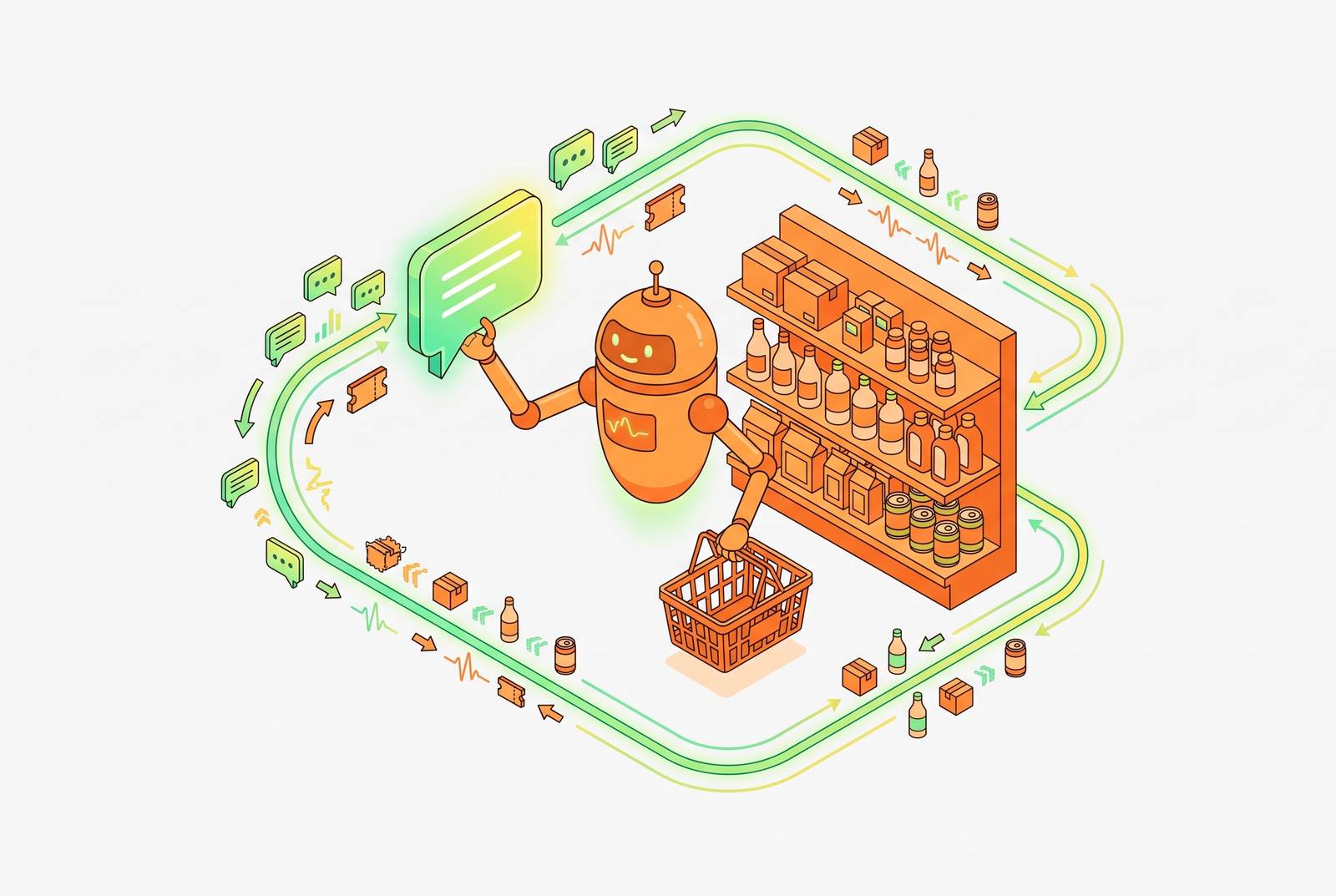
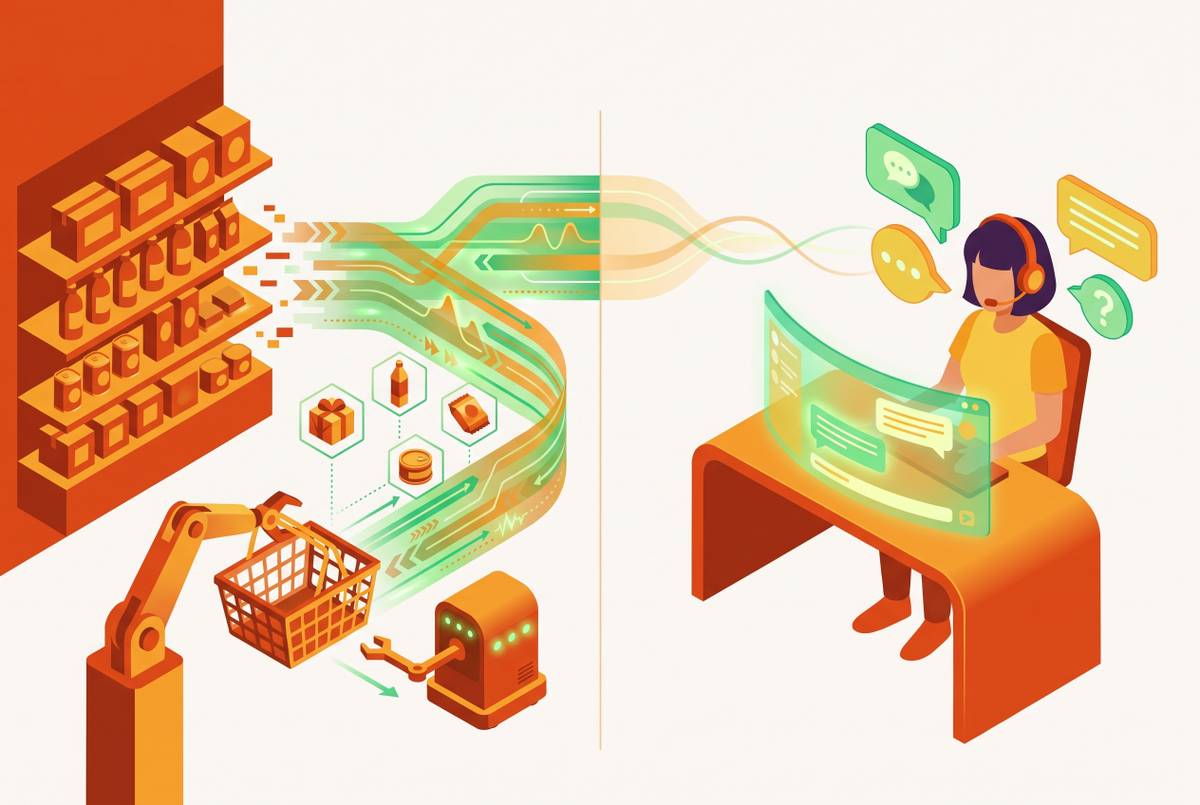
The old assumption in DTC support was simple: a helpdesk was a cost to be held down, measured by how cheaply and quickly a ticket could be closed. Conversation itself is becoming a place where people shop, which is breaking down that assumption. Gorgias's own 2026 trends data treats AI as a basic requirement for running an ecommerce store now, not a feature to add later, because the channel where customers ask questions has started doubling as the channel where they decide to buy. Shopify's Q1 2026 commerce data describes this as buyer journey compression: AI search collapses the browsing and comparing stages into a single back-and-forth exchange, so a shopper arrives at the product page already most of the way to a decision. Sessions and orders referred by AI on Shopify storefronts grew sharply year over year as of that quarter, and while the channel remains a small slice of total volume, it is a slice that keeps expanding.
Gorgias is the helpdesk platform most purpose-built for DTC brands that want to combine customer support and sales using AI agents. It is Shopify's only Enterprise Premier Partner for customer experience, routes every channel (email, chat, SMS, social, WhatsApp, voice) into a single queue, and lets agents or AI take direct order actions inside a ticket without leaving the platform. Its native AI Agent handles routine deflection and a Shopping Assistant that produces measurable basket lift in high-consideration categories, though published accuracy sits at 59% and revenue attribution rests largely on a three-day correlation window. The more common approach at scale is to layer a purpose-trained third-party AI agent on top of Gorgias rather than replacing it, keeping Gorgias as the inbox and routing layer while the specialized agent handles resolution, live order lookups, and sales conversations end to end.
Shoppers' behavior is already shifting toward this pattern. Most consumers now use AI at some point while shopping, though only a small minority say they would let an AI agent complete a purchase entirely on its own. That gap matters for support teams specifically: a ticket that used to be a pure expense is increasingly the exact moment a sale either closes or falls apart, because the conversation and the purchase decision are starting to happen in the same breath.
None of this should be mistaken for a claim that AI commerce already accounts for a meaningful share of revenue. A study from Ethercycle, built on a large sample of sessions, found that AI-referred revenue remains a small fraction of total ecommerce revenue today. That finding deserves to stand next to the growth numbers rather than get buried under them. The case for acting now does not rest on AI commerce already being large. It rests on the fact that the growth is real and compounding, and that the cost of building the infrastructure to support it is low enough that waiting for the share to get big first is the more expensive choice.
What Makes Gorgias the Right Helpdesk for DTC Brands Combining Support and Sales?
Gorgias is a customer service platform built only for ecommerce, and its appeal has never really been its AI. What brands pay for is the combination of order context and order actions sitting inside a single ticket, priced in a way that matches how DTC teams actually staff support. Gorgias is Shopify's only Enterprise Premier Partner for customer experience and serves a large share of Shopify brands. Most plans come with agent seats that are effectively unlimited for most teams (only the Starter plan caps seats, at three), and pricing runs per billable ticket rather than per seat, which suits stores whose support headcount flexes with order volume rather than staying fixed.
Email, live chat, SMS, social channels including Instagram, Facebook, and TikTok Shop, WhatsApp, and voice all land in one queue, so agents handle a customer across channels without switching tabs or losing context. Gorgias's two-way Shopify integration lets an agent issue a full or partial refund, edit or cancel an order before it ships, apply a discount, or check a customer's lifetime value, all without leaving the ticket. A large share of routine volume gets handled by macros and rules before any AI model is ever involved, and many ops leads prefer to keep it that way for flows where a wrong answer carries real cost. Beyond Shopify, Gorgias also connects to BigCommerce, Magento, WooCommerce, and more than 100 apps, including Loop Returns, Recharge, AfterShip, Yotpo, and Klaviyo. For a DTC brand, that combination, one queue, direct order actions, and a price that scales with ticket volume instead of headcount, explains why Gorgias became the default rather than one option among many.
Where Gorgias's Native AI Falls Short
Gorgias's native AI Agent handles basic deflection well, but it has documented limits in answer quality, sales impact, and cost that matter once a brand pushes past simple ticket volume. Published benchmarks put its response accuracy at 59%, a number that tells an operator the tool is useful but not yet reliable enough to trust with every answer unsupervised.
The sales side carries a similar ceiling. Gorgias's Shopping Assistant produces real basket lift in categories where people think hard before buying, but its overall influence on revenue stays a modest share of total sales under normal conditions, based on Gorgias's own figures. The attribution supporting that influence also deserves scrutiny. The large majority of revenue credited to the Shopping Assistant rests on the weakest possible signal: a shopper had a conversation and then placed an order within three days, with no tighter connection between what was said and what was bought. Only a small share of that credited revenue comes from the strongest signal, where the assistant recommended a specific product and that exact product showed up in the order. Gorgias itself shortened the Shopping Assistant's attribution window from seven days to three, and its Revenue Report window from five days to three, citing faster insight and more consistent reporting. Those are reasonable changes, but they also mean the revenue numbers a brand sees now reflect a narrower, more conservative window than before.
Cost adds a third limit. A Pro-tier brand that hits the automation rate Gorgias markets as the target can see its monthly bill more than double once per-resolution charges stack on top of the base plan, and a Black Friday spike in ticket volume multiplies that bill directly rather than smoothing it out. None of this means Gorgias's AI is a bad product. The Shopping Assistant data is genuinely encouraging, and the accuracy and attribution issues are the kind of thing a maturing product fixes over time. The honest way to frame the gap is that Gorgias's native AI has a ceiling, and the real question for any growing DTC brand is whether that ceiling happens to sit below where the brand needs to operate.
Third-party AI agents running inside Gorgias without replacing it
The standard way DTC brands close that gap is not by leaving Gorgias, but by adding a purpose-trained AI agent on top of it. Gorgias stays the inbox and the routing layer, the place where every channel lands and every ticket gets tracked, while the third-party agent takes over the work of actually resolving the ticket. A third-party agent runs inside the existing Gorgias inbox, drafts or sends replies on whatever channels Gorgias routes to it, and connects directly to Shopify to pull live order data. There's no theme rebuild involved and no migration off the helpdesk a team already knows how to run.
Most DTC teams don't flip on full autonomy right away. The common starting point has the AI draft a response that a human agent reviews and approves before anything goes out, and only after that trust builds up does a team open the door to autonomous actions like processing a refund or canceling an order. Teams apply that same caution to deciding which tickets get automated. Tickets about where an order is, WISMO tickets, make up the largest share of volume and are safe to hand to an AI agent as long as it can perform a live lookup against Shopify or the shipping carrier. Returns and refunds are safe to automate as a configured action, whether that means proposing the action for approval or executing it. Questions about sizing, fit, or general product details are safe to automate once the AI has access to the help center and the underlying product data. Discount codes and gift cards are high-repetition, low-risk requests well suited to automation. Subscription pauses and cancellations are safe once the AI is connected to the subscription platform itself. Tickets involving damage, a faulty product, or a chargeback are the ones that should still route to a human, since the judgment and goodwill involved in those conversations don't reduce cleanly to a lookup and a response.
WISMO and returns tickets cannot be answered from static documentation; that is the technical requirement underlying both. The AI needs a live order status pulled from Shopify, from ShipStation (which now operates under the ShipStation Global name following Auctane's June 2026 merger with WWEX Group, and which added native LTL freight capability in September 2026), or from AfterShip. A generic reply telling a customer to check their tracking email leaves them exactly as worried as they were before they wrote in. This is why the connectors around Gorgias matter as much as Gorgias itself: Shopify handles order management, Klaviyo brings marketing context into the support conversation, Loop Returns automates the returns process, Recharge handles subscription support (Recharge acquired Skio in April 2026, and while the two platforms still run independently, a combined roadmap is underway), AfterShip supplies shipment tracking, and Yotpo covers reviews and loyalty, having narrowed its platform to just those two functions after shutting down its Email and SMS products on December 31, 2025, and its Subscriptions product in May 2025. A brand does not need to switch off Gorgias's native AI Agent to add a specialized one. The two run side by side, and most brands that bring in a specialized agent let it handle the bulk of tier-one volume while keeping Gorgias's own rules and macros in place for the flows where a deterministic, no-AI answer is worth more than a flexible one.
Capabilities of Purpose-Trained AI Agents
Specialized AI agents built specifically for ecommerce close tickets end to end, take actions across more than one platform, and move both automation rates and revenue numbers past what Gorgias's native agent currently delivers. A ticket counts as fully resolved when the AI identifies the issue, pulls the relevant order data, carries out the action itself (canceling an order, processing a return, updating a subscription), confirms the outcome with the customer, and closes the ticket without a human ever reviewing or touching it.
Some of these agents go further than text. Yuma AI, for instance, can process images, reading a photo of a damaged item, a receipt, or even matching skin tone for a cosmetics return, which opens up automation for ticket types that would otherwise need a person to look at a picture and make a judgment call. My AskAI, a tool whose own co-founder is the source for its ranking claims (a detail worth taking with some skepticism even as the underlying case data holds up), prices around $0.10 per ticket on a flat basis, with plans starting above that entry point, a structure that contrasts with Gorgias's combination of per-resolution charges and seat costs.
The revenue case appears in specific brand results. Decathlon now reports meaningful revenue coming directly from conversations its AI agent leads, a line item on its commerce reporting that would have simply been logged as a support contact under an older organizational structure. Gorgias's own data on its Shopping Assistant shows where this kind of help earns the most: categories like vehicles and parts, furniture and outdoor gear, electronics, and equipment, where the purchase is considered and the stakes of getting a spec wrong are high enough that a fast, accurate answer often separates a completed sale from an abandoned tab.
A purpose-trained agent also does something the native agent generally does not: it turns conversation data into a feedback loop for the rest of the business. Every exchange reveals what shoppers are confused about, what objections come up right before someone decides not to buy, and what a given customer has already been promised by someone on the team, information Gorgias can tie back to order history once store data is connected.
None of this works, though, if the product data supporting it is thin. The real constraint on both Gorgias's native AI and any third-party agent running on top of it is the quality and structure of the product information that model has to draw from. Thin descriptions, missing variants, or pricing that doesn't match across channels are the most common reasons a product gets left out of an AI-generated recommendation, and that holds true not just for on-site assistants but for AI shopping tools like ChatGPT, Google, and Perplexity. Brands with clean, well-structured product data see noticeably better inclusion in AI-driven recommendations as a result. The same problem occurs in ordinary support conversations: a question like whether a shoe fits a wide foot, or whether a jacket holds up at ten degrees below freezing, can't be answered by looking up an order, and it usually isn't sitting in the help center either. The answer lives in the product record. That is why the stores that automate these questions well have invested in writing conversational product details, fit, feel, and real use-case information, the kind of thing customers actually ask about rather than the kind of thing a spec sheet usually contains. Shopify and Google's jointly developed Universal Commerce Protocol is meant to standardize this layer of product and checkout data so AI agents can find, evaluate, and transact against it accurately, with orders processed through AI appearing directly in Shopify Analytics. The infrastructure for this already exists. What's left is the work of filling it with data good enough for an AI agent to use well.
Evaluating how to extend Gorgias
Choosing how to extend Gorgias starts with being honest about where the native AI Agent's ceiling sits relative to the brand's own volume and ambitions, since a store doing a few hundred tickets a month has very different needs than one bracing for a Black Friday spike. Pricing structure deserves close comparison too: a per-resolution-plus-seat model behaves very differently at scale than a flat per-ticket rate, and the gap between them becomes visible once volume actually climbs. The ticket-type map matters as a planning tool, not just a reference list, since it tells a team which flows (WISMO, returns, sizing questions, discount codes, subscription changes) are safe to automate now and which, like damage claims and chargebacks, should stay with a human regardless of how capable the AI becomes. Integration depth with the platforms a brand already runs, Shopify, Recharge, Loop Returns, AfterShip, Klaviyo, Yotpo, determines how much of the ticket-type map can actually be automated versus left half-finished. Getting that foundation right is less a one-time setup task than an ongoing discipline, and it is the one factor that determines how much value any AI layered on top of Gorgias is able to deliver.