Shopper Trust in AI Recommendations vs Human Reviews
AI narrows options early, but human reviews close sales when money's on the line.
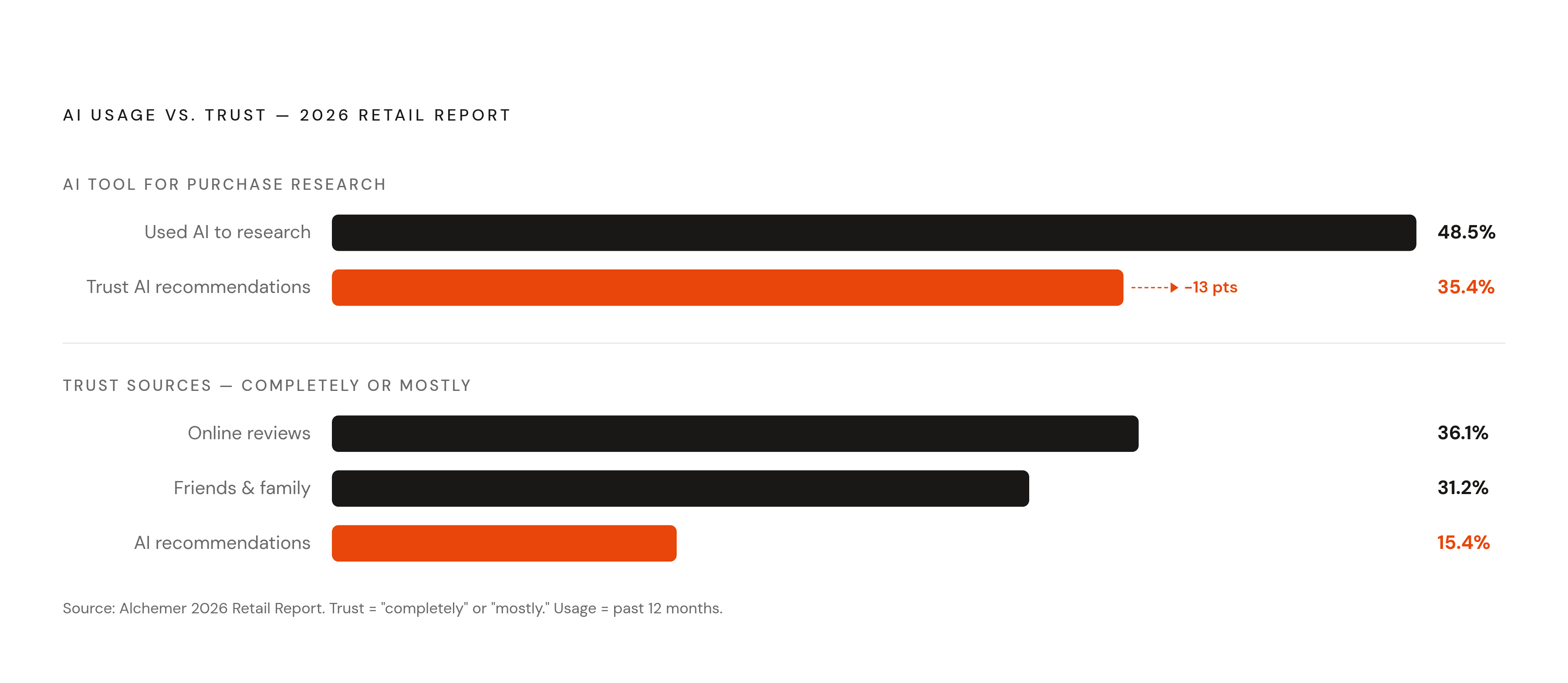
Alchemer's 2026 Retail Report puts a number on something most retailers have sensed but couldn't quite name: 48.5% of shoppers used an AI tool to research a purchase in the past year, but only 35.4% trust AI shopping recommendations completely or mostly. That's a 13-point gap between the people using the tool and the people who believe what it tells them, and it defines the current moment in retail more than any other single statistic. The gap doesn't mean AI is broken or that shoppers are confused about what it does. It means shoppers have learned to split using AI from believing AI: these are two separate decisions, often made within the same few minutes of the same shopping session. Asked which source they trust most at the moment of purchase, shoppers put AI a distant third: just 15.4% trust AI more than other sources, while online reviews (36.1%) and friends and family (31.2%) each beat it by more than double digits. The reasons shoppers give aren't vague unease. Privacy concerns lead at 35.1%, fake reviews and AI-generated content follow at 21.4%, and bias toward what the retailer wants to sell rounds out the top three at 16.5%, a suspicion so widespread that 78% of shoppers believe AI recommendations are already influenced by advertisers, even though, as of early 2026, that isn't actually the case. Each of those concerns names a specific, plausible failure, one a shopper has either experienced directly or can picture without much effort.
Why the gap divides shoppers into two distinct groups
The 13-point gap looks like a single number, but it's actually an average of two populations that behave almost nothing alike. Alchemer's 2026 Retail Report finds that 63% of shoppers who actively use AI tools trust AI recommendations, so their confidence sits closer to reviews and word of mouth than the aggregate figure suggests. Among non-users, the pattern flips hard: most say they don't trust AI for business recommendations. Blend those two groups into one statistic and you get 35.4% trust against 48.5% usage, a gap that reads as puzzling only until you realize it's measuring two different relationships with the technology, not one relationship held at half-strength by everyone.
So if a direct-to-consumer brand wants to build trust at scale, that split has a direct consequence. Two audiences are shopping at once: AI-native shoppers who arrive from a chatbot or an AI search result already leaning toward a decision, and AI-skeptic shoppers who need an entirely different set of signals before they'll take a brand seriously. A brand that designs one trust strategy aimed at "shoppers" in general will satisfy neither group particularly well. What reassures an AI-native shopper, fast synthesis, clean structured data, a confident recommendation, barely registers with an AI-skeptic shopper, who wants to see what another human being actually experienced with the product. The two groups are answering different questions rather than sitting at different points on the same spectrum.
AI and human reviews across the purchase journey
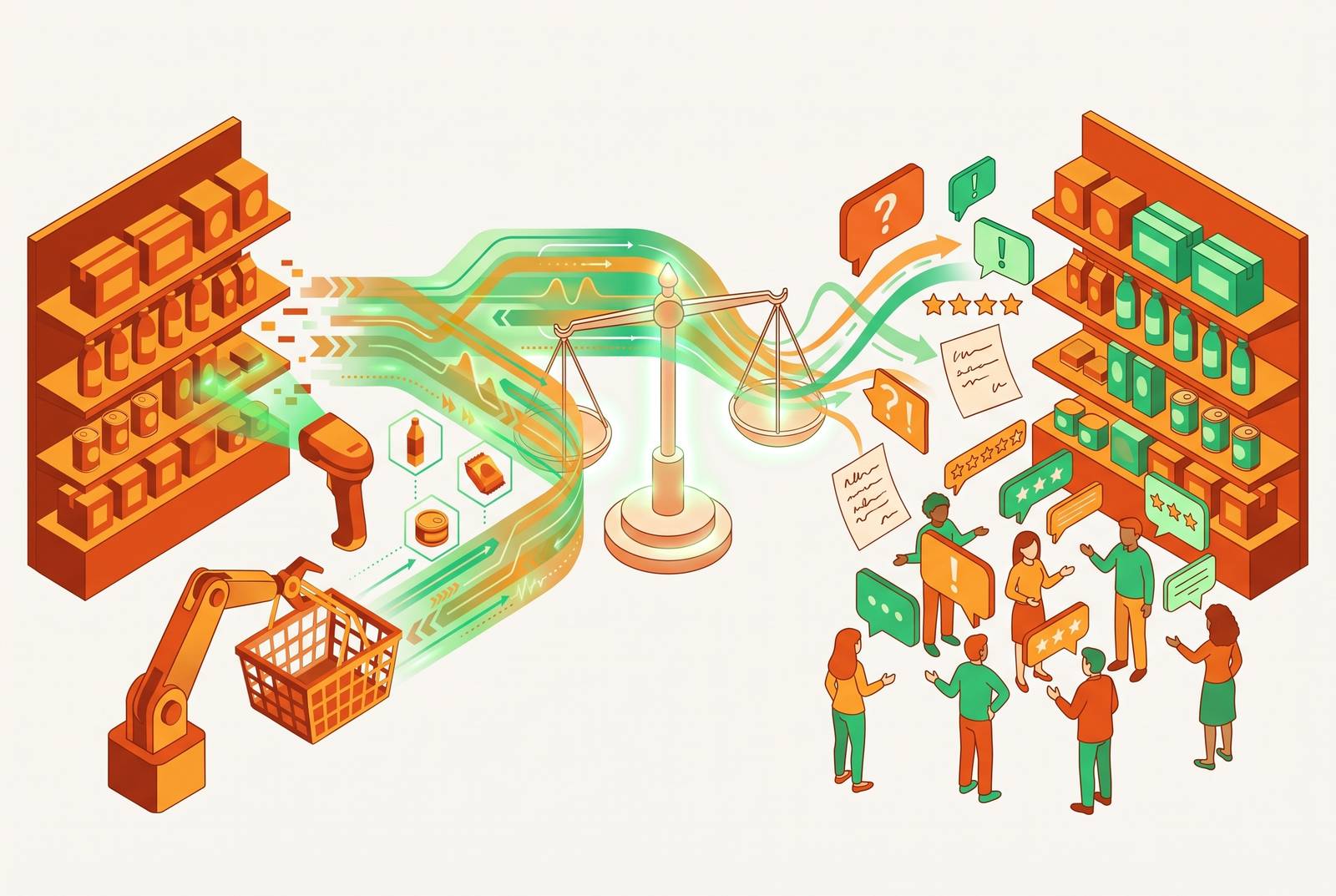
The reason the split holds up is that AI and human reviews aren't competing for the same job. AI reduces complexity and builds a shortlist early on, but when money, fit, or service quality is actually on the line, human reviews supply the evidence that closes the decision. The National Law Review made this distinction in July 2026 commentary: AI helps people decide what to investigate, while human reviews help them decide what to believe. That's a division of labor, not a competition, and it holds up against the data on how people actually use these tools.
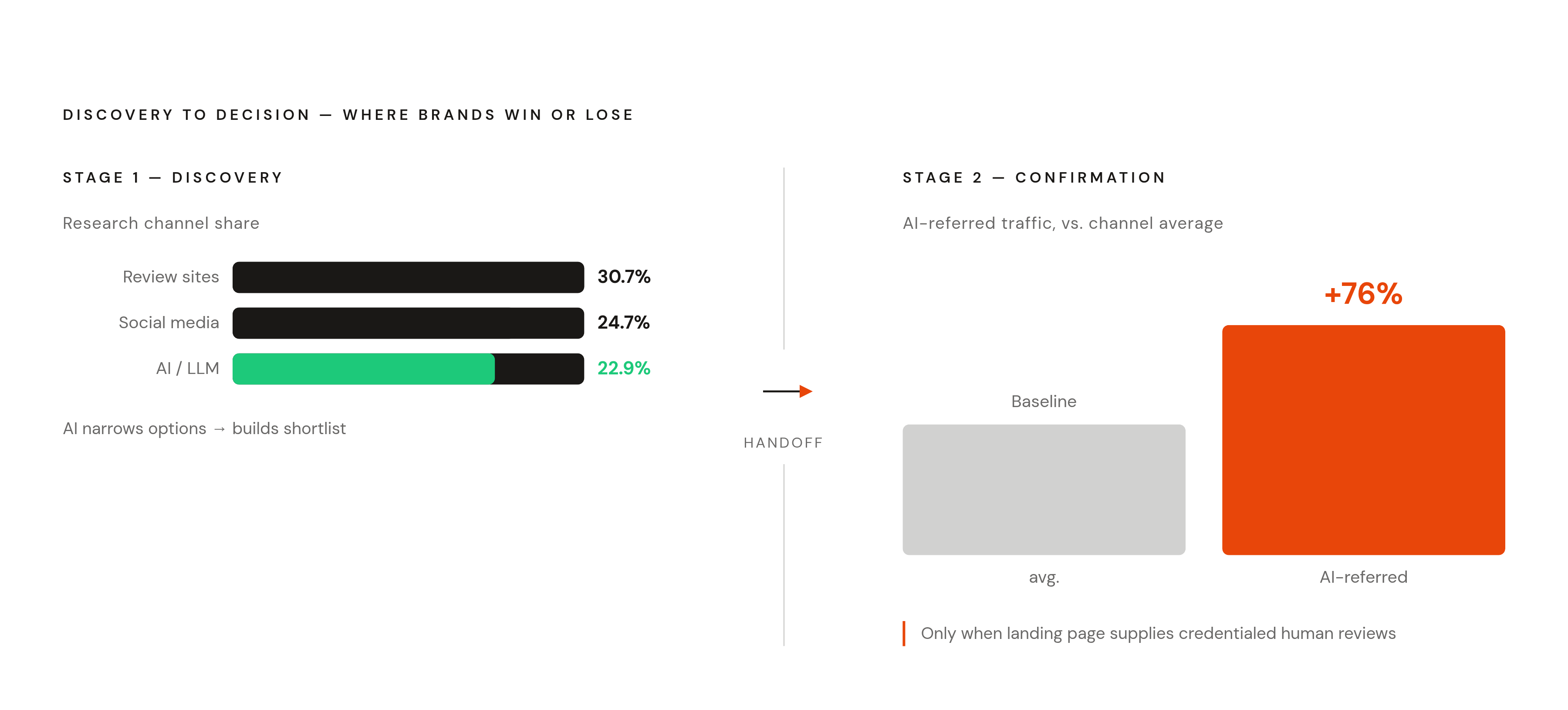
Alchemer's Retail Report backs this up with channel-level detail: 22.9% of shoppers now turn to an LLM, ChatGPT, Claude, Gemini, or Perplexity, when researching a purchase, a figure gaining ground on social media (24.7%) and review sites (30.7%) as research channels. Notice where AI sits in that list: alongside the other research channels, not above them, and certainly not positioned as the channel that closes the sale. Gartner's survey data, cited in the research supporting this piece, reinforces the same boundary from a different angle: shoppers show measurably more willingness to let AI narrow down their options than to let AI make the final call on what to buy. AI functions as a filter at the top of the funnel. It doesn't function as the thing that gets a card out of a wallet.
That boundary creates a handoff moment, the point where a shopper moves from AI-assisted discovery to actually evaluating a product on a brand's own site, and it's both the most valuable and the most fragile point in the entire journey. AI-referred visitors show up more engaged, and they convert at a higher rate than shoppers from other channels. But arriving engaged isn't the same as arriving convinced. These shoppers still need the brand's own site to confirm what the AI told them, and human reviews do almost all of that work. You can see how a product holds up after the money has changed hands, how a support team responds when something goes wrong, and whether a delivery promise was actually kept. An AI summary can reference those facts. It can't originate them, because it wasn't the one who used the product.
What happens when brands instrument each stage correctly
Two cases show what it looks like when a brand gets the confirmation stage right. Feastables, the chocolate and snack brand founded by MrBeast, built an AI chatbot called FeastyBot using Certainly to handle customer questions and proactively engage visitors on-site. That's AI deployed at the confirmation stage rather than the discovery stage, and it turned interest generated upstream into completed purchases: the brand saw a 20% increase in average order value and a meaningful share of total revenue tied directly to the tool, alongside a Net Promoter Score that came in above the typical 30 to 40 benchmark for B2C consumer brands. Peter Sheppard Footwear took a different route to the same stage. The retailer audited its customer journey, migrated to Shopify Plus, and added online chat, abandoned cart emails, and more personalization throughout the site. The result was substantial season-on-season growth in online revenue and a sharp jump in conversion rate.
What both cases share: AI sitting at the confirmation stage, trained on real product data, able to surface the specs, policies, and reviews a shopper needs to go from curious to committed. That's the mechanism, and it points directly at the failure mode on the other side. A brand can show up well in AI discovery channels, get an answer in ChatGPT, get cited by Perplexity, and still lose the sale if its product pages carry thin or uncredentialed reviews. The AI did its job and sent the shopper. The site didn't do its job and close them. Winning the discovery stage buys a brand nothing if the confirmation stage can't carry the weight.
The handoff moment, when an AI-referred shopper actually lands on a product page, is where the site has to function as the confirmation layer in practice. Ethercycle's 2026 analysis found AI-referred traffic converts about 76% above the channel-comparable portfolio average, which makes this exact moment the place to answer the specific pre-sale objections, fit, material, shipping, returns, that a static review section may not surface fast enough. An AI revenue platform like Kinect deploys a brand-trained AI sales rep directly on the storefront, positioned to surface the human-grounded evidence a shopper needs right then: specs, policies, reviews, the brand's own voice, turning that confirmation stage from a generic product page into a credentialed sales moment rather than a missed opportunity.
Human review credibility amid rising AI content
Human reviews are becoming more trusted at precisely the moment AI-generated content is spreading fastest across the internet. The logic behind it is scarcity: AI content can be produced instantly, while a verified purchaser's review cannot. A brand can generate a product description, a lifestyle photo, and a glowing summary in seconds, but none of that proves the product works. A review written by a verified purchaser is different in kind, because it's the one signal AI content can't trivially fake or replicate at scale, and that scarcity is exactly what raises its evidential weight in a shopper's mind.
Marty Bauer, an ecommerce expert at Omnisend, put the dynamic this way: "In the age of AI, people are naturally turning to other people for reassurance. When everything from product descriptions to images can be generated instantly, reviews can feel more genuine than anything a brand says." The fake-review problem complicates this without reversing it. Capital One data cited in research for this piece shows fake reviews are growing faster than total review volume, so that concern is real and it's rising. But the response from shoppers hasn't been to abandon reviews as a category. It's been to get more selective about which reviews they trust, favoring verified purchases, detailed feedback, timestamps, and photos over generic star ratings. Shoppers are getting better at telling good reviews from bad ones rather than losing faith in reviews.
How AI shopping surfaces read review data
Reviews don't just confirm a purchase decision for a human reader; they also feed the ranking logic that determines whether a product shows up in an AI recommendation. AI shopping surfaces use aggregateRating schema as a quality filter, so a product with no rating data visible in structured markup often won't appear in a recommendation response, even when it ranks well in ordinary search results. An audit of a large sample of Shopify product pages, cited in the research behind this piece, found that only a small fraction carried the structured data required for ChatGPT or Perplexity to recommend them, leaving most products invisible to AI shopping assistants no matter how strong their on-page reviews actually are.
The platforms don't all read that data the same way. Perplexity draws from external citations and third-party reviews. ChatGPT Shopping pulls from Bing Merchant Center feeds cross-referenced against Schema.org markup. Google Gemini leans on Google Merchant Center feed quality and product highlight fields. Amazon Rufus relies on its own internal review corpus and how ready a product's listing is for conversational Q&A. Four different platforms use four different ingestion methods, and all of them require structured, verified review data that is machine-readable.
So the problem of earning human trust and the problem of being discovered by AI turn out to be the same thing wearing different clothes. If a brand invests in high-quality, structured, verified reviews, it closes AI-skeptic shoppers at the confirmation stage. That same investment also improves the brand's visibility and citation rate in the AI discovery channels that send AI-native shoppers to the site. Review infrastructure is one piece of infrastructure that pays out at both ends of the journey, not two separate line items.
Whether AI trust will converge with review trust over time, or whether the gap is structural
The 2026 data doesn't agree on where this is headed. BrightLocal's survey found that 64% of active AI users trust tools like ChatGPT as much as traditional reviews for local recommendations, and 42% of all consumers already trust AI platforms just as much. That's convergence, at least among people already using the tools regularly. Alchemer's data, gathered over the same period, points the other way: shoppers are surrounded by more AI every quarter, while trust has stayed stuck near 35.4%, not climbing in step with adoption the way genuine convergence would predict. One reading says the gap is a lag that will close as more people get comfortable with the tools. The other says it's a ceiling that adoption alone won't break.
The disagreement likely traces back to the same split in the shopper base. Among active AI users, trust is already high, at 63% by Alchemer's count and 64% by BrightLocal's, and it may keep rising as these shoppers log more sessions and build more confidence in the output. Among non-users and skeptics, trust sits low for structural reasons that more usage alone won't fix, since the objection isn't unfamiliarity but specific concerns about privacy, fake content, and bias that no amount of exposure resolves on its own.
That raises the obvious objection: if AI trust is climbing fast among the shoppers who use it most, why put real resources into human review infrastructure? The data gives a clear answer. Even among active AI users, nearly all of them double-check an AI recommendation before they complete a purchase, so review quality still decides the outcome for the most AI-fluent shoppers in the room, not just the skeptics. That makes the investment case asymmetric rather than a bet on which scenario plays out. If trust converges, strong reviews keep paying off as the signal AI-native shoppers use to confirm what the chatbot already told them. If the gap holds as a ceiling, strong reviews become the only way to reach the large and durable population of skeptics who were never going to take AI's word for it regardless. Underinvesting in reviews carries real cost under either scenario. Overinvesting carries almost none. The blueprint doesn't change based on which future arrives.
Where DTC brands should place their trust-building investment
Put the whole map together, and you can see the investment priorities follow directly from where each signal does its work. At the discovery stage, the job is visibility inside AI research channels, which runs through structured data: aggregateRating schema, Bing Merchant Center feeds, Google Merchant Center product highlights, whatever a given platform requires to surface a product. If a brand skips this step, its product simply doesn't exist for a growing share of research sessions, no matter how good the product or its reviews actually are.
At the handoff moment, the job shifts to confirmation, and this is where the site itself has to carry weight an AI summary can't. Ethercycle's 76% conversion lift for AI-referred traffic only holds if the landing experience answers the objections a shopper brings with them: fit, material, shipping terms, return policy, the specific questions that separate browsing from buying. So you need more than one static page design to serve both the AI-native shopper and the AI-skeptic shopper at this stage. A brand well-represented in AI discovery but thin on credentialed reviews at the confirmation stage still loses the shopper right when it matters most: they arrive primed, and they find nothing solid to confirm what brought them there. Kinect's agent-ready storefront infrastructure is built for exactly that gap: when a shopper lands from ChatGPT, Google, or Perplexity, they meet a trained brand presence ready to cite reviews, answer objections, and close the decision with the same precision that got them there.
Structured data for discovery and credentialed human evidence for confirmation are two investments, but they don't compete for the same budget. A brand must fund both the discovery stage and the confirmation stage, since skipping either one keeps losing shoppers at that stage no matter how much the other improves.
Sources
- Human Reviews vs AI Recommendations: What Consumers Trust More in 2026
- Retail AI Adoption Outpaces Consumer Trust
- product.ai
- Report: Consumers wary of 'AI slop,' still trust online reviews
- ethercycle.com
- Half of consumers are asking AI for business recommendations - BrightLocal
- AI Shopping Use and Perception Statistics