AI Shopping Assistants Compared for Consumer Use Cases
Where you shop shapes what AI recommends—and whose wallet it's optimizing for.
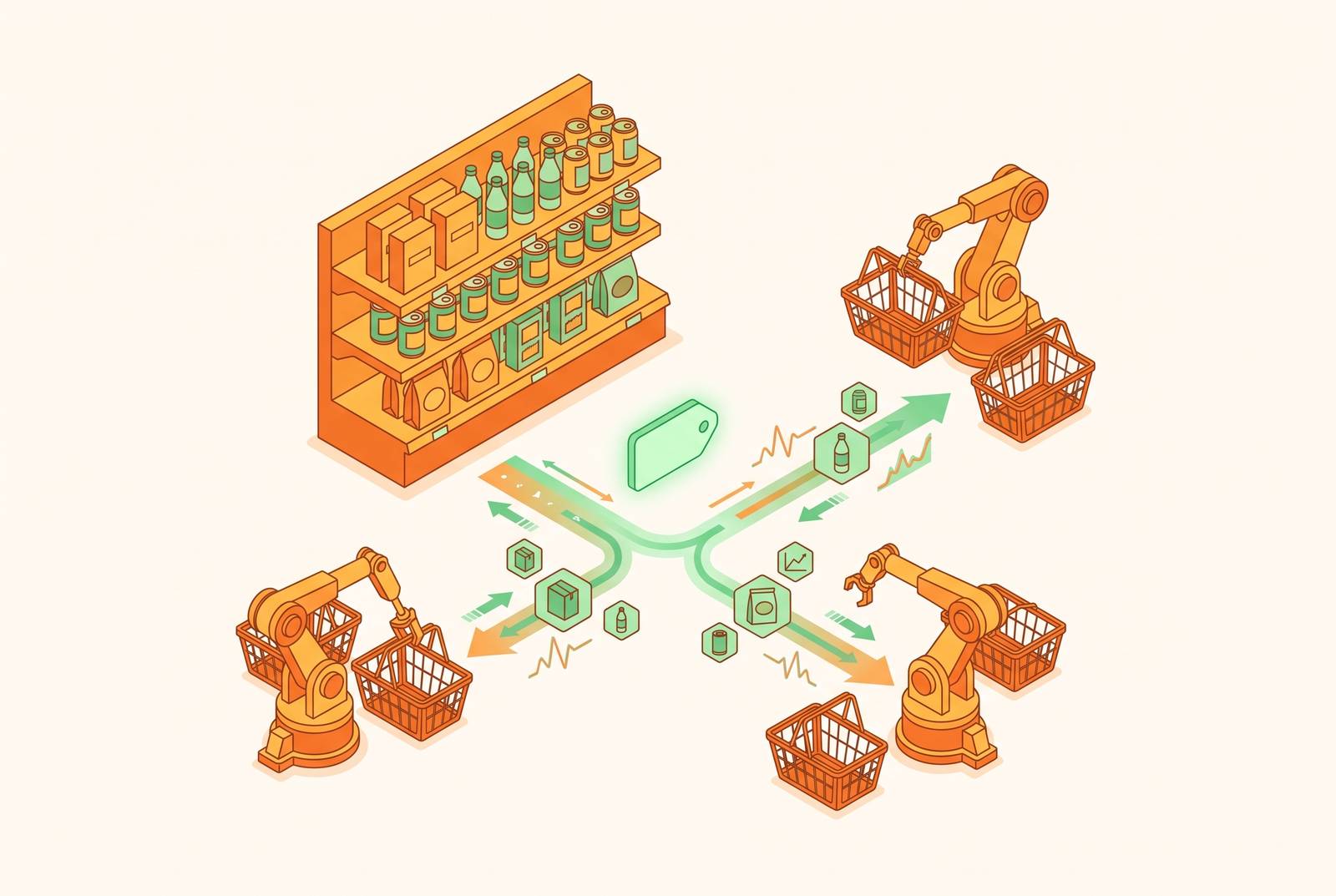
AI shopping assistants are not one product category with different logos. They occupy different positions in the purchase journey, between a shopper and a brand, or directly on a brand's own storefront, and that position determines whose interests the assistant is actually built to serve. A shopper who asks "which moisturizer is right for dry, sensitive skin?" gets a structurally different answer depending on which tool they ask, because the two kinds of assistant are drawing on different data and answering to different parties.
AI shopping assistants and the purchase journey
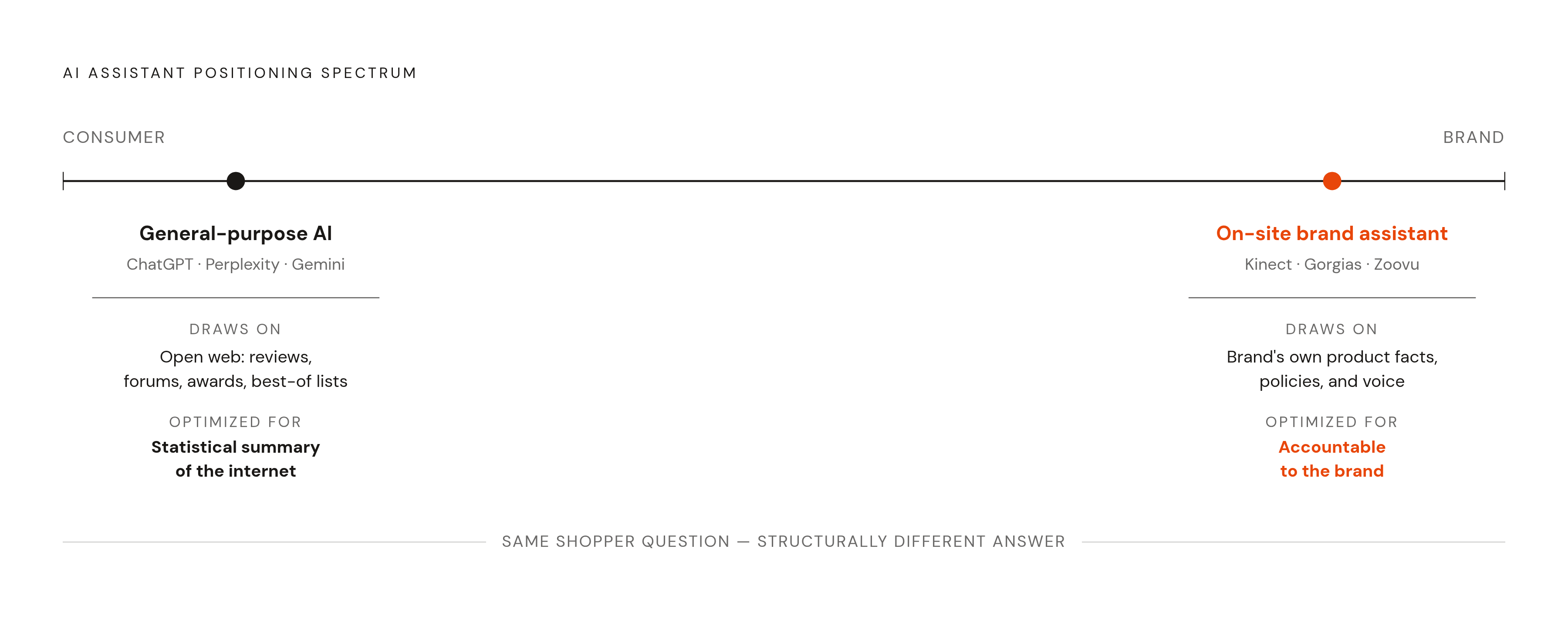
Every AI shopping assistant sits somewhere on a line between the consumer and the brand, and where it sits determines what it can see and who it ultimately works for. An assistant positioned between the two, like a general-purpose AI chatbot, draws on whatever it has indexed across the open web: product reviews, press mentions, forum threads, best-of lists. The position a shopping assistant occupies, between consumer and brand or directly on the brand's own storefront, decides which data it can read and whose interests it is set up to optimize for. A brand-deployed assistant answers from the brand's own facts; a general-purpose assistant answers from a statistical summary of what the internet has said about a product category. So the same question about a moisturizer for dry, sensitive skin gets two different answers, depending on which tool a shopper opens. Neither answer is dishonest, but only one of them is accountable to the brand whose product is being recommended. Understanding that distinction is the precondition for everything that follows in this comparison, because every feature, pricing model, and conversion statistic discussed below inherits its meaning from which side of that line the tool sits on.
Why consumer adoption of AI-assisted shopping is accelerating
The reason this comparison matters now, rather than as a forward-looking exercise, is that adoption has already moved past the experimental phase. The Braze Retail Customer Engagement Review expects consumer adoption of agentic shopping to jump from roughly one in five shoppers to nearly half of all shoppers by the end of 2026. That is a doubling within a single year, and it is happening alongside infrastructure that has quietly reached production scale. Shopify merchants are now live inside the ChatGPT ecosystem, and Google has launched AI Mode with agentic checkout built in, with Wayfair, Chewy, and Quince among the retailers already running it. These are live commercial channels processing real transactions, not pilot programs sitting in a lab.
The clearest evidence that this shift already has teeth comes from Shopify's own Q1 2026 data: AI-referred sessions and AI-referred orders both grew dramatically year over year, and those AI-referred orders converted meaningfully better and carried a higher average order value than traffic arriving through organic search. That last detail is the one brands should sit with, because it means the AI channel isn't just adding incremental volume, it is outperforming the channel that DTC marketing has optimized around for two decades. A brand that has not yet asked how its products are described, cited, or recommended inside an AI assistant is already behind a competitor that has, and a consumer who has not yet used one of these tools to shop is about to be in the minority.
How general-purpose AI assistants work as shopping tools
General-purpose AI assistants pick products by a logic that has almost nothing to do with how search engines ranked results for the last two decades. Research into AI shopping behavior, along with audit data from brands tracking their own visibility, shows that ChatGPT recommendations weight authoritative list mentions, awards citations, and review volume. A brand's position in Google's organic search results carries little to no weight in that calculation. The practical consequence is stark: audit data shows a majority of brands that rank well on Google are not cited by AI systems. Years of SEO investment do not transfer to AI visibility, because the two systems are reading entirely different signals.
General-purpose AI assistants select products based on criteria fundamentally different from search ranking: they weight authoritative mentions, awards, and review volume rather than a brand's Google position, leaving many well-ranked brands invisible to AI recommendation. For a shopper, the moisturizer that ChatGPT or Perplexity surfaces is the product best represented in the training corpus and in whatever structured data feeds the assistant happens to be able to read, not necessarily the best fit for that shopper's skin type or budget. A niche brand with an excellent product and a thin public footprint may simply not exist, as far as the assistant is concerned, next to a mass-market competitor with hundreds of indexed reviews and a magazine "best of" mention from three years ago.
Beneath recommendation quality is a harder issue: how these assistants handle the information a shopper volunteers to them. A 2026 study from the University of Iowa, by Soogand Alavi and Salar Nozari, examined what happens when a consumer delegates shopping to a buyer agent and describes themselves in natural language rather than specifying a numeric budget. The finding: seller-side AI can recover that consumer's willingness to pay from the dialogue alone, almost one-for-one, without the consumer disclosing a budget. The researchers call this mechanism role coherence. The same persona a consumer gives an agent to make it useful, "I'm shopping for a gift for my partner who's particular about quality," for instance, functions simultaneously as an information channel back to the seller. The study is explicit that this cannot be fixed by writing a better prompt or adding a confidentiality instruction, because the leakage arises from the act of delegation itself, not from careless wording. If a shopper believes their budget is private while using a buyer agent, they may be exposed to personalized pricing they never agreed to, because describing themselves honestly enough for the agent to help them is the same act as revealing what they're willing to pay.
How on-site shopping assistants work differently
The conversion evidence for these tools needs to be read carefully rather than taken at the headline figure. Gorgias's June 2026 benchmark across merchants running its Shopping Assistant found a meaningful uplift in average order value on orders the assistant influenced, compared to the same store's other orders, found that roughly one in seven Shopping Assistant conversations ended in an attributed order, and those numbers are genuine signals of value that are easy to overstate if the attribution method behind them isn't understood.
Most of the "influenced revenue" figure in Gorgias's own report comes from its weakest evidentiary standard: a shopper had a conversation with the assistant, then placed an order within three days, with nothing else tying the assistant to that specific purchase. Gorgias's own framing separates out a much smaller "hard core" of orders, the cases where the assistant actually recommended the item that got bought, and that number is meaningfully smaller than the gross headline figure suggests. The pattern extends well past Gorgias. Almost every benchmark published by an AI shopping assistant vendor relies on a simple last-conversation attribution window, and that method systematically overstates lift by crediting the assistant for sales that would likely have happened anyway. A shopper who was already planning to buy a product, and who happens to chat with an assistant along the way, gets counted as "influenced" under this methodology even when the assistant changed nothing about the outcome. Reading a vendor's conversion statistics requires asking which of these two measurements produced the number on the page.
The uplift that these tools do produce isn't being bought with discount codes. Gorgias's data shows assistant-issued discount codes appear on under one percent of influenced revenue, and orders that use them are smaller than orders that don't. That detail matters because it rules out the simplest alternative explanation for the conversion lift, that the assistant is just discounting its way to a sale. Where these tools add the least value is in habitual, low-consideration categories like food, beverage, and supplements, where the shopper already knows what they want and a conversation adds no real decision-making value. Where they earn the most is in considered purchases that require fit, compatibility, or expertise to get right. A 2026 roundup cites Tatcha's deployment as a case in point, reporting three times the site-average conversion rate and a meaningful share of total site revenue influenced, a result consistent with a category, skincare, where shoppers genuinely need help narrowing down options rather than simply checking out faster.
A factual comparison of the main on-site AI shopping assistants available in 2026
The question that should organize any comparison of these tools is not which one has the longest feature list, but whether it was built natively for commerce or adapted from some other function, like customer support. That origin shapes what the tool is actually good at, which is the lens to apply to each option below.
Kinect was built around the problem the previous two sections laid out directly: a brand with no AI presence of its own gets described, inaccurately or incompletely, by whatever an outside model happens to piece together from scattered web sources. Kinect's approach is one brand agent per brand, trained on that brand's own product facts, policies, and voice, rather than a generic assistant layered across many storefronts. It also surfaces that same brand data to the general-purpose AI channels covered earlier, ChatGPT, Perplexity, Gemini, so the intelligence that helps a shopper on-site is the same intelligence answering a buyer agent off-site with accurate, differentiated product data rather than leaving that answer to chance. For a DTC brand trying to manage the shift from click-based discovery to conversation- and agent-based commerce, Kinect's pitch is consolidation: one platform handling both the on-site conversation and the brand's visibility inside outside AI assistants, rather than a patchwork of separate tools solving each half of the problem.
Zoovu is built for complex, high-consideration, technical catalogs, the kind where a shopper needs guided discovery around compatibility or configuration rather than a simple product description. It runs on SAP, Shopify Plus, BigCommerce, and Salesforce Commerce Cloud, with pricing that is quote-based and modular. It fits brands carrying large technical catalogs where getting the configuration right is the primary job the assistant needs to do.
Gorgias AI Agent fits teams that are already running a helpdesk-led support stack and want shopping assistance layered on top of it rather than bolted on as a separate system. The AI Agent itself runs on Shopify only; Gorgias documentation confirms that BigCommerce and Magento merchants get the helpdesk, with read-only store visibility, but not the AI Agent. Pricing combines a per-resolution cost with the underlying helpdesk plan cost. Gorgias started as an email-automation tool, pivoted into customer support, and added shopping capability after that; the attribution caveats discussed in the previous section apply most directly to its own published benchmarks. It fits brands where support deflection and shopping assistance are genuinely one workflow rather than two.
AskTimmy AI covers visual and semantic product search for Shopify brands on a limited budget, suited to smaller brands with visually driven catalogs that need semantic search without a large price tag.
Tidio, through its Lyro AI feature, offers the fastest and least expensive entry point among these options, running on Shopify, WooCommerce, BigCommerce, and Wix. Pricing combines Tidio's entry-level plans with a separate Lyro add-on billed in monthly conversation-quota bundles; for example, you pay $39 a month for 50 AI conversations. It suits stores that want something running quickly with minimal setup, but merchandising control is more limited than a purpose-built commerce platform offers.
One infrastructure detail applies to all of these choices, regardless of which assistant a brand runs. ChatGPT and comparable general-purpose assistants surface products based on structured data quality, not search ranking seniority, and only a minority of merchants currently have catalogs that are machine-readable in the way these systems need. Separately, Google's legacy Content API for Shopping shut down on August 18, 2026, so any brand running programmatic, API-based Merchant Center integrations needed to migrate to the Merchant API to keep its feed delivering. Manual file uploads, scheduled fetches, and Google Sheets feeds were unaffected. So any brand evaluating an on-site assistant should check that migration status alongside the vendor comparison above, since a broken feed undermines even the best-chosen tool.
What AI shopping conversations reveal that clickstream analytics cannot
The value of an on-site assistant doesn't stop at the conversion numbers discussed earlier. It extends into something clickstream analytics was never built to capture: the actual language shoppers use when they're asking for help. A Klaviyo survey of thousands of shoppers found that 78% of people include emotional or personal context at least some of the time when using AI to shop, asking for "something to cheer me up" or "a gift that feels thoughtful." No click path, no funnel report, and no heatmap records that kind of language, because clickstream data only sees what a shopper did, not what they said while doing it.
Shopping chat logs also expose the specific, concrete questions customers ask about sizing, care instructions, and compatibility, handing merchandising and marketing teams the actual words customers use rather than the inferred intent a traditional analytics dashboard produces. That signal has a measurable commercial payoff: personalized product recommendations built on this kind of input have been found to account for a meaningful share of commerce revenue, and close to half of consumers report making an impulse purchase after receiving an AI-driven suggestion.
That signal comes with a limit that any brand reading it needs to keep in view. Conversation data only represents the shoppers who chose to engage with the assistant in the first place, a self-selected group that is not the same as the full population of visitors to a storefront. A brand drawing conclusions from chat logs alone risks mistaking the preferences of its most AI-comfortable customers for the preferences of its entire customer base, and the two are not guaranteed to match.