How AI Shopping Channels Rank Products Differently Than Google Search
AI Mode filters products through language relevance before bidding even enters the equation.
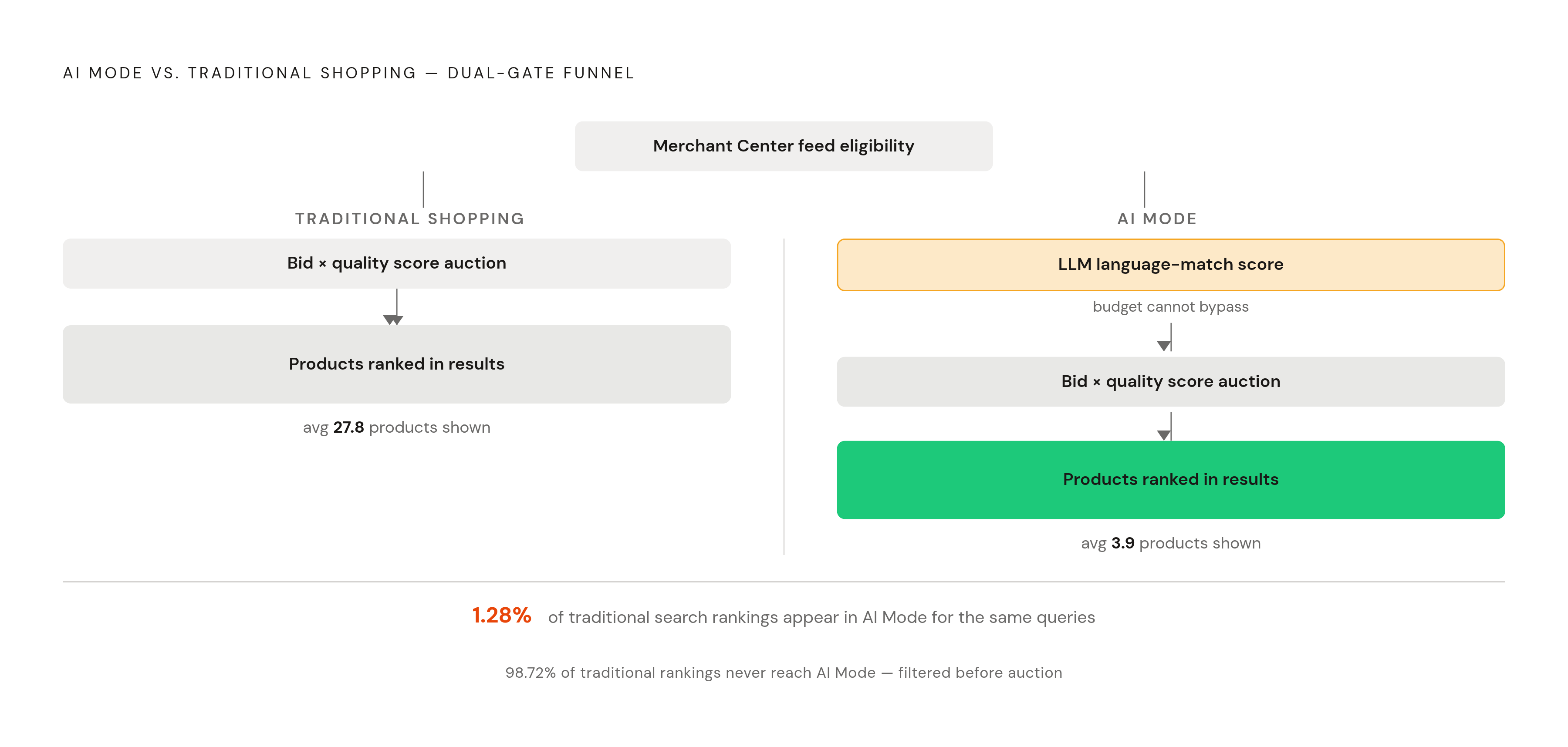
Google's AI Mode and traditional Shopping results run on two separate selection processes, not two versions of the same one. Classic Google Shopping ranks products by multiplying bid against quality score, and that quality score comes mostly from click-through rate, ad relevance, and how good the landing page is. Feed completeness against required attributes decides whether a product gets into Merchant Center in the first place, but that eligibility check is a separate gate from the quality score that drives the auction itself. AI Mode, live for all US search queries since mid-June 2025, adds a step before any of that auction logic runs: a large language model reads the shopper's natural-language query, scores each candidate product against what that shopper actually seems to want, and builds a short summary carousel from the results. If a product doesn't clear that language-matching step, it never gets anywhere near the bid layer, no matter how much a brand is willing to spend.
That ordering decides which products a shopper sees before any bidding takes place, regardless of how much a brand has spent. A brand can run a well-funded, well-optimized Shopping campaign and still never show up in AI Mode, because the auction it's winning happens downstream of a filter it never passed. Google still handles far more shopping queries through traditional search than through AI Mode, so none of this displaces the older system. It runs alongside it, built on a different logic for deciding what counts as a good answer.
The scale of the divergence is now documented, not just theorized. A Productrise study tracking more than 2 million product listings across over 100,000 searches over 23 days in August 2026 found that only 1.28% of products ranking in traditional search also showed up in AI Mode for the same queries. A separate Productrise study had already found the same basic pattern: AI Mode surfaced only a small fraction of the products that ranked in traditional search. Two independent measurements point the same direction, months apart, which rules out a one-time quirk in the data. AI Mode also shows far fewer products per search, an average of 3.9 compared to 27.8 in traditional search, so each product that does make it into an AI Mode carousel is carrying a lot more commercial weight than a single listing buried in a 27-item traditional results page.
Put together, these numbers describe a split in what "ranking well" even means. A brand with strong organic placement and a healthy Shopping campaign can be entirely invisible in AI Mode for the identical query, and a brand that's barely competitive on paid search can turn up prominently in an AI carousel if its product data answers the question the shopper actually asked. That split is the setup for everything that follows: once selection runs on a different mechanism, the next question is what that mechanism actually rewards, and the price data gives the clearest answer available.
The Price Gap Between AI Mode and Traditional Search
When the identical product shows up in both AI Mode and traditional search on the same day, the Productrise study found its AI Mode price ran meaningfully higher on average. That gap isn't a pricing error or some artifact of how AI Mode happens to time its crawl. Lowest-price ranking has long been one of the dominant signals in traditional Google Shopping, so a wide price gap on matched products indicates that signal carries much less influence inside AI Mode's retrieval step.
The pattern holds in both directions the data can be read. When AI Mode and traditional search disagree on price for the same matched product, AI Mode lands on the higher-priced side in most of those cases, a split too lopsided to read as noise. Close to half of matched products also show a different lead seller between the two surfaces. That's a meaningful detail: AI Mode is choosing a different offer entirely from a different seller, not just redisplaying the same offer from the same seller at a different number, which shows the retrieval layer evaluating sellers and listings on criteria that don't reduce to who's charging the least.
The practical read for brands is direct. The strategy that wins placement in traditional Shopping, competitive bidding paired with the lowest viable price, is not the strategy that wins a spot in an AI Mode carousel. An SEO manager who reviewed the Productrise findings noted that AI Mode "seems more likely to link to the brand's website itself over the marketplace. If the brand's own product data is complete enough for the retrieval layer to work with, that's a structural opening for direct-to-consumer brands over marketplace resellers. A reseller competing purely on price has less to offer an AI model that's weighing how well a product description answers a shopper's actual question, while a brand selling direct, with full control over its own product page and feed, has more material the model can use to make that judgment. The price gap, read this way, is a visible trace of a retrieval layer built to value fit over cost.
How each major AI shopping surface, ChatGPT, Google AI Mode, Perplexity, and Gemini, applies its own selection logic
Type the same product query into Google, ChatGPT, and Perplexity, and you don't just get three different-looking answers. You get three different sets of recommended brands, built from three different retrieval processes, so optimizing for one surface doesn't carry over to the others automatically. GPT-4o shares no median domain overlap at all with Google's top organic results for the same queries, and Perplexity's overlap with Google is just 14.3%. These are not numbers that suggest the surfaces are converging toward some shared standard over time. They suggest three separate systems, each built around its own sources and its own way of deciding what a good answer looks like, operating in parallel rather than drifting together.
ChatGPT has no paid ranking option at all; a brand can't buy its way into a recommendation the way it could buy a Shopping ad slot. What influences ChatGPT's picks instead is closer to reputation built outside the brand's own channels: how often it's mentioned by other sources, whether it shows up in expert reviews, how much editorial coverage it's picked up elsewhere on the web. OpenAI's shopping-tuned model reaches a majority of correct product matches on complex, multi-constraint queries, the kind that ask for a product meeting several conditions at once, and the cleaner and more complete a brand's structured product data is, the more often that model lands on the brand's own product as the answer.
Perplexity works from a different mix of inputs. It draws on Google Shopping-format feeds, on direct crawling of web pages that carry valid schema.org markup, and on its own merchant partnership program. It also leans heavily on citations, meaning editorial reviews and buying guides that name a specific product carry real weight in what Perplexity ends up recommending, in a way that a bare product listing without any third-party coverage doesn't.
Google's AI Mode, along with Gemini, stays tightly wired into Google's own Merchant Center and Shopping feed infrastructure, so product data submitted to Merchant Center flows directly into what Gemini recommends. AI Mode carousels also pull heavily from Google's free product listings, not only from paid placements, so a store that spent its optimization budget entirely on paid Shopping attributes while leaving its free listing data thin ends up underrepresented in AI Mode regardless of ad spend.
What ties these three systems together is the data layer underneath them: each platform draws on that shared feed infrastructure, then applies its own distinct ranking logic on top of it. That shared substrate is a floor, not a ceiling. Meeting the minimum feed requirements gets a product into consideration across multiple surfaces, but each platform layers its own additional logic on top, citation patterns for Perplexity, editorial mentions for ChatGPT, free listing depth for Google AI Mode, and winning visibility on any one of them means satisfying that platform's specific layer in addition to the shared baseline underneath it.
The attributes that barely register in a traditional Shopping auction are what the AI retrieval layer runs on. Product descriptions, structured highlight fields, specification pairs, certifications: none of these move the needle much in a bid-based auction, but they are the raw material an LLM uses to decide whether a product answers the question a shopper actually typed. An audit of more than 60 Shopify and WooCommerce stores conducted across the first two quarters of 2026 traced the gap between stores that showed up in AI carousels and stores that got bypassed back to the same six feed attributes and description patterns, consistently, across the full set of stores audited.
Title carries real weight in both classic and AI surfaces, but the winning approach shifts: AI Mode rewards a spec-first title written in something close to a full sentence that answers a question, rather than a string of stacked keywords. The product_highlight field barely matters in classic Shopping, where it's optional and shows up mainly in free listings, but it matters a great deal in AI Mode, since it supports multiple bullet points that the language model lifts close to verbatim into its summaries, making it the single attribute most consistently tied to mid-funnel queries like "best winter coat for extreme cold." The product_detail field, built from structured name-and-value spec pairs, carries little weight classically, but it becomes critical in AI Mode for comparison queries, where the model has to tell two similar products apart on paper. For ChatGPT in particular, the q_and_a and reviews fields in the OpenAI Product Feed do the same job that product_highlight and product_detail do for Google, giving the model the structured context it needs to match a product against a complex query with several conditions attached.
The same audit identified three description patterns that consistently appear in products that make it into AI summaries. The first sentence of a description should lead with the product's primary use case, since the retrieval model scores those opening one or two sentences directly against what the shopper is asking for. A description should include at least three explicit feature-benefit pairs, since AI summaries are built to compare, and a line like "600-fill-power down insulation keeps core temperature stable to −15°C" gives the model something to compare with, while "warm and comfortable" gives it nothing. Descriptions should also match the way a shopper would actually phrase a question, since they're indexed semantically: a description written the way a knowledgeable salesperson would explain the product outperforms one built around stacked keywords aimed at older search engines.
The retrieval layer builds a "best X for Y" answer by pulling from whatever structured data is available for each candidate product, so a listing with complete highlights and feature-benefit descriptions gives the model what it needs to place that product in the summary, while a listing with sparse data doesn't make the cut, regardless of how competitive its price is or how well it ranks in organic search. You need data consistency across surfaces just to be considered; it isn't a quality signal layered on top. Perplexity suppresses listings where the feed price doesn't match the live price on the site, so if a brand's data is internally inconsistent, it gets filtered out before anyone weighs the quality of its writing.
The brands currently earning citations across these AI surfaces are often not the brands with the strongest traditional Google authority. They tend to be the brands with the most complete and most consistently structured product data, built to answer a shopper's question rather than to win an auction. Analysis of direct-to-consumer e-commerce strategy from 2026 recommends treating Google's traditional search as the volume engine it remains, and treating the AI shopping surfaces as a second channel worth real investment on its own terms. The underlying work, building clean, structured, consistent product data, overlaps heavily across both, so the investment a brand makes to win in one place tends to pay off in the other as well.
Sources
- Why 80% of AI Overview Products Don't Rank in Top 10
- Boost Your Sales with AI Search Visibility for Ecommerce
- ChatGPT vs Perplexity vs Gemini vs Google AI Mode: Ecommerce Comparison 2026
- AI Shopping: What ChatGPT Recommends (Data Study)
- How to Get Your Products Recommended by ChatGPT, Perplexity, and Google AI
- How AI Shopping Surfaces Read Your Product Feed: ChatGPT, Perplexity, Google AI Mode & Microsoft Copilot
- Google AI Mode Prices 21.6% Higher Than Search (2026 Data)
- D2C Ecommerce SEO 2026: Rank in Google + AI Search