AI Personalization in DTC E-Commerce Explained
AI discovery is moving shopping earlier, where most DTC investment still isn't looking.
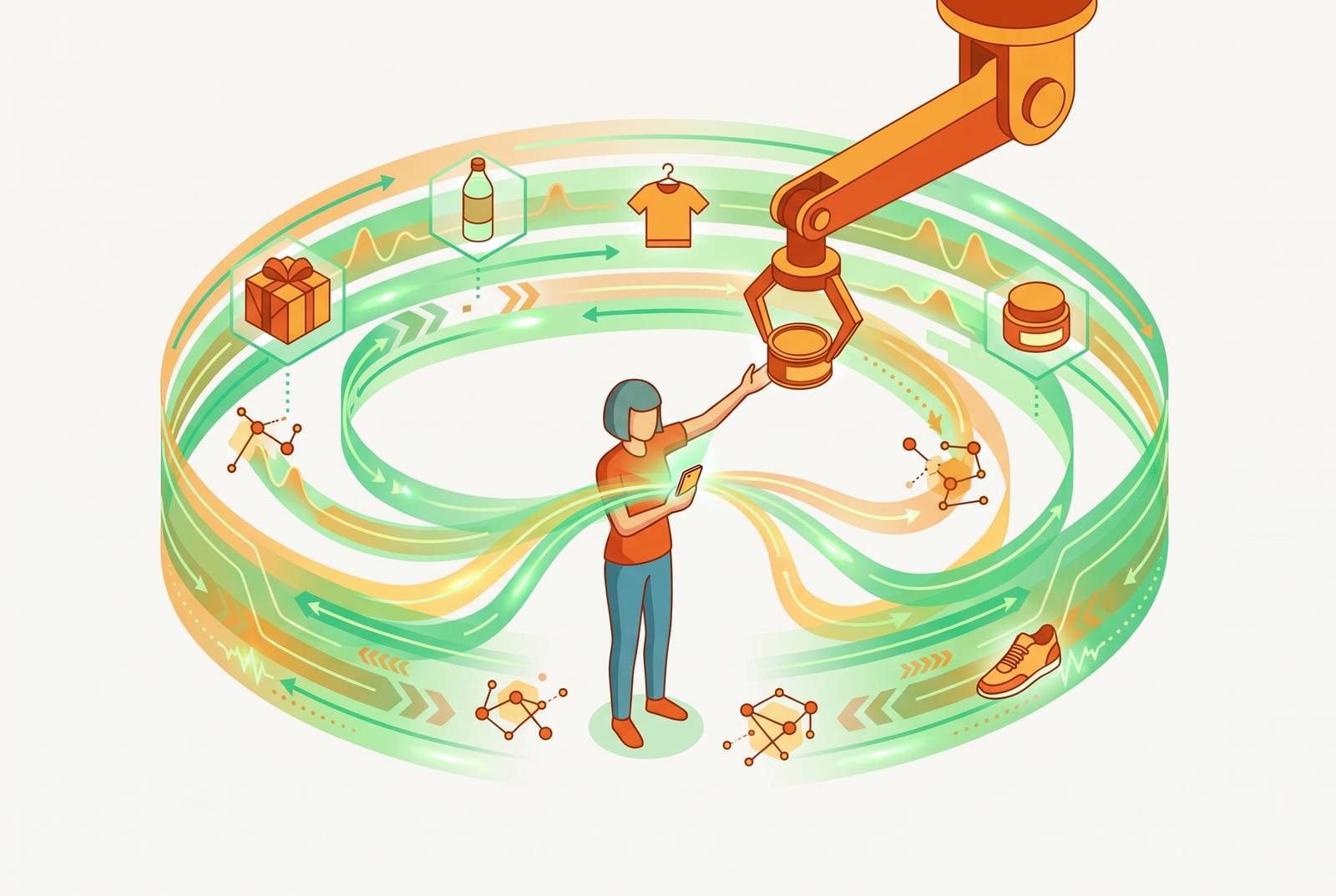
Most DTC operators still think of AI personalization as a recommendation widget on a product page, or an email flow segmented by purchase history. That picture is out of date. Discovery, evaluation, and purchase, three steps that used to unfold across separate site visits, now happen inside a single AI-mediated conversation before a shopper ever lands on a brand's site. The widgets and the segmented emails still matter, but they sit downstream of a bigger change in where shopping actually starts. A shopper today can ask an AI assistant a plain question about a product category and arrive at a brand's site already knowing what they want. The real work of personalization has moved earlier than most teams are looking.
That's the gap this piece is built to close: most AI investment in DTC still goes toward copywriting tools, email segmentation, and on-page recommendation carousels, while the growth is happening in the pre-site layer of intent matching. AI-driven traffic to Shopify stores has grown eightfold year-over-year since January 2025, and orders coming from AI-powered searches have grown fifteenfold over the same period. Those numbers don't read as a modest lift on top of the existing channel mix. They read as a structural reallocation of where buying decisions get made, and brand operators who keep treating AI personalization as a product-page feature will keep missing where the leverage actually sits.
How AI collapses the discovery-to-purchase funnel
Journey compression drives that reallocation: when a shopper uses ChatGPT, Perplexity, or Gemini to research a product category, the comparing and shortlisting that used to take three or four separate site visits now happens entirely inside the chat. By the time that shopper clicks through to a brand's site, they've already done the work a browsing session used to require, so the visit itself carries a different kind of intent than a click from a search results page ever did.
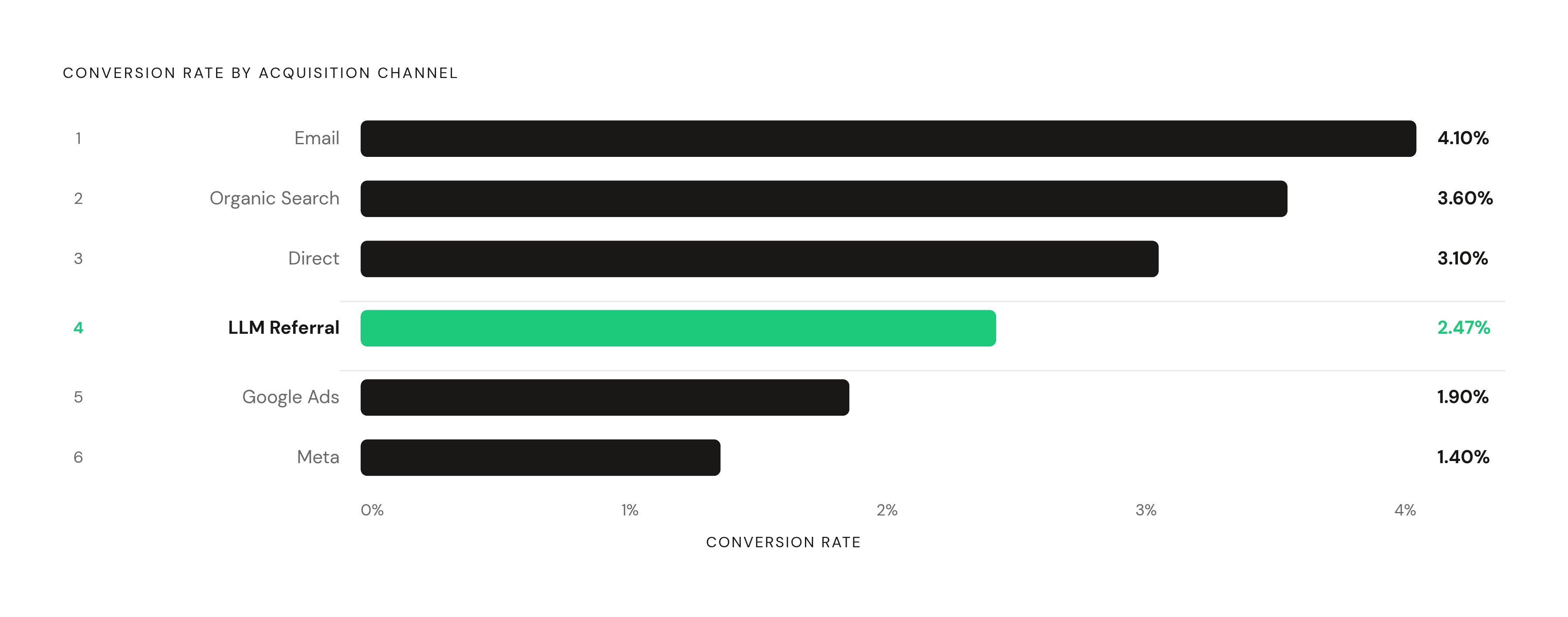
That traffic's behavior once it lands is the clearest evidence of this. LLM-referred traffic, the clicks coming from ChatGPT, Perplexity, Claude, and Google's AI features, converts at 2.47%. That puts it fourth among all acquisition channels, ahead of Google Ads and ahead of Meta. A search ad or a social placement still has to do the work of convincing someone mid-scroll; an AI conversation has already done that convincing before the click happens, and the conversion rate reflects it.
Adobe's Q1 2026 data backs this up from a different angle. The data comes from over a trillion visits across more than 130 North American retailers, and it shows AI referral traffic converting substantially better than non-AI traffic: AI-referred shoppers spend longer on-site and generate more revenue per visit. None of that is because the technology itself works some kind of magic on shoppers. It's because the shopper arriving from an AI conversation has already been matched, filtered, and convinced, in a way a shopper clicking a banner ad has not.
That reframes what "personalization" means at this stage of the funnel. The AI assistant, not the brand's own recommendation engine, is doing the matching between what a shopper wants and what a brand sells. If a brand doesn't show up inside those AI conversations, you can't call that a neutral skip.
What AI discovery engines use to cite brands
You get matched inside an AI conversation by a different set of rules than you rank in a Google search. AI discovery engines don't weigh domain authority or backlink counts the way traditional search does. They select products based on the quality of a brand's structured data, how often third parties cite it, and the volume and substance of its reviews. A brand's SEO ranking, built over years of keyword work and link-building, tells you almost nothing about whether an AI assistant will recommend it.
ChatGPT in particular pulls from authoritative list mentions, awards, and review volume when it selects products to surface. Reddit accounts for a large share of the sources these systems cite, more than any single publisher or retailer site; editorial coverage and genuine community discussion carry more weight in this system than paid placement ever could. A brand trying to buy its way into AI citations the way it might buy its way into search ads is solving the wrong problem.
The split between the two systems runs deep. Audit data cited in the research behind this piece found that a significant share of brands that rank well on Google's first page get zero mentions across AI-generated responses. Strong traditional SEO doesn't transfer into AI discoverability, and brands that have spent years optimizing for one are often invisible in the other.
The infrastructure gap compounds the problem. At a panel at Consensus Miami, PayPal's May Zabaneh reported that a large majority of merchants already see AI agent traffic on their sites, but only a small fraction of them have machine-readable product catalogs. Without structured, machine-readable data, an AI agent has nothing to parse and nothing to cite, no matter how good the product or the reviews behind it are.
The platforms aren't uniform either. Google AI Overviews cite retailers far less often than ChatGPT does, and that gap is wide enough that treating every AI platform the same way will misallocate effort no matter how well-intentioned the strategy is. And the paid side of this landscape is catching up to the organic side: on May 12, 2026, OpenAI began offering product feed ads inside ChatGPT, built to handle large advertiser catalogs.
How on-site AI moves shoppers from browsing to buying
Once a pre-qualified shopper actually lands on a site, a second layer of personalization takes over, and the conversion gap it produces is large enough to be the single biggest lever most DTC brands have available to them. Shoppers who engage with on-site AI convert at roughly 12.3%, a meaningfully higher rate than those who browse without any AI assistance, and they complete purchases faster, which narrows the window in which a shopper might otherwise abandon the cart and leave.
A few production deployments make the pattern concrete. The DTC cashmere brand Naadam now routes all of its frontline customer support through an AI agent, and customers write in to thank specific "team members" by name, not realizing those team members are the AI system. At Naadam, the human support staff have taken the time this frees up and redirected it toward product development, brand work, and growth, instead of answering repetitive questions. Meroda Cosmetics ran a preliminary A/B test and found a meaningful lift in revenue per visitor alongside strong customer satisfaction scores, so the uplift shows up both in the revenue line and in what shoppers report about the experience.
Cart abandonment is where on-site AI personalization pays for itself most directly. Conversational AI deployed on abandoned carts recovers substantially more revenue than email-only recovery flows, and it does so at roughly twelve times lower cost per interaction than routing the same conversations through human live chat. That combination, higher recovery and lower cost, is hard to find anywhere else in a DTC operator's toolkit.
Try-on functionality is a less obvious example of the same dynamic, but the data behind it is striking. A 2026 study from DRESSX spanned millions of shoppers across a wide range of countries, and it found that shoppers who used try-on features converted from product view to cart at a materially higher rate than those who didn't. In the luxury segment, which included platforms like Victoria Beckham and Loulou de Saison, the gap in view-to-purchase conversion between try-on users and non-users was dramatic. Try-on works as a personalization surface precisely because it resolves the one piece of uncertainty, fit and appearance, that no amount of product copy or review reading can settle on its own.
None of this works unconditionally, though, and the gap between Naadam's result and a cautionary case elsewhere comes down to how the system was built. The model that holds up puts humans in charge of setting goals and handling edge cases, while the AI agent handles the high-volume, repetitive execution underneath that. Naadam is the example of that division working as intended. Klarna's first implementation of AI customer service is the example of what happens when that division gets ignored, and the agent gets asked to operate without the human oversight the model depends on.
The layers of AI personalization in the stack
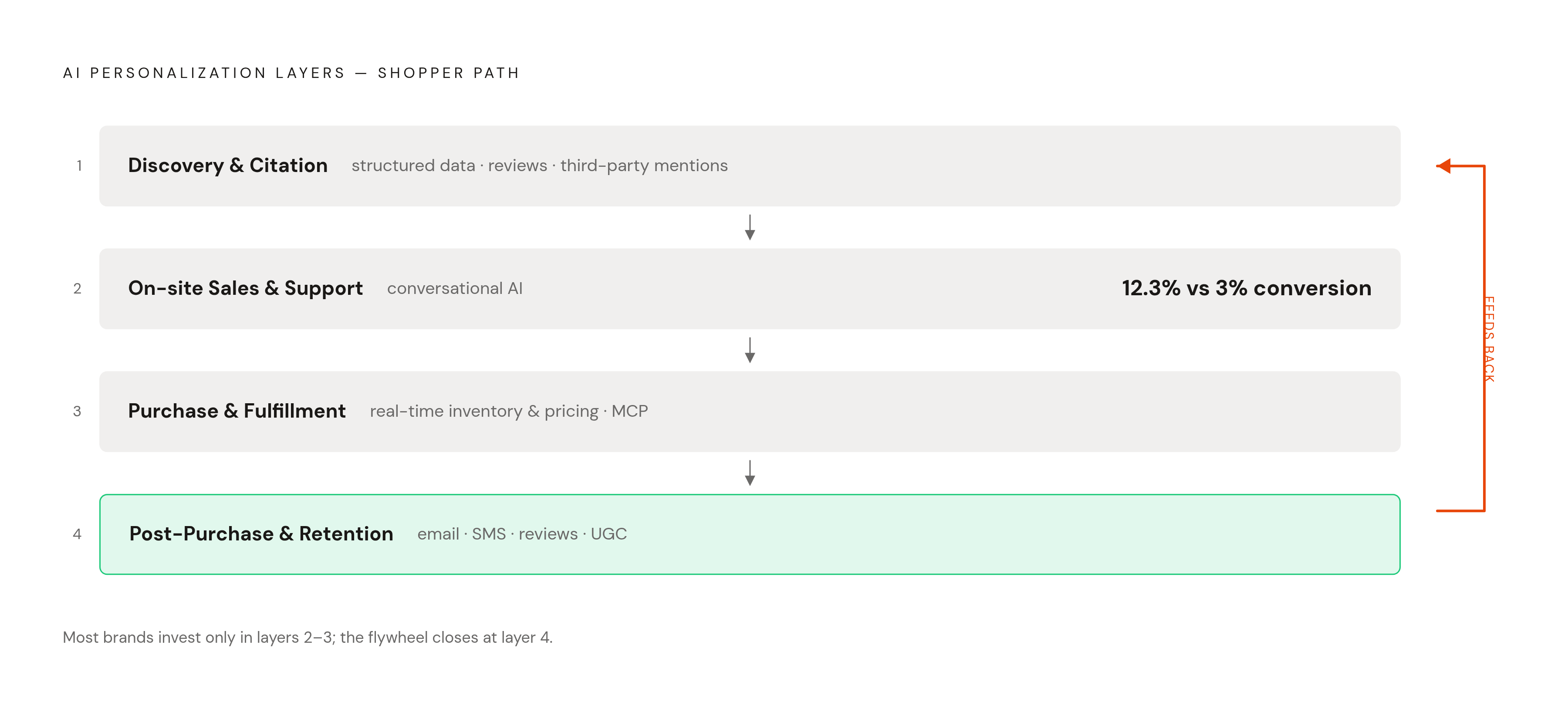
Putting the pre-site and on-site pieces together, AI personalization in DTC turns out to be a stack of distinct layers rather than one technology, and each layer operates at its own point in the shopper's path. Most brands have built coverage for only one or two of those layers, which is part of why so many of them misjudge where their AI investment should go.
The earliest layer is discovery and citation, covered in the sections above: the structured data, reviews, and third-party mentions that let an AI assistant surface a brand at all before a shopper ever visits its site. Sitting just after that is the on-site sales and support layer, the conversational systems that greet an arriving shopper, answer product questions, match them to the right SKU, handle objections, and step in to recover a session before it's abandoned. The fourfold conversion gap between AI-assisted and unassisted sessions lives in this layer, and most of the concrete numbers in this piece come from it.
Past the purchase itself sits a fourth layer: post-purchase intelligence and retention, covering the AI-driven email, SMS, and recommendation work calibrated to a customer's purchase timing, browsing behavior, and preferred channel. This layer does more than retain customers. It's also where review prompts and user-generated content get collected, and that content feeds straight back into the citation layer that determines AI discoverability. The loop closes on itself: shoppers who arrive through an AI referral and convert go on to produce the reviews, the Reddit mentions, and the UGC that train the next round of AI responses other shoppers will see. Post-purchase touchpoints aren't only retention plays under this model. They feed into whether the next shopper's AI conversation surfaces the brand.
Connectivity makes agent-based shopping possible in the first place, and it underlies all four layers. Anthropic's Model Context Protocol, known as MCP, gives AI agents a way to pull real-time inventory, pricing, and product detail directly from a brand's systems. An emerging consensus has settled around a division of labor here: MCP handles tool integration, while a separate protocol known as A2A handles coordination between agents.
Why last-click attribution undercounts AI personalization
Most of the DTC brands that have already deployed AI personalization are still measuring its impact through last-click attribution, and that method systematically undercounts what AI personalization actually contributes. Most AI-assisted interactions happen somewhere in the middle of the shopper's path, not at the final click that attribution models are built to credit, which is structurally why the method undercounts it.
The pre-site layer makes this especially hard to see. A conversation inside ChatGPT or Perplexity leaves behind no pageview, no session cookie, nothing a last-click model can register. A purchase shaped entirely by an off-site AI conversation appears in a brand's analytics as direct traffic or as unattributed, with no clear source recorded.
The on-site layer runs into a related but separate problem. Meta, Google, and TikTok all report return-on-ad-spend figures that can overstate real profitability, because each platform's attribution model tends to claim full credit for the same conversion. Added together, the revenue these platforms claim credit for can exceed the brand's actual total revenue by a meaningful margin, and that alone is reason enough to treat any single platform's reported ROAS with caution.
A more honest measurement framework replaces last-click with a few complementary approaches: session-level attribution tied to a conversation ID where that's available, post-purchase surveys that simply ask shoppers where they first heard about the product, branded search volume tracked over time as a rough proxy for off-site AI citation impact, and direct comparison of conversion rates between sessions that involved AI interaction and sessions that didn't. None of these is perfect on its own, but together they catch a lot of what last-click attribution misses.
The metrics DTC brands prioritize are shifting as a result, moving toward conversion rate, customer acquisition cost, customer lifetime value, and average order value. These are profitability-focused numbers, and the shift toward them means a brand is maturing past visibility metrics like impressions or session counts, which were never built to capture what AI personalization actually does to a shopper's path to purchase. The most reliable way to validate any of these numbers is to compare AI-engaged shopper cohorts against a brand's own historical baseline, not against some industry-wide benchmark pulled from a different brand's traffic mix. That comparison, run against a brand's own numbers, is what produces a result worth acting on internally.
A brand's AI personalization stack in 2026
Put together, the picture that emerges is a brand that treats AI personalization as four connected layers rather than one feature to bolt onto a product page. The first layer needs structured, machine-readable product data and a genuine presence in the reviews and third-party discussion that AI systems cite, because that's what gets a brand matched to a shopper's intent before the first click ever happens. The second layer requires on-site conversational systems built to answer questions, match shoppers to the right product, and recover abandoning sessions, with humans kept in charge of setting the goals and handling the edge cases the AI agent can't. The third layer requires post-purchase systems that don't just retain the customer who already bought, but actively generate the reviews and UGC that feed back into the first layer for the next shopper.
Most DTC brands today have built real strength in one or two of these layers and left the rest untouched, usually the on-site layer, because that's where the vendor tools and the clearest ROI case have existed the longest. The brands that will keep growing from here are the ones that treat the pre-site citation layer and the post-purchase flywheel as seriously as they've already learned to treat the shopping cart on their own site, since that's where the structural reallocation documented throughout this piece is still unfolding.