Measuring AI Sales Agent Revenue Attribution Honestly
Current tracking systems can't see AI agent sales, hiding the channel's actual revenue performance.

Most AI sales agent revenue attribution in circulation today is wrong by design, not by accident. The tools that brands use to measure online sales were built around a human clicking through a browser, and that assumption no longer holds for a growing share of transactions; dashboards showing zero AI-driven revenue understate the channel's actual size.
Why standard attribution infrastructure cannot see agent-initiated purchases
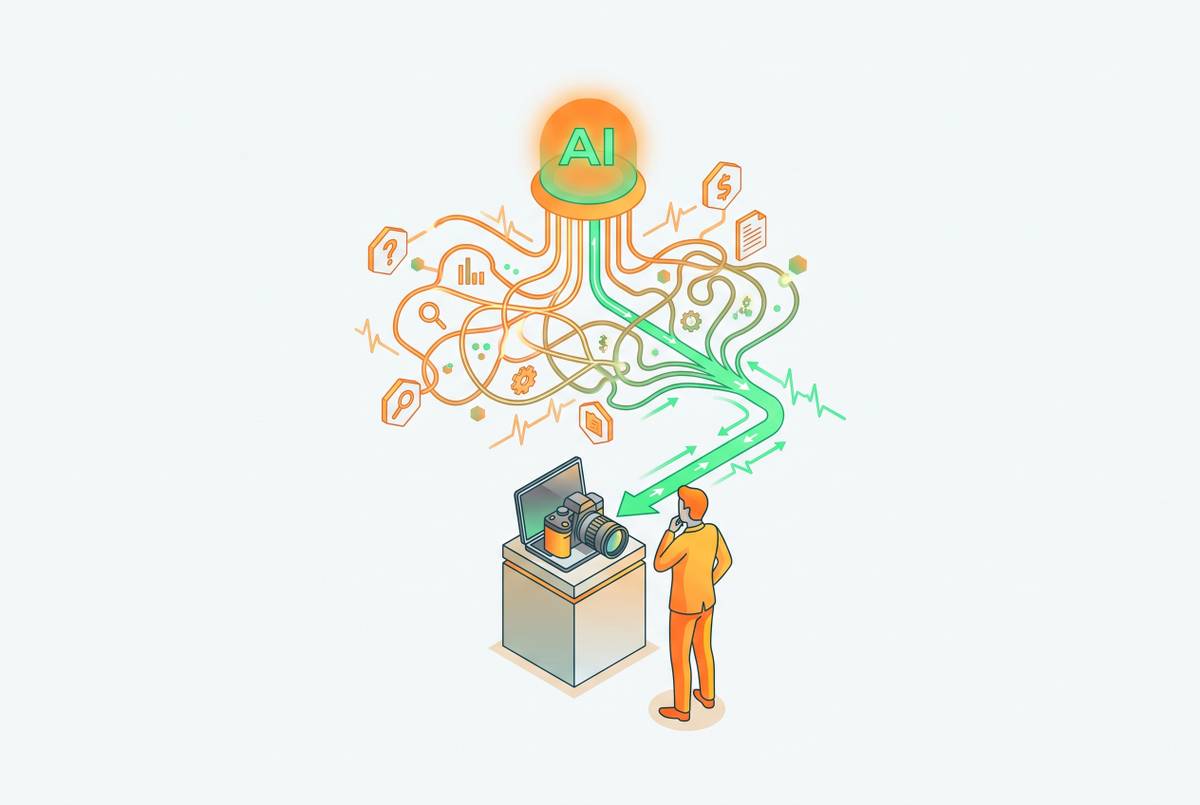
The entire attribution stack that DTC brands rely on, GA4, Meta Pixel, TikTok Pixel, Google Ads conversion tracking, was built on one premise: a shopper opens a browser, loads a page, clicks through a funnel, and lands on a thank-you page where a pixel fires and logs the sale. AI shopping agents don't follow that path. When an agent queries a storefront's API, it pulls product data and completes checkout right inside a chat interface, using a stored payment method. No browser window opens. No JavaScript runs. No cookie gets set. No thank-you page ever loads to trigger the pixel that was supposed to record the sale.
The old tracking chain breaks at every point. GA4 shows nothing. Meta Pixel shows nothing. TikTok Pixel shows nothing. Google Ads conversion tracking shows nothing. The order exists in the brand's order management system and the revenue has landed, but the attribution layer records zero, because the mechanism it depends on, a browser session, never occurred.
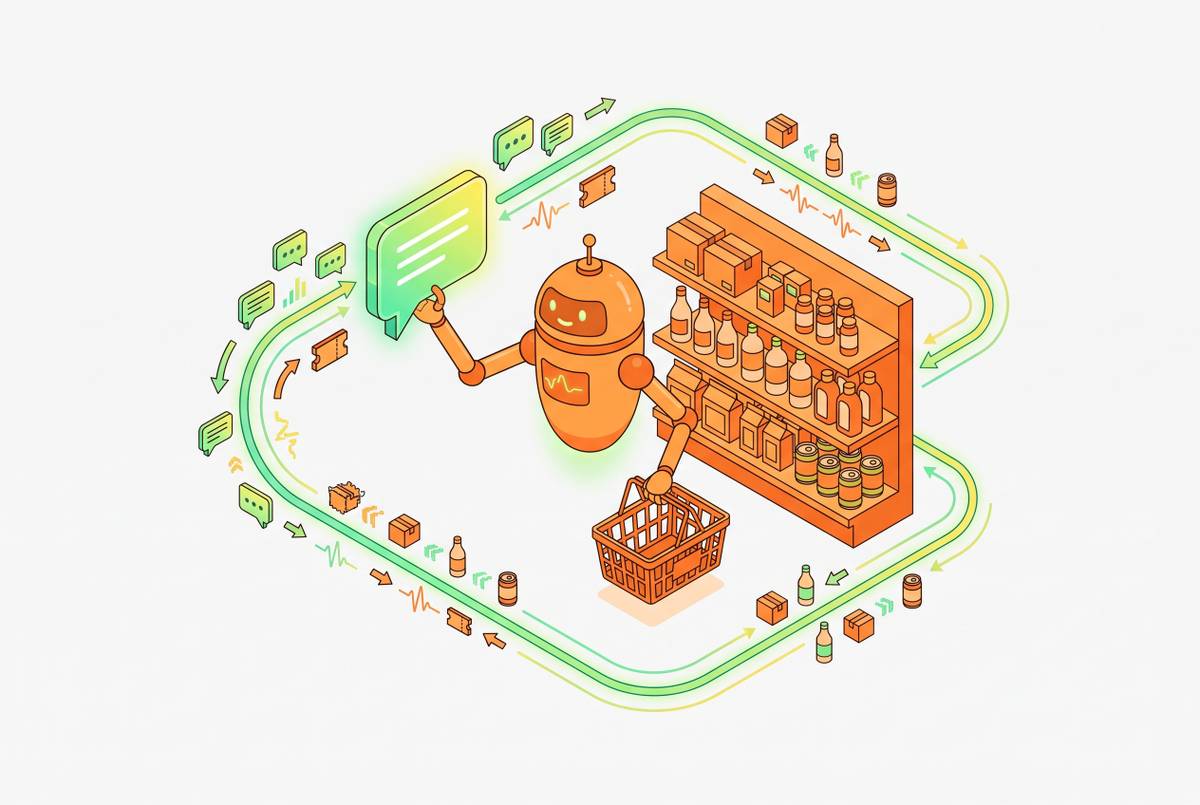
Each AI shopping channel handles the handoff a little differently, but the underlying pattern repeats: product data gets pulled through an API, the purchase gets completed inside the chat window, stored payment credentials do the work a checkout form used to do, and none of the identity-capture steps that analytics platforms depend on ever fire. Google AI Mode comes closest to an exception, since it sometimes links users through to a merchant's own site instead of closing the loop inside the chat. But those outbound links carry a noreferrer attribute, which strips the referrer data a browser would normally pass along, so even if a human lands on the merchant's site after an AI Mode session, standard tracking can't reliably credit that visit to it. Referrer data either disappears or appears generically as "google.com," indistinguishable from ordinary organic search traffic.
The practical damage compounds in a particular way. Ad platforms run on performance feedback: creative and channels that show strong conversion numbers get more budget, and those that appear to underperform get cut. When an entire revenue channel reports as zero because the tracking infrastructure can't see it, the optimization algorithm treats that invisibility as poor performance and reallocates spend away from a channel that may be driving some of the strongest sales a brand has. The system is actively punishing AI commerce for being invisible to tools that were never built to see it.
How much AI-referred traffic is already flowing, and why it converts differently from organic
The traffic sitting inside that blind spot isn't a rounding error. AI-referred sessions already make up a fast-growing share of DTC traffic, and that traffic converts above the site average for most brands measuring it. The attribution gap described above is hiding what is, in many cases, already a brand's best-performing acquisition channel.
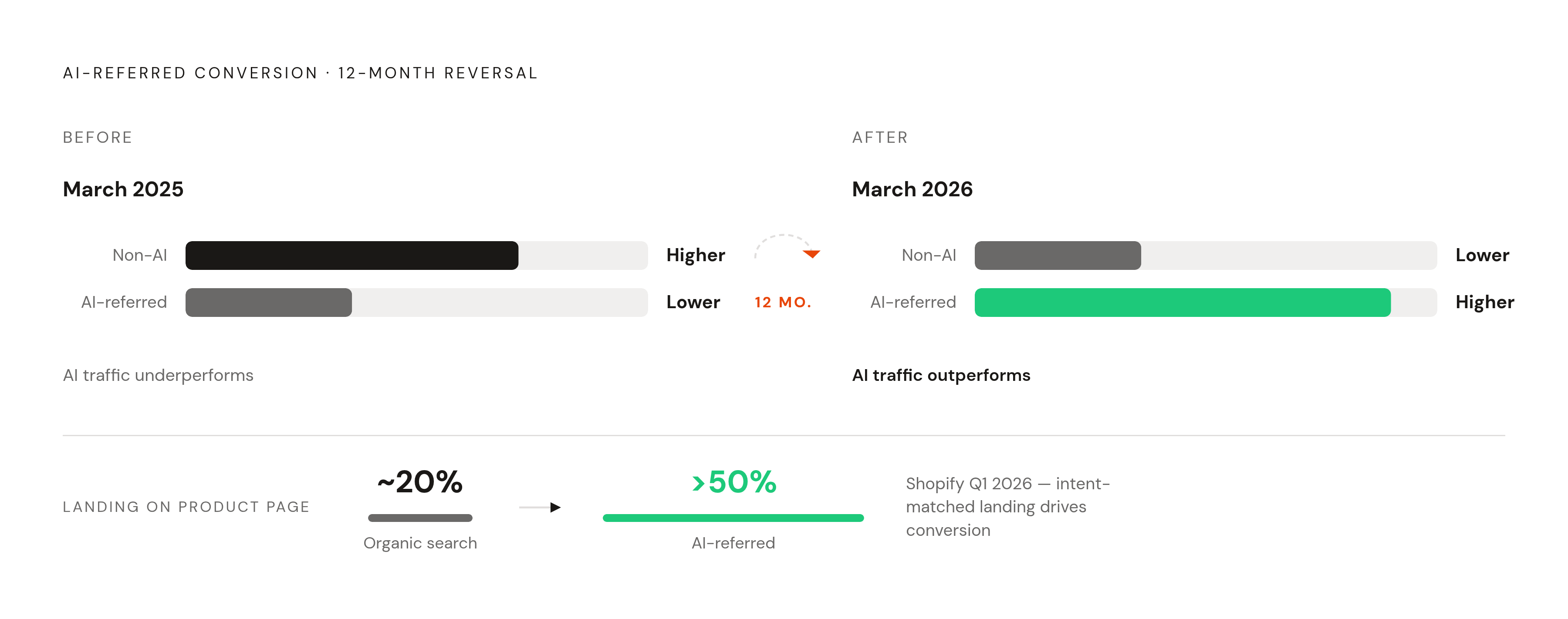
The gap traces to a specific shift in behavior: a shopper who asks ChatGPT or Perplexity for a product recommendation has already done a version of the research and comparison work that a typical funnel is designed to walk someone through. By the time that shopper reaches a merchant's site, the conversation has already done the persuading. Shopify's Q1 2026 data on AI search bears this out directly: more than half of AI-referred sessions land a shopper straight onto a product page, compared with roughly one in five sessions from organic search. That shopper arrives pre-qualified, so it skips the browse-and-discover phase organic traffic typically has to pass through.
Adobe's independent Q1 2026 data tells a similar story from a different angle. AI-referred traffic to U.S. retail sites grew faster year over year than non-AI traffic, and by March 2026 it was converting at substantially better rates than non-AI sessions. A year earlier, in March 2025, the relationship ran the other way, with AI traffic converting worse than the rest of the site. The flip in roughly twelve months says something about how quickly both the technology and the shopper behavior around it have matured.
A separate dataset, pulled from ten Shopify stores over multiple years, found AI assistant traffic converting well above site average, and most of that revenue came from first-time customers. The researchers behind that dataset describe their own numbers as a floor rather than a ceiling, because the measurement approach they used still misses a meaningful share of AI-influenced activity. On-site conversational AI tells a parallel story: shoppers who engage with a chat interface directly on a brand's own site convert at rates far above shoppers who don't, and the ones who come back for a second chat session tend to spend more per order than they did the first time.
Even those figures likely understate the real size of the shift. Most AI search sessions never produce a click to a website. A shopper reads the AI's answer, forms a preference, closes the window, and buys later through a search, a direct visit, or a bookmark that looks, to any attribution system, like it has nothing to do with AI. The influence shapes the sale but disappears from the data by the time the sale closes, so the gap in the previous section is larger than any single dashboard metric can show.
How Vendor-Reported Lift Figures Get Inflated
Given how much of this traffic sits outside standard measurement, it matters a great deal where the big headline numbers about AI commerce actually come from. Most of the figures circulating about AI sales agent revenue are self-reported by the platforms that built those agents, measured over short windows, and built without holdout controls that would isolate the AI effect from everything else happening in a brand's business at the same time. That's a methodological weakness, and it's the weakness, not the underlying channel's actual performance, that produces the dramatic lift numbers making the rounds.
Vendor case studies touting large conversion lifts tend to share a structure: a short post-implementation window, sometimes as brief as seven days, compared against a prior period with no attempt to control for seasonality, concurrent promotions, or shifts in traffic mix. A seven-day comparison during a sale event or a seasonal spike will produce an impressive-looking lift regardless of whether the AI feature did anything.
A more skeptical data point comes from an analysis of ten Shopify stores conducted by Ethercycle, which used the platform's own last-non-direct-click attribution model across two full years of real order data. That analysis found AI traffic and AI-driven revenue at a fraction of a percent of total sessions and total revenue, and that figure directly challenges the louder claims that large shares of e-commerce transactions are already AI-driven. Those louder claims tend to trace back to consumer surveys asking shoppers whether they've ever used AI while shopping, not to actual transaction data, and the gap between "have used AI at some point" and "AI drove this specific purchase" is enormous.
Both pictures can be accurate at the same time. AI-referred traffic converts at a premium, and the Ethercycle data doesn't contradict that. But the volume moving through that channel is still small enough, for most mid-market DTC brands in 2026, that its absolute contribution to total revenue remains modest. The field is earlier-stage than the breathless coverage implies, not fraudulent and not a dead end.
Williams-Sonoma offers the clearest positive example of how this should actually be measured. The retailer reported a 620% rise in revenue attributed to its AI assistant in Q2 2026. The number that matters there isn't the size of the jump so much as what it demonstrates: a large, sophisticated seller is already tagging, attributing, and reporting assistant-influenced sales with real channel-level discipline. That means the methodology behind that number is replicable by other brands, even if a 620% increase isn't a figure every brand should expect to reproduce.
A second distortion runs in the other direction. A Facebook campaign introduces a shopper to a brand, the shopper researches that brand weeks later by asking ChatGPT about it, and the eventual purchase is recorded with no conversion signal connecting any of those steps. Neither channel gets credit for its actual role in the sale, and the attribution system ends up understating the contribution of both paid social and AI search simultaneously.
Consumer surveys add a further layer of confusion. One recent study found that a strong majority of consumers already use AI somewhere in their shopping journey, whether for product ideas, summarizing reviews, or comparing prices, while only a small minority report having completed an actual purchase after an AI assistant referred them. So when survey-based claims talk about AI commerce, you should expect them to wildly overstate its transaction-level impact. Usage is widespread. Direct, trackable purchase referral is still comparatively rare.
The three-layer measurement stack that can replace guesswork with defensible data
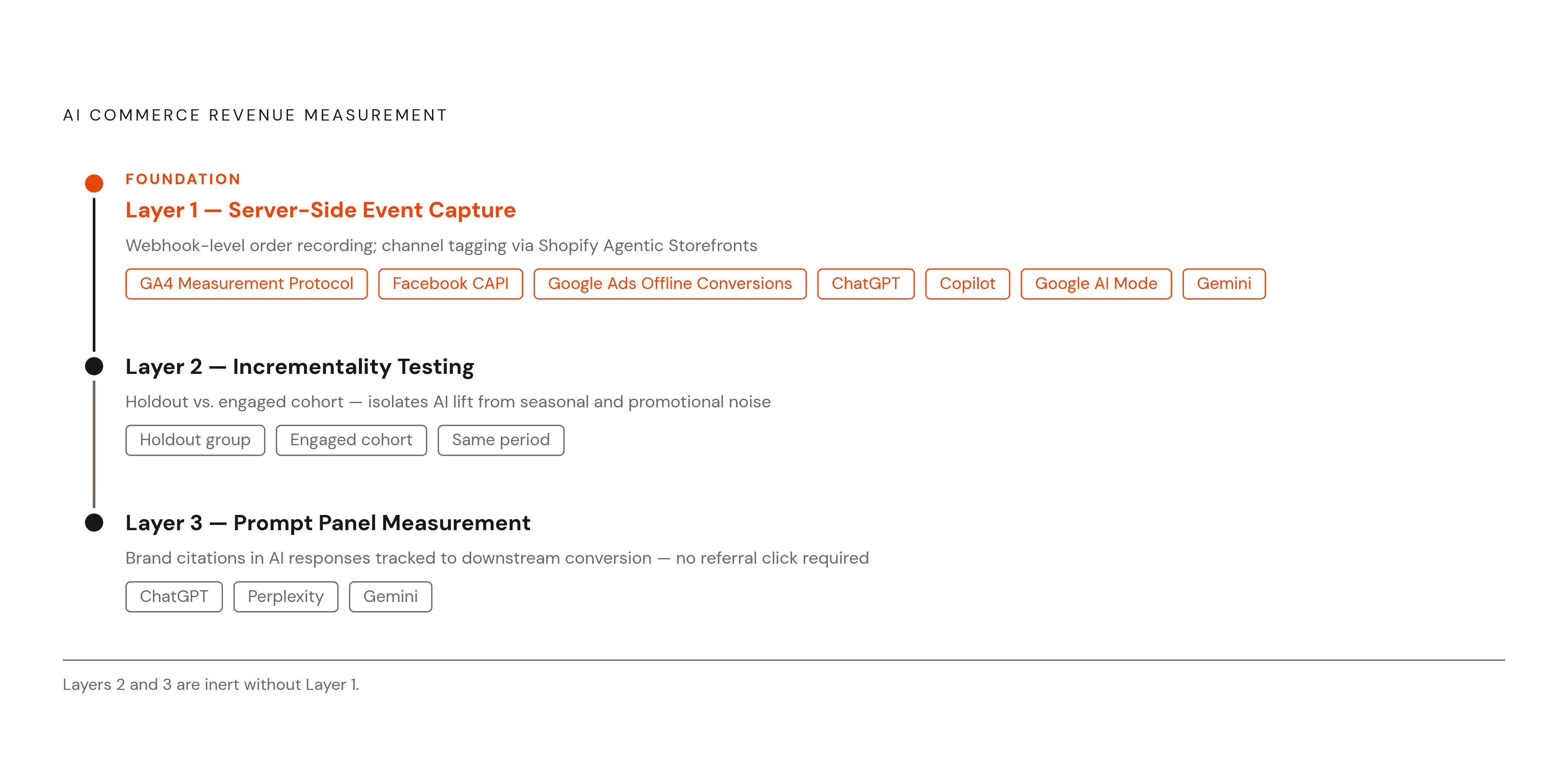
Fixing this requires accepting a basic fact: client-side tracking is structurally blind to agent-completed purchases, and no setting or plugin changes that. So honest measurement means you build a separate, server-side infrastructure that captures what the browser-based system never could, and even a well-built version of it in 2026 only produces careful estimates, not hard certainties. Brands should say that to their own teams and investors rather than pretend otherwise.
The first layer is server-side event capture, and it's the non-negotiable foundation everything else sits on. On Shopify, this means webhook-level order capture: the order gets recorded on the server the moment it completes, before any browser interaction would have been required, and that event then gets routed to GA4 Measurement Protocol, Facebook CAPI, and Google Ads Offline Conversions. WooCommerce has no native equivalent for agentic storefronts, so you need custom server-side tracking built at the hook level, specifically the woocommerce_payment_complete hook. Shopify's Agentic Storefronts go a step further, offering native AI attribution that tags orders by referring channel, ChatGPT, Copilot, Google AI Mode, Gemini, directly inside the merchant admin. That's as close to plug-and-play attribution as anything available in 2026.
The second layer is incrementality testing, which sidesteps the need for channel-level precision. Instead of trying to tag every single AI-influenced session, a brand builds a holdout group that doesn't get AI-influenced treatment and compares it against an engaged cohort over the same period. That comparison isolates the AI effect from seasonal swings and promotional noise in a way a simple before-and-after comparison never can. This is the methodology that separates honest measurement from the vendor case studies described earlier: a controlled period, a real baseline, and a comparison against a brand's own historical performance rather than an arbitrary pre-launch window. Figures built this way are the only kind a commerce team can actually defend in front of a CFO.
The third layer, sometimes called prompt panel measurement, exists because most AI-influenced revenue never produces a referral session. Brands need a way to track how their products get cited inside AI responses themselves, monitoring which brand and product mentions appear when ChatGPT, Perplexity, and Gemini answer relevant shopping queries, and then tracking downstream conversion from those citation paths even when no direct click connects the two. This layer requires you to understand how each engine actually selects products to recommend. ChatGPT favors products that show up in authoritative list mentions, awards, and high review volume, weighting structured data quality and third-party validation over the domain authority and backlink signals that used to matter for search rank. Perplexity leans on Schema.org product markup, full GTIN coverage, and real-time price accuracy as its primary signals, and gives an added visibility boost to products with in-platform checkout enabled. Because citation overlap across these engines is thin, a product that gets recommended by ChatGPT won't automatically show up in Perplexity or Gemini results, so gaps in any one platform's data feed disqualify a product on that platform specifically, regardless of how it performs elsewhere.
None of this infrastructure produces honest numbers without an organizational structure behind it. Brands succeeding at conversational commerce give the channel a dual reporting line: customer experience owns the quality of the interaction, while merchandising or digital commerce owns attach rate and conversion, and both sides get compensated against both metrics. If that structure is missing, the server-side data described above just lands in a dashboard that nobody is accountable for reading.
Building Attribution Infrastructure Now
Brands that build this measurement infrastructure now will have years of historical agent-revenue data by the time industry-wide standards catch up, and that head start compounds in a way a brand starting from zero later cannot recover.
The case for acting now is structural. The industry is still an estimated 18 to 24 months away from full attribution maturity. Brands investing in server-side infrastructure today will have accumulated that entire stretch of historical agent revenue data by the time standardized frameworks arrive, giving them a real baseline to validate new tools against. Brands that wait until the tooling matures on its own will be starting from zero at that point, with no historical data to compare against and none of the compounding advantage that comes from having measured the channel honestly from the start.
The protocol landscape is also consolidating in a way that lowers the technical barrier to acting now. Four protocols dominate agent commerce: ACP, built by Stripe and OpenAI; UCP, built by Google and Shopify; MCP, built by Anthropic; and AP2, built by Google. Shopify is enrolled as a native co-developer and distribution partner for UCP specifically, so brands already running on Shopify inherit a meaningful share of agentic readiness by default. That inheritance weakens the usual argument for waiting, since the technical overhead of getting started is lower than it would have been even a year earlier. The brands that treat this moment as a build phase are the ones that will have real data to work from when the rest of the industry finally catches up.