How AI Buyer Agents Make Purchase Decisions
Autonomous agents score on structured data, not brand presence or visual appeal.
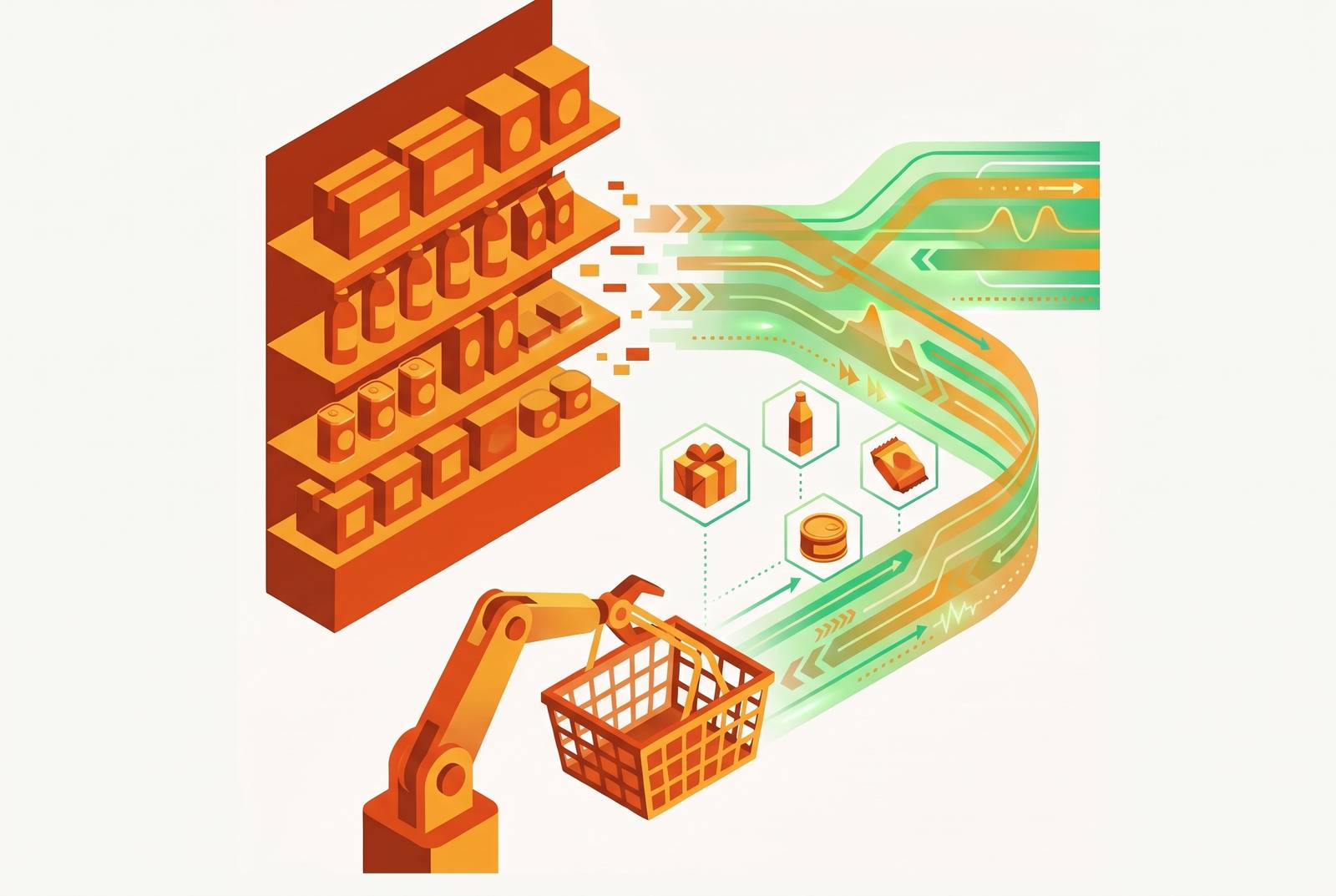
A growing share of purchases are now decided before a human eye ever lands on a product page. AI buyer agents do not browse storefronts the way a person does: they query APIs, pull structured data, score it against a set of criteria, and in some cases execute the transaction without a shopper ever touching a cart button.
That is an architectural change, not a gradual drift. The entire purchase journey, awareness, comparison, evaluation, checkout, now runs inside a language model sitting between the consumer and the seller. A shopper who wants wireless headphones can hand the whole sequence to an agent with a single natural-language request, and the agent does the filtering, the comparison, and the decision. Hero images, category navigation, and on-site merchandising have no role in that sequence, because no browsing happens. This piece is about what replaces the storefront: the signal hierarchy an agent actually scores against, and what a brand has to get right to be chosen before a human ever sees the results.
The five levels of AI autonomy
Most tools sold today as shopping agents are not shopping agents in the full sense. They are reasoning systems that still wait for a person to click "buy," and treating them as if they already transact independently leads brands to prepare for the wrong fight.
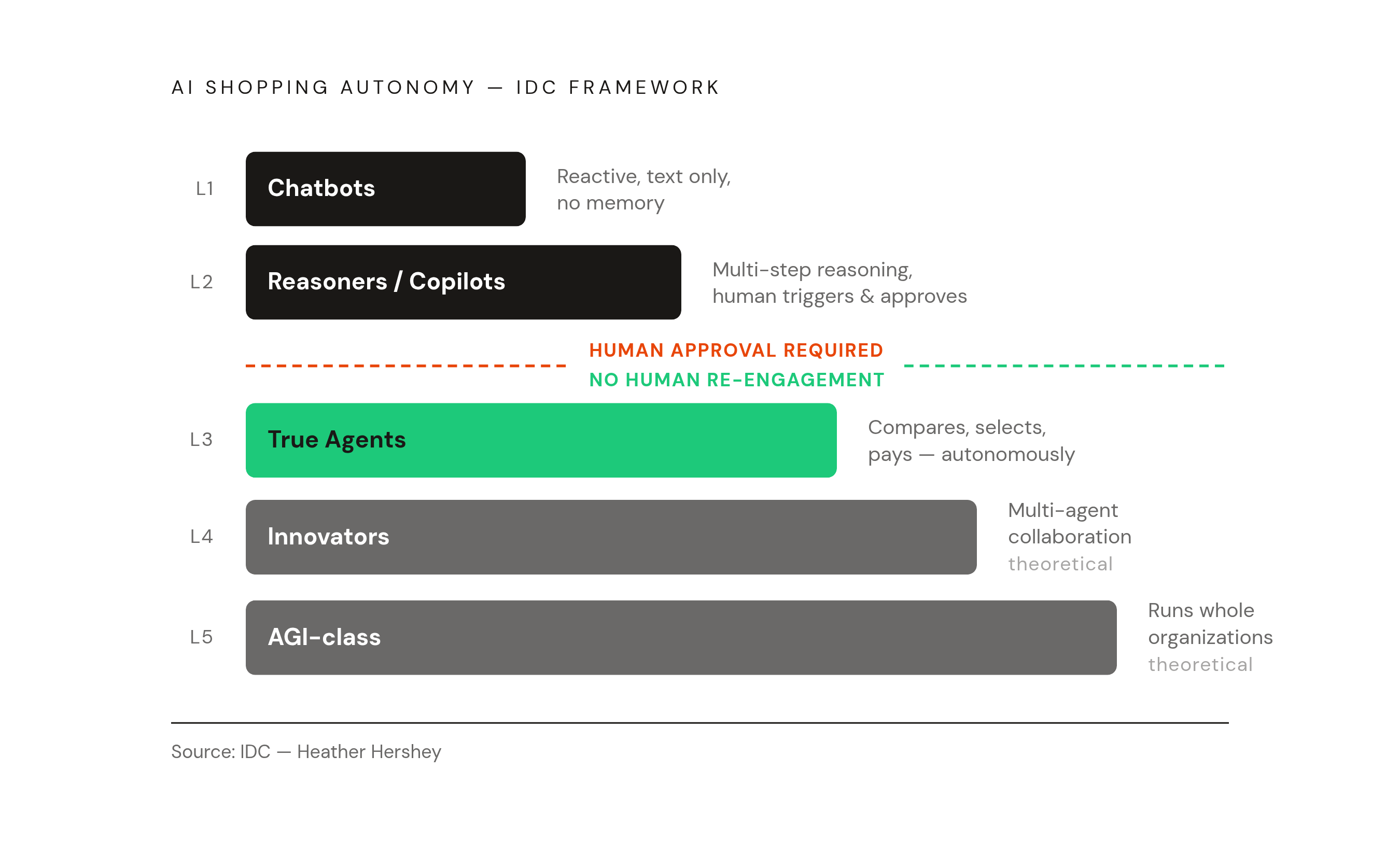
IDC analyst Heather Hershey's five-level framework, adopted by OroCommerce, gives the clearest operational map of where the industry actually stands. Chatbots occupy Level 1: reactive systems with no memory, able to generate text and nothing more. Level 2 covers reasoners, often branded as copilots, able to chain together multi-step reasoning, but they still need a human to trigger the process, and execution of the plan they produce still cannot happen on their own. Level 3 is the true agent: a system that uses digital tools to carry out a multistep plan on its own, from comparison through payment. Level 4, described as "innovators," involves multiple agents collaborating and inventing new processes, and remains theoretical. Level 5 is theoretical too, with AGI-class systems that can run whole organizations without a human stepping in.
Return to the headphones example. A Level 1 chatbot can describe headphones if asked. A Level 2 copilot can compare five models, rank them by stated criteria, and hand the shopper a recommendation, but a person still has to approve the purchase. A Level 3 agent takes that same comparison and completes the purchase itself, so no re-engagement is required. The test that separates the two is simple: watch where a "shopping agent" demo requires human approval. If a person still clicks "buy," the system is a Level 2 copilot, whatever the vendor calls it.
AI-powered product discovery, chatbots that add items to a cart for a human to check out, inventory reorder suggestions, AI-generated purchase orders routed for human sign-off, recommendation engines built on browsing history, voice assistants that jot down a shopping list, none of these execute a transaction on their own. Consumer attitudes track the same gap: only a small minority of shoppers currently say they would trust an agent to act fully on their own, so most deployments are Copilot-class both by choice and by capability.
The distinction matters because the decision logic a brand optimizes for differs by level. A Copilot still has to be found and surfaced during the research phase, where a human remains in the loop and brand presence in reviews and comparisons still counts. A true Level 3 agent has to be satisfied on structured signals alone, because the shopper may never see the comparison it ran. The industry mostly operates at Level 2 today, but the infrastructure for Level 3 is already being assembled alongside it, so brands need to build for both.
The signal hierarchy a Level 3 agent scores against
Once an agent has the authority to transact, its evaluation process is mechanical and unsentimental. It has no memory of a brand's advertising history and no preference for a familiar logo. It pulls structured data: price, availability, shipping speed, trust scores, and return flexibility, treats each as a scored variable, and the listing with the best-quality signals wins the sale, regardless of brand recognition.
Delivery infrastructure sits inside that scoring, not downstream of it. When an agent compares merchants, delivery speed, cost, reliability, and pickup options enter the selection criteria before the transaction executes, the same way price does. A listing that says "ships in 3 to 5 business days" loses to a competitor offering a precise, machine-readable delivery commitment, because the agent can score precision and cannot score vagueness.
That scoring now runs on real infrastructure. Google's Universal Commerce Protocol launched in January 2026, with Shopify as a co-development platform alongside Wayfair, Target, Etsy, and Walmart among the founding partners. So an agent gets a standard way to query merchant data directly, instead of scraping a storefront built for human eyes.
The hierarchy also shifts depending on which AI surface is doing the evaluating. Perplexity runs a Merchant Program where brands submit structured product catalogs directly for inclusion in its AI-driven discovery results, and it rewards brands that feed it clean data over brands that merely rank well elsewhere.
A second, less visible dynamic runs alongside all of this: the consumer's own description of what they want. University of Iowa research found that when a buyer agent shops on behalf of a verbal consumer profile, the seller-side system it negotiates with can infer that shopper's willingness to pay from the dialogue alone, nearly one-for-one. The researchers call this "preference leakage," and it is a direct consequence of delegation itself: the richer the description a shopper hands to an agent, the more precisely a seller-side system can tailor its price to the ceiling that description reveals. There is no prompt-level fix for this. Closing the gap requires architectural changes on the seller side that trade personalization against the shopper's pricing privacy. For brand operators, this is a risk to understand rather than a lever to pull: knowing that agent-to-agent negotiation can leak a buyer's ceiling shapes how that negotiation layer gets built going forward, not how a single sale gets priced today.
Where brands disappear before human visibility
A brand can rank near the top of Google and be entirely absent from AI-driven discovery, because the two systems score on different inputs, and most brands have no idea the gap exists. Audit data shows a majority of brands that rank well on Google are not cited by AI systems at all, which confirms the two ranking systems are genuinely distinct rather than loosely correlated.
The failure is invisible in the tools most brands already check. If a shopper asks ChatGPT or Perplexity for a recommendation and the brand never comes up, there is no session recorded, no bounce, no click, nothing for a last-click report to catch. Standard attribution tools already miss AI-assisted discovery, word-of-mouth, and true organic demand, so this loss just adds to a blind spot that was already there. Brands that see paid channels performing well often stop asking why organic and AI-referred revenue has gone flat, because the paid numbers look fine on their own.
Each of these failures maps to a specific signal the agent needed and didn't get. Product descriptions that stay generic and never answer a direct use-case question give an agent nothing to score against a competitor's more specific listing. A product detail page with no Review or AggregateRating schema is invisible to Perplexity's structured ingestion, no matter how strong the organic copy around it reads. Vague shipping and availability fields leave an agent unable to score delivery speed at all, so it defaults to whichever competitor supplied a number. A brand with no presence in review sites, expert publications, or authoritative list content is missing the exact signals ChatGPT weighs when it selects which products to mention, regardless of how that brand performs in a Google search.
How buyer agent logic changes the on-site conversion moment
A shopper who lands on a brand's own site has frequently already had their decision shaped by an agent's evaluation upstream, whether that agent is a full Level 3 system or a Copilot doing research on the shopper's behalf. Brands whose on-site experience matches that upstream logic convert these shoppers at materially higher rates than brands that still present a storefront built for undirected browsing.
Shopify data shows AI-referred visitors convert at a materially higher rate than organic search visitors, and they spend more per order. Envive reports that chat-engaged shoppers convert at a 4x lift over shoppers who never chat. The pre-qualification an agent runs upstream shortens the decision a shopper still has to make once they arrive.
To capture that lift, the on-site layer has to answer the same structured questions the upstream agent already asked. A shopper, or a Copilot doing research for one, needs to ask "will this work for X?" and get a precise, sourced answer rather than a generic product blurb. That kind of prompting works: suggested product questions, recommendations triggered directly by search results, and "Ask Anything" input bars together drove 50% of conversation-driven purchases during BFCM 2025, an even split against purchases that started from a shopper's own question.
The highest-leverage moment in this whole loop is the in-chat close. Payment links, tokenized wallets, and integrated checkout APIs let a shopper complete a purchase without leaving the conversation they started, so the brands posting the strongest conversion rates in conversational commerce are the ones that never ask the shopper to leave that thread to finish buying.
Shopify's 2026 AI strategy is built around that full loop rather than any single piece of it: running the business through an assistant, building and editing the store through prompts, distributing products into AI channels, helping shoppers buy inside a conversation, testing storefront changes against simulated shoppers, and giving developers an agent-ready platform to build on. Sidekick, Shopify's assistant, is now multimodal, handling both voice and visual input, which extends the in-chat close to shoppers who would rather describe or show what they want than type it.
Measuring wins and losses in agent-mediated commerce
Standard attribution tools cannot see most of what this piece has described. A brand can be losing a growing share of sales to a better-structured competitor and find nothing in its dashboard that says so. The channels attribution tools chronically miss, AI-assisted discovery, word-of-mouth, true organic demand, are exactly the channels this new decision layer runs through. If a shopper asks an AI assistant for a recommendation before touching any paid channel, that influence never enters the attribution model.
Platform over-attribution makes the problem worse rather than better. Reported ROAS figures from Meta and Google can significantly overstate how much those campaigns actually contribute, so a campaign that looks strong on-platform may deliver far less real lift than what would have happened anyway.
If brands want an honest read, they need to combine three independent methods, not trust any single number. Attribution.ai runs marketing mix modeling, incrementality tests, and post-purchase surveys against Shopify stores, and attaches a confidence interval to every figure it produces, withholding a read entirely where the evidence doesn't yet support one. Its geo holdout testing produces causal lift estimates rather than simple correlations. Correlation is what a last-click report already gives a brand, and correlation fails to catch an agent-mediated sale. Post-purchase surveys serve as a check on the model rather than a standalone answer, reconciling what a shopper says drove their purchase against what the model inferred. Readiness gates label every measurement by the method behind it and block budget recommendations until the supporting evidence clears a set threshold, which keeps a brand from shifting spend on a number nobody has actually proven yet.
The brands that will be chosen by agents are the ones whose data an agent can actually read: precise shipping commitments, structured review data, catalogs submitted directly to the programs built to ingest them. The brands that measure their way out of the last-click blind spot are the only ones who will know, in time to act on it, whether that work is paying off.