Buyer Agent Readiness Audit for Shopify Stores
AI agents rate your store differently than Google does, and most Shopify stores fail the test.

Shopify storefronts are now being read by machines that never load a single image or scroll a single pixel. ChatGPT, Gemini, Perplexity, and Copilot parse product feeds, schema markup, and review data to decide what to recommend, and a storefront that looks polished to a human buyer can be functionally invisible to an AI agent. This piece lays out what a Shopify merchant needs to audit, section by section, to close that gap before it costs more sales than anyone is currently tracking.
The audit runs across six areas, each mapping to a different signal that AI shopping assistants read at query time. Audit area 1 is product feed completeness: titles, descriptions, and structured attribute fields like material, size, and compatibility need to hold actual data rather than supplier shorthand or marketing copy, with zero suppressed products in Google Merchant Center. Audit area 2 is schema markup, specifically JSON-LD Product, AggregateRating, BreadcrumbList, and FAQPage schema on every product and policy page, verified at the individual product-page level through Google's Rich Results Test rather than the homepage alone. Audit area 3 covers review coverage and third-party citation signals, confirming that review apps output structured schema crawlers can actually read and that the brand appears in independent editorial content like gift guides, comparison posts, and relevant Reddit threads. Audit area 4 is pricing accuracy and inventory freshness: prices must match exactly across the storefront, the Google Merchant Center feed, and any other submitted feed, out-of-stock SKUs must be pulled or marked with availability schema, and feed refresh cadence must keep pace with actual inventory turnover. Audit area 5 checks brand voice and policy accuracy in crawlable text, meaning return policy, shipping terms, and sizing guidance each need a dedicated, indexable page in plain language rather than buried paragraphs, images, or video. Audit area 6 is checkout and agent transaction readiness: the Google AI Mode opt-in inside Shopify admin needs to be confirmed, the ChatGPT feed connection verified error-free, and order tagging set up to identify which transactions originated from an agent channel.
Why does ranking well on Google not guarantee visibility in AI shopping assistants?
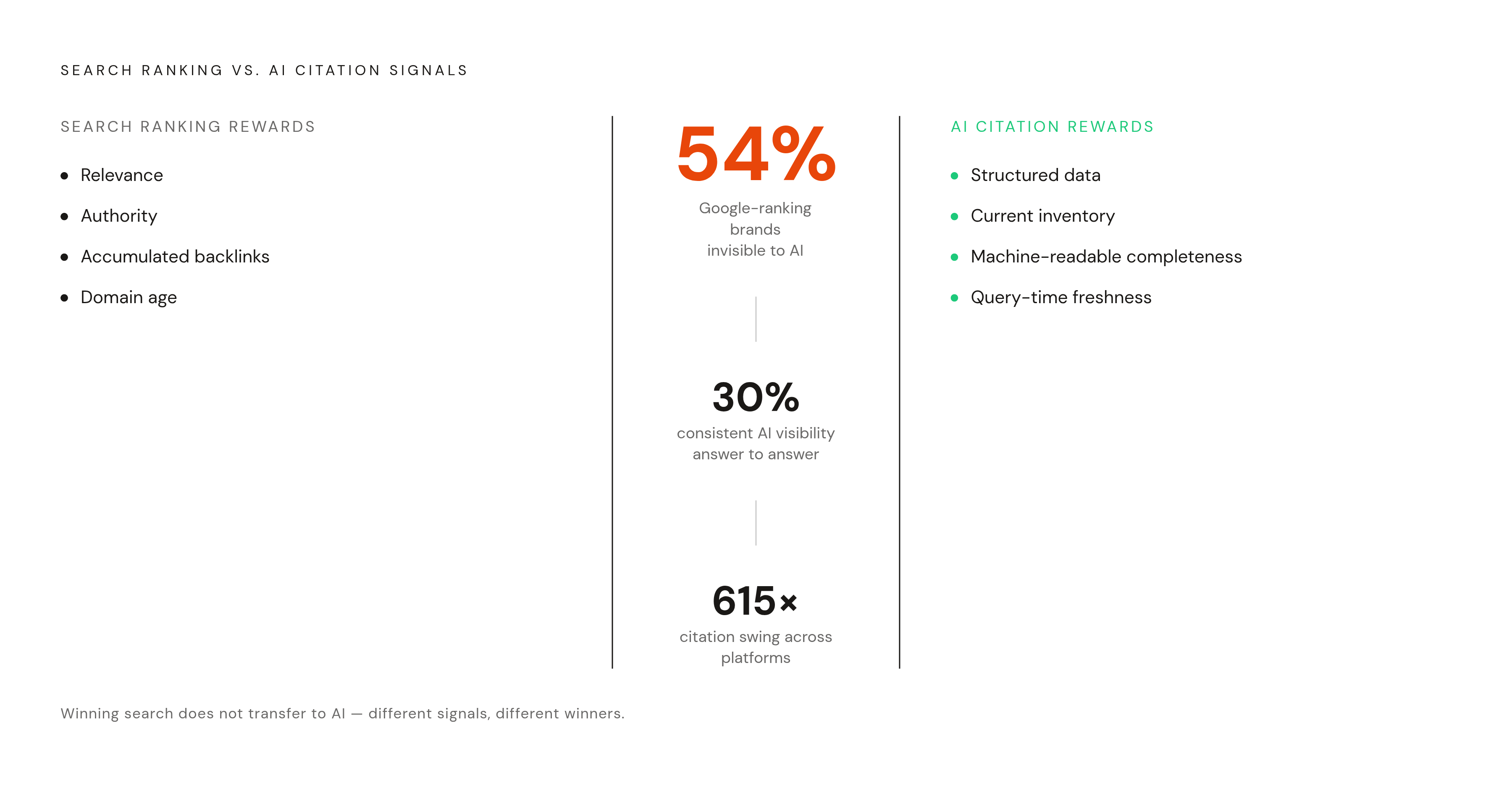
Audit data cited by NudgeNow found that 54% of brands ranking well on Google are not cited by AI systems at all. That number alone should unsettle anyone who has spent the last decade treating search rank as a proxy for discoverability, because it means the correlation between the two has effectively broken.
The reason is structural. A well-written title tag, a solid backlink profile, and years of domain authority tell Google's crawler that a page deserves to rank. None of that tells an AI agent what the product is made of, what sizes it comes in, or whether it's in stock right now. Search ranking rewards relevance and authority signals accumulated over time; AI citation rewards structured, current, machine-readable completeness at the moment of the query. Those are different scoring systems, and a merchant can win one while failing the other completely.
The inconsistency compounds fast. Per NudgeNow's research, only 30% of brands maintain consistent AI visibility from one answer to the next, and citation volumes can swing by a factor of 615 between platforms. A brand cited confidently by Gemini might not appear at all in a Perplexity answer to the nearly identical question, because the two systems are weighing different inputs entirely.
McKinsey research puts a number on what that instability costs: 42% lost deal consideration when product data is missing from an AI response. That is not a rounding error. Every query an agent answers without the merchant's product in the mix is a small, silent leak, and those leaks add up over a fiscal quarter in ways a traffic dashboard won't show unless someone is looking for them specifically.
AI readiness sits alongside SEO as a second discipline with its own criteria, and merchants who treat it as an SEO subcategory are going to keep missing the gaps that actually matter. The rest of this piece is built around one question: which signals does an agent need, and where exactly are they missing on a given Shopify store?
The scale of the shift Shopify merchants are already inside
Adobe Analytics measured a 4,700% year-over-year jump in generative-AI traffic to U.S. retail sites between July 2024 and July 2025, a figure large enough that it reads like a typo the first time it's encountered. It isn't, and the numbers below show why.
Inside Shopify's own ecosystem, the pattern holds. AI-attributed orders on Shopify grew 11x between January 2025 and March 2026, according to NudgeNow, a trajectory that has prompted platforms like Kinect, a DTC-focused AI sales and catalog intelligence layer, to build specifically around making Shopify catalogs readable by those agent surfaces. Those are checkout completions happening now, sourced from agent referrals on infrastructure Shopify merchants are already running.
Consumer behavior is moving in the same direction on a longer runway. Braze's Retail Customer Engagement Review projects agentic shopping adoption climbing from 19% in 2025 to 46% by the end of 2026, which means close to half of shoppers could be delegating some portion of product research or purchasing to an agent within roughly a year.
Merchant readiness has not kept pace. Checkout.com's June 2026 research found that 89% of merchants say they're actively preparing for agentic commerce, yet 72% of those same merchants admit consumers will move faster than they can adapt. That gap, between what merchants intend to do and what they've actually built, is exactly the space this audit is meant to close.
Audit area 1 — Product feed completeness and attribute coverage
The feed is the first thing an agent reads, and it's often the least maintained part of a Shopify store. A sparse feed doesn't just under-inform the agent; it produces confidently wrong descriptions, because the agent fills gaps with inference rather than leaving them blank.
Start with titles. Products imported from a supplier CSV years ago sometimes still carry SKU codes or internal naming shorthand instead of a real, buyer-facing title. Descriptions need the same scrutiny: they should read like answers to actual buyer questions (what is this for, who is it for, how does it fit) rather than a bullet list of specs copied from a manufacturer's sheet.
Attribute coverage is where most Shopify catalogs quietly fail. Material, size, fit, compatibility, certifications, whatever is decision-relevant in that specific category, needs to live in a structured field, not just in a photo or a paragraph of marketing copy. Google Merchant Center connection matters here too: the feed needs to be passing clean data with zero errors and zero suppressed products, because a suppressed product is a product an agent will never see regardless of how good its description reads on-site.
There's a distinction worth holding onto: feed optimization formats and distributes data that already exists, while enrichment means going back and filling in what's missing so an AI engine can identify the exact right SKU with confidence. Most Shopify merchants have invested in the former and skipped the latter entirely. Semrush research cited by Shopify confirms that structured product data, customer reviews, accurate pricing, and stock availability all directly influence whether products surface in Perplexity's answers, which makes attribute-level gaps a visibility problem, not just a data-hygiene one.
Red flags worth flagging specifically: descriptions duplicated across every variant with zero differentiation, color or material info that exists only in an image and nowhere in a data field, and default Shopify titles that were never touched after a bulk import. Each one is a small thing. Each one is also, multiplied across a catalog of a few hundred SKUs, the difference between an agent describing a brand accurately and an agent guessing.
Audit area 2 — Structured data markup and machine-readable signals on the storefront
Schema markup, specifically JSON-LD, is how a crawler or an agent reads price, availability, ratings, and product identity directly, without trying to interpret how a page is laid out visually. It communicates that information explicitly rather than leaving it to be inferred.
Product schema needs to be present on every product page, not just a handful of flagship listings or the homepage. Price, currency, and availability fields inside that schema need to be accurate and current; a stale price sitting in schema markup while the storefront shows a sale price is exactly the kind of mismatch that produces an agent quoting the wrong number to a buyer. AggregateRating schema should be populated wherever reviews actually exist, BreadcrumbList schema should reflect real category hierarchy, and FAQPage schema deserves particular attention because agents pull answers from FAQ markup directly and often verbatim.
Shopify themes generate some of this automatically, but the auto-generated version is frequently minimal, covering the bare legal minimum of the spec rather than what a serious audit would want in place. Running a page through Google's Rich Results Test or the Schema.org validator at the individual product-page level, not the homepage, is the only way to see the gap between what the theme actually outputs and what's technically possible.
The underlying principle carries through every part of this audit: agents read data, not design. A size guide rendered as a beautifully designed JPEG is invisible to a crawler. The same information sitting in a structured table or a schema field is fully legible. Missing or malformed schema forces an agent to guess at price, availability, and identity, and a guess wrong even once is enough to damage a buyer's trust in the brand, not in the agent that made the guess.
Audit area 3 — Review coverage and third-party citation signals
Perplexity weighs third-party citations heavily: Reddit threads, expert blog mentions, review-site presence. These function as trust signals the system uses to decide which brands make it into a recommendation and which don't. Amazon's Rufus does something similar, synthesizing review sentiment and Q&A content to build its shortlists, which means review volume and review quality are doing real ranking work, not just social proof.
The audit here needs to check review count per product, since products with thin or no review coverage are weak candidates for citation regardless of how good the product itself is. It also needs to confirm those reviews are structured and crawlable rather than locked behind JavaScript rendering that a crawler can't parse. Beyond the storefront, the audit should check whether the brand shows up anywhere in third-party editorial content: gift guides, comparison posts, relevant subreddit threads, the kind of content agents cite because it reads as independent.
Here's the gap that surprises most merchants: a Shopify backend can hold hundreds of legitimate reviews that are completely invisible to an external agent, simply because the review app in use doesn't output structured schema or actively blocks crawler access. The reviews exist. The agent can't see them. And unlike the paid levers available elsewhere in digital marketing, there's no auction to buy back into a Perplexity citation or a Reddit mention. That kind of trust signal has to be earned through content that already exists and is readable.
Audit area 4 — Pricing accuracy, inventory signals, and real-time data freshness
An agent makes a purchase decision using whatever data is available at the exact moment it crawls the site. If that price is outdated or that product is actually out of stock, the resulting buying experience breaks, and the damage lands on the merchant's reputation, not the agent's.
Microsoft's Copilot tracks pricing competitiveness through Bing specifically, which means price accuracy functions as a ranking input, not merely a courtesy to shoppers. The audit needs to confirm prices match exactly across the Shopify storefront, the Google Merchant Center feed, and any other submitted product feed, because discrepancies between those sources trigger suppression in Google Shopping and produce confused, inconsistent agent recommendations.
Out-of-stock products need to be either pulled from feeds entirely or clearly marked with availability schema; an agent should never be recommending a SKU that can't actually be purchased. Sale prices need defined start and end dates written into the feed itself, since an agent reading an expired sale price sets a buyer expectation the merchant then has to walk back at checkout. Feed refresh cadence matters proportionally to SKU turnover; a store moving significant inventory daily needs a feed that refreshes at least that often.
Shopify's native feed sync to Google runs automatically in a lot of default setups, but that sync can silently disconnect and go unnoticed for weeks if nobody's checking it. The agent isn't going to apologize for the bad data it passed along. The merchant absorbs the return, the complaint, and whatever trust was lost in the exchange.
Audit area 5 — Brand voice and policy accuracy in AI-readable content
Ask an agent what a brand's return policy is, and it will answer using whatever crawlable content it can find. If that policy is vague, buried three clicks deep, or contradicted by something in the footer, the agent either guesses at an answer or states the wrong one with total confidence.
The return and refund policy needs its own dedicated, crawlable page with specific terms, not a paragraph folded into a general FAQ. Shipping policy should state delivery windows and conditions in plain language, since agents extract this exact information to answer time-sensitive buyer questions like whether an order will arrive by a certain date. Sizing and fit guidance needs to exist as structured text somewhere, because a chart that only exists as an image tells an agent nothing. Brand story and differentiation need to live in crawlable on-page copy too; a brand that only tells its story through video or photography is a brand an agent can't read.
It's worth checking robots.txt and meta-noindex settings directly, since it's entirely possible for a policy page to be accidentally blocked from crawlers without anyone on the team realizing it.
The underlying risk is straightforward: an agent trained on whatever it can find will describe a brand using whatever fragments are available to it. Brands that write clear, accurate, crawlable answers to the questions buyers actually ask control how they get described. Brands that skip that work hand their description over to inference, and inference is rarely flattering or precise.
Audit area 6 — Checkout and agent transaction readiness
Making an agent's shortlist means nothing if the checkout flow falls apart the moment that agent, or a buyer it referred, actually shows up to complete a purchase.
Shopify's Agentic Storefronts feature, announced in December 2025, enables checkout directly inside ChatGPT, Perplexity, and Microsoft Copilot. Google AI Mode eligibility, though, requires the merchant to actively opt in through the Shopify admin; it's not automatic the way some of the other integrations are. That opt-in status is the first thing to check.
From there, the audit should confirm the product feed connection is live and passing products to ChatGPT cleanly; the feed connects by default, but a default connection still needs to be verified error-free. Checkout itself needs to work smoothly on mobile and inside in-app browsers specifically, since ChatGPT routes referred buyers into an in-app browser experience, and any friction there is a completed sale lost at the very last step. Discount codes and promotions need a second look too, checking that they're structured in ways that don't leak or conflict with agent-referred traffic, and payment methods need to be broad enough to actually capture buyers arriving from different agent surfaces.
Perplexity processes in-chat purchases through PayPal. Google AI Mode orders flow into the standard Shopify admin like any other sale. Either way, order tagging needs to be in place to identify which transactions actually originated from an agent channel; without that tagging, there's no way to measure whether any of this readiness work is producing revenue at all.
How to score and prioritize the gaps the audit surfaces
Not every gap found in an audit like this carries the same weight, and treating them as equal is how a merchant burns a quarter fixing the wrong things first.
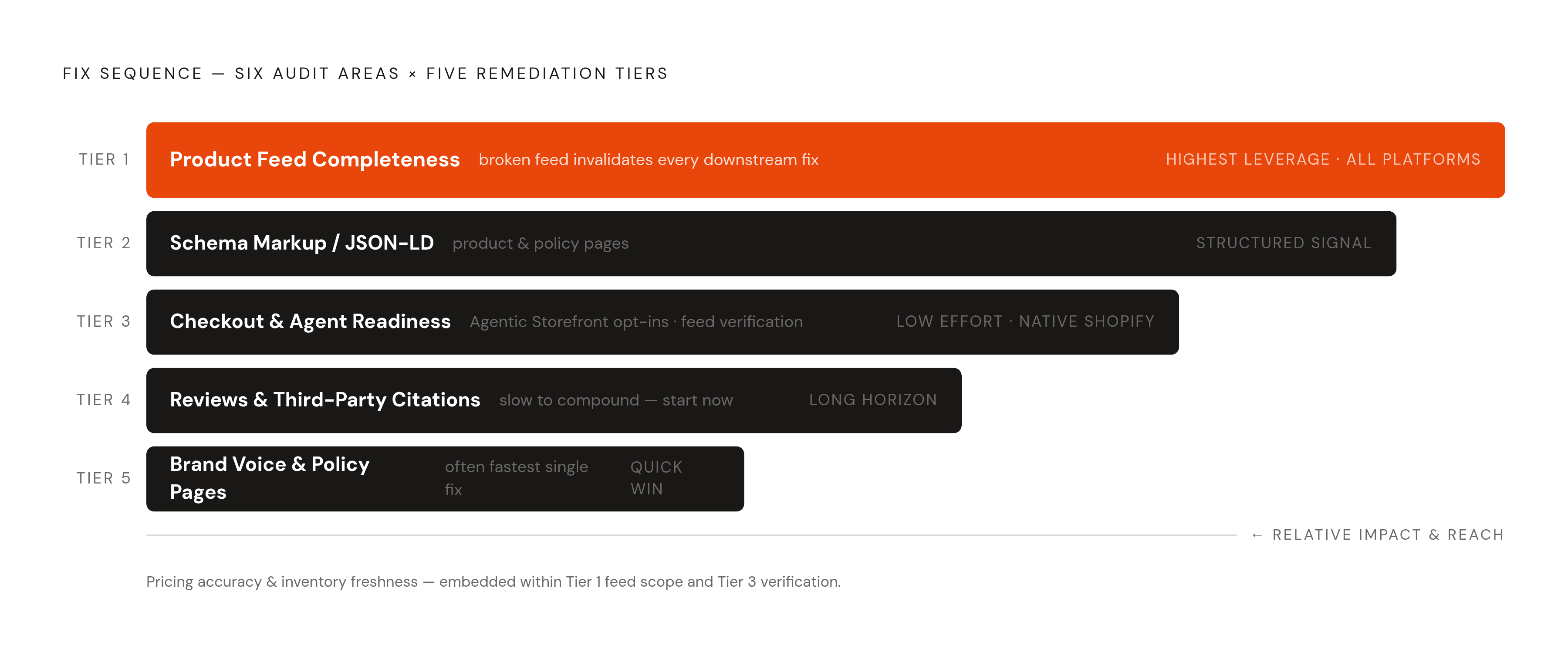
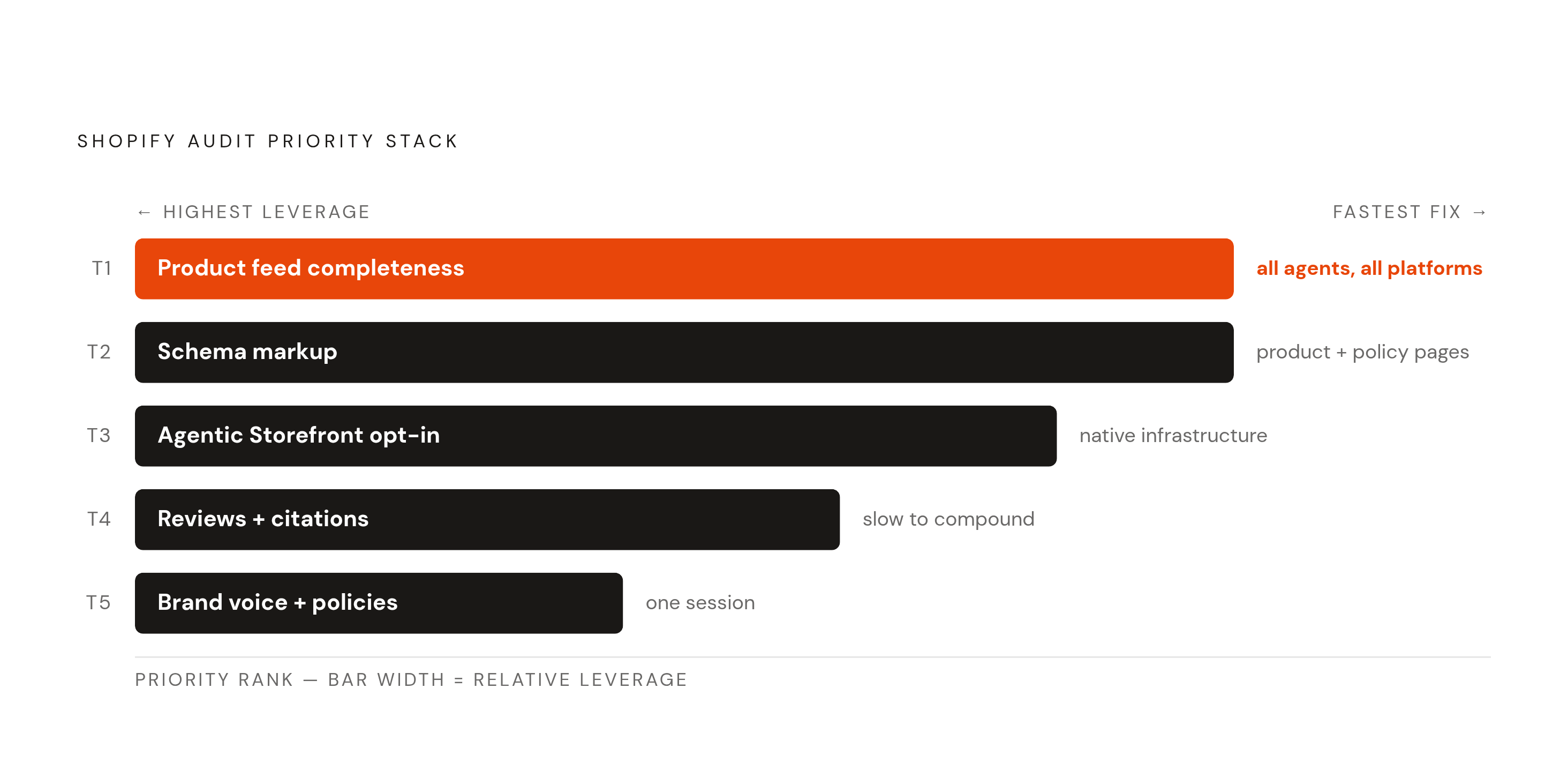
A broken product feed affects every agent on every platform simultaneously; it's the highest-leverage fix and belongs first in line, as Tier 1. Schema markup on product and policy pages sits at Tier 2: medium effort, but it affects crawlability and data accuracy broadly across the storefront. Tier 3 is the opt-in and verification work around Agentic Storefronts and the Shopify Catalog feed, low effort because it's largely Shopify-native infrastructure waiting to be switched on and confirmed working.
Review structure and third-party citation presence land in Tier 4. This one is slower to compound, since earned citations don't materialize overnight, which is exactly why the work should start immediately rather than waiting for a quieter quarter. Tier 5 covers brand voice and policy pages, mostly a content-editing task, and often the single fastest fix in the entire audit; a return policy page can go from vague to specific in one working session.
Completion criteria need to be concrete. "Zero suppressed products in Google Merchant Center" is a finish line that can be checked. "Feed is healthy" cannot be checked the same way, and vague standards don't hold up well when it's time to audit again in six months.
That's the last point worth making plainly: this isn't a project with an end date. Feed accuracy decays. Inventory data goes stale. Reviews accumulate or they don't. Agent readiness needs a recurring slot on the operations calendar, the same way SEO audits or inventory reconciliation already do, because the signals an agent reads today won't be the same signals it's weighing six months from now, and a storefront that passed this audit once is not a storefront that stays passed without someone checking again.