Multilingual AI Shopping Assistants for DTC Brands Expanding Globally
AI agents skip products with incomplete multilingual catalog data entirely.

ChatGPT alone handles an enormous volume of shopping queries each day, arriving in dozens of languages and answered in whatever language the shopper used to ask. That single fact rewrites what "international expansion" means for a DTC brand. Translation, currency conversion, and shipping logistics used to be the whole checklist. Now there's a fourth line item most brands haven't noticed: whether an AI shopping agent can actually read their product data in the shopper's own language. Get that wrong, and the brand doesn't get a weak recommendation, it gets skipped entirely, because an agent that can't parse the catalog in the query's language has nothing to recommend.
How agentic commerce actually works to change everything about international discovery
Agentic commerce, as Braze defines it, is what happens when an AI agent researches, compares, and completes a purchase with barely any human steering. The shopper states a goal. The agent takes it from there, through checkout, and the brand never gets a chance to make its case to an actual person.
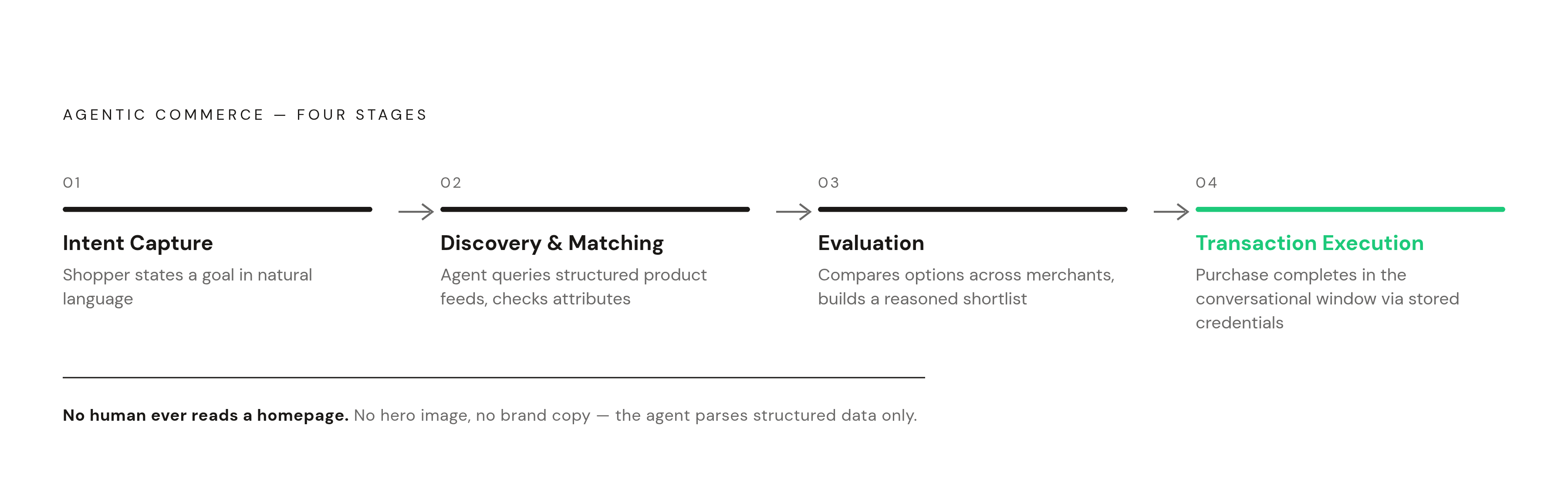
The agentic commerce process breaks into four stages, and each one matters differently for a brand trying to break into a market it doesn't already own. Intent capture comes first: the shopper describes what they need, in their own words, in their own language. Then discovery and matching, where the agent queries structured product feeds directly, not marketing pages, and checks the attributes against what the shopper asked for. Then evaluation, where the agent compares options across merchants and returns a shortlist with reasoning attached. Finally, transaction execution, where the purchase completes inside the same conversational window using stored payment credentials.
Notice what's missing from that flow. No human ever reads the homepage. The agent never encounters a beautifully translated hero image or an on-brand paragraph about heritage and craftsmanship. It parses structured data, full stop. If that data is incomplete, or if it only exists in English, the product gets excluded before any shopper ever sees a recommendation naming it. That is the actual failure mode, not a weaker ranking, a total absence from the shortlist.
This isn't a niche behavior confined to early adopters, either. Braze's Retail Customer Engagement Review projects consumer adoption of agentic shopping jumping from 19% to 46% by the end of 2026, a near-tripling in under a year. The infrastructure to support that shift is already built and already live in the exact markets DTC brands are trying to enter.
OpenAI and Stripe launched ACP in September 2025 to govern agent checkout inside ChatGPT, reaching 700 million weekly users at launch and climbing to 900 million by February 2026. Google's AP2, also launched in September 2025, brought on more than 60 partners at launch, including Mastercard, PayPal, and American Express, and defines digitally signed spending mandates that travel with the transaction from intent to completion. Then there's UCP, co-developed by Google, Shopify, Etsy, Wayfair, Target, and Walmart, and endorsed by Carrefour, Zalando, Flipkart, and Sephora among others. None of these are pilot programs. They're live rails, built by companies with no reason to build them small.
Brands like Etsy, Glossier, SKIMS, Spanx, and Vuori are already live on ChatGPT Shopping, per Paz.ai. That means they're competing not just against domestic rivals but against every international entrant in every language those platforms serve. Brand recognition and ad budget don't decide who wins that competition. Catalog quality does, and most brands still haven't accepted that.
Why the international opportunity compounds the stakes of what agent-referred shoppers look like
Shoppers referred by AI agents don't behave like shoppers from search or social. Research into AI-referred shopping behavior puts the difference in blunt terms: meaningfully higher conversion, more time on site, more add-to-carts, and a lower bounce rate compared to other traffic sources.
A trust mechanism produces those numbers, not luck. Consumers who receive an AI agent recommendation tend to be more likely to follow through to that brand's site than those arriving from other channels. Criteo data shows AI-referred visits converting at a notably higher rate than other channels, and more than half of those visitors count as upper-funnel, net-new shoppers discovering the brand through the agent.
For a DTC company entering a market where it has zero organic presence and no paid-search history, that net-new quality is the whole opportunity. These are shoppers finding the brand for the first time, through a channel that costs nothing to appear in if the catalog data earns it. Compare that to the alternative, buying visibility through paid search in an unfamiliar market, and the economics tilt hard toward agent discovery for any brand willing to do the enrichment work.
International expansion usually fails regardless. ATTN Agency puts the failure rate for DTC brands attempting international expansion at 73%. Agent discovery won't fix that failure rate on its own, but it offers a cheaper path to early traction than paid acquisition, and only for brands whose product data is actually built to be read by the agent doing the recommending. Everyone else is paying for the same shot at visibility they'd get for free.
Global Insight Services, cited by Venture Media, projects the global DTC market reaching $225.5 billion in 2024 and climbing to $880.1 billion by 2034. An increasing share of that growth will route through AI-mediated discovery rather than a shopper typing a brand name into a search bar. Brands solving catalog enrichment now are positioning themselves ahead of a market nearly quadrupling in size, while everyone waiting for the trend to mature is choosing to compete for the smaller, shrinking half of it.
The gap for new markets created by 54% of brands that rank on Google being invisible to AI agents
Ranking well on Google and getting cited by an AI agent turn out to be almost unrelated achievements. Research from NudgeNow on product data enrichment found that 54% of brands ranking well on Google don't get cited by AI systems at all. That statistic alone should end the argument that SEO investment covers agentic discovery. It doesn't, and treating the two as the same problem is the mistake most brands are currently making.
The reason comes down to what each system actually reads. ChatbotX notes that LLMs process product information in a fundamentally different way than search crawlers do. A search engine cares about page authority and backlinks. An agent cares about structured attributes: price, availability, shipping timeline, dimensions, material, return terms. Brand awareness carries zero weight if the underlying data feed is thin.
For a brand entering an international market, this gap doesn't just persist, it doubles. Catalog data might already be incomplete in English, and whatever attributes do exist might only exist in English. An agent answering a query in French or Japanese or Spanish either reads English-language data poorly matched to the question, or skips the listing rather than risk a bad recommendation. Localized pricing, shipping windows, return policies, and size conventions are often simply absent, not translated badly, just missing.
What an agent needs to make a confident recommendation breaks into four categories. Complete structured attributes come first: SKU, dimensions, weight, material, color, compatibility. Transactional signals follow: price in local currency, shipping timeline to that specific market, return conditions that apply there. Semantic richness matters just as much, meaning descriptions phrased the way shoppers in that language and culture actually talk, not a literal translation of English marketing copy. And trust signals, sustainability claims, certifications, brand background, all need to be accurate and current in the local context.
ChatGPT accounts for a commanding majority of AI referral traffic, with Perplexity and Google AI Overviews making up most of the rest. Every one of those systems runs on the same foundation: structured, complete data. Research noted by seerinteractive.com indicates that sites following agentic SEO best practices see 28% higher inclusion in agent-curated recommendation lists. The gap between a prepared catalog and an unprepared one already appears in the numbers. It isn't theoretical anymore.
What language-native catalog enrichment requires, beyond translation
Translating an English product description into German just preserves whatever gaps existed in the English version, now in a second language. Enrichment is a different task altogether: building language-native content from scratch for each target market, shaped around how shoppers there actually phrase what they need.
That work covers a few distinct layers. Attribute-level localization means matching size systems (EU, UK, Japan), using the measurement units shoppers in that market expect (centimeters, not inches), and naming materials the way local consumers actually talk about them. Query-mirroring description writing goes further: a product gets described the way a Brazilian or German shopper would phrase a question to an AI agent, using the phrasing and structure native to that shopper's own language.
Localized transactional fields matter just as much. Price needs to display in local currency, shipping timelines need to tie to actual carriers serving that country, and return-policy language needs to reflect the consumer rights that actually apply there. Market-specific trust signals, regional certifications, local sustainability standards, review counts from in-market customers, round out the picture. None of this works if the underlying schema markup (the Product, Offer, and FAQ data an agent actually parses) stays in English while only the visible page gets translated.
Semantic depth counts for more than raw completeness. ChatbotX points out that a product listed simply as "insulated jacket, navy, size M" is less visible to agentic search than one that describes temperature range, packability, and specific use cases. More words don't help. The right words do.
Non-product pages carry weight too, and this is where most brands cut corners. Shipping pages, return policies, and brand story pages all feed into how an agent assesses whether a retailer can be trusted, so placeholder translations on those pages undercut the whole catalog even when the product listings themselves are solid. Pricing consistency across channels matters just as much: Paz.ai's risk framework notes that when a price in the product feed doesn't match the price on the actual site, that mismatch reads as a trust failure that can undermine a product's standing in recommendation consideration.
A discipline covers all of this, and it already has a name: Agentic Commerce Optimization, applied separately to every language market a brand enters. Each target-language catalog needs to stand as its own first-class data asset, built and maintained independently of the English original.
Key features of a platform that makes multilingual AI readiness operational
Enriching a catalog across five or six languages by hand isn't realistic for most DTC teams, and the platform choice shapes this work as much as the strategy does. The core requirement is a single catalog intelligence trained on the brand's own data, its products, policies, reviews, and voice, deployable across every target market and every AI surface without rebuilding the storefront from scratch for each one.
A platform built for this needs to do several things at once, and skipping any one of them recreates the visibility gap somewhere else in the funnel. It has to ingest the full catalog and generate language-native descriptions and attributes for each market, treating each market's language as its own foundation for the data rather than running existing English fields through a translation layer. It needs to maintain structured, machine-readable feeds that satisfy ACP, AP2, and UCP protocol requirements, so agents on ChatGPT and Perplexity can actually act on the data instead of skimming it. It should surface brand data consistently across every AI channel in every target language, so the brand controls what gets said about it instead of leaving that to whatever a model infers on its own.
Localized transactional signals need to stay current and consistent across every channel an agent might check. These include pricing, availability, shipping windows, and return terms. And the same catalog intelligence powering those external AI channels should also run the brand's own on-site assistant, so an international shopper gets the same quality of answer whether they're asking ChatGPT or asking the brand's own site directly. All of this needs to plug into whatever commerce stack the brand already runs, Shopify, WooCommerce, Salesforce Commerce Cloud, Adobe Commerce, without a theme rebuild or a pile of disconnected tools bolted on top.
A brand entering three markets at once doesn't have months to spend on custom IT work per market. The platform should be live fast, trained once, and deployed everywhere.
The real test that separates one platform from another is simple to state: does it treat each target-language catalog as its own first-class data asset, or does it bolt a translation step onto an English-first system? The second approach is worse than doing nothing, because it recreates the same visibility gap, market by market, while giving the brand false confidence that the problem's already solved.
How to measure whether your multilingual catalog is being cited and chosen by AI agents
None of this is worth anything without measurement. The first metric worth tracking is AI referral traffic broken out by language and geography, kept separate from regular search traffic. Skip that split, and a brand can't tell whether traffic came from AI-driven discovery happening in Germany or organic search traffic happening in the US, two entirely different signals that get muddied the moment they're combined.
Found rate by language market is the sharper number: for each target language, what percentage of the brand's priority queries actually return the brand as a recommended result. A high-value query returning a zero found rate points to a catalog gap, not a lack of demand, and that distinction changes what a team does next. Fixing demand and fixing a catalog gap are two entirely different projects, and confusing them wastes a quarter.
Price and availability mismatch rate needs its own tracking per market too. If what the agent shows differs from what the merchant site shows, that's a trust failure, and it needs catching market by market rather than folded into a single global average that hides where it's actually happening.
AOV and conversion from AI-referred sessions round out the picture. Yotpo's CommerceGPT Analysis, presented at Shopify's NRF 2026 session, found AI-referred orders carrying roughly 30% higher average order value. If that pattern holds in a newly entered market, it's a signal the catalog is earning genuinely high-intent recommendations. If it doesn't hold, the enrichment work in that language still has gaps to close, and the metrics above usually point to exactly where.
Measure all of this against the brand's own baseline in that specific market.
There's a reason this can't be treated as optional. Braze's Retail Customer Engagement Review found that 71% of marketing leaders already believe AI agents have weakened their ability to connect directly with customers. In a market where the brand has no prior customer relationship at all, the agent is often the only point of contact a shopper has with the brand before deciding whether to buy.
The measurement data itself points to the fix. A low found rate in a given language market usually traces back to attribute gaps or missing localized schema. A high found rate paired with weak conversion points somewhere else entirely, toward a landing-page mismatch or a pricing inconsistency the agent picked up on. That feedback loop is what turns catalog enrichment from a one-time launch project into an ongoing discipline. Brands that build that loop early end up with a language-native data advantage that late arrivals will spend months trying to close, because AI shopping agents keep citing the sources they've already learned to trust, and that habit compounds in favor of whoever earned the trust first.