Dynamic Product Page Personalization for Returning Shoppers
AI-compressed shopping requires product pages that adapt to what returning customers already know.

A returning shopper in 2026 often reaches a product page after an AI assistant has already done the comparing, narrowing, and shortlisting on their behalf. By the time the page loads, the shopper isn't browsing; they're confirming.
Practitioners call this journey compression. A shopper describes what they need to an AI assistant, the assistant narrows the criteria and surfaces a short list of candidates, and the click-through lands the shopper directly on a specific product page already knowing what they want. The research phase that used to unfold across a dozen browser tabs now happens in a single conversation, somewhere the brand never sees, before the storefront ever registers a visit. L.E.K. Consulting has found that 31% of AI users say their purchase decision was largely made before they reached a brand or retailer site, and NIQ reported that 27% of shoppers actively use AI-powered tools to research or decide what to buy. Neither figure suggests AI is replacing the site visit. It's compressing what used to happen before it.
For a first-time visitor, that compression already changes the sales job: the page has to answer questions the shopper has already half-answered elsewhere. For a returning shopper, the stakes are higher still: the brand is meeting someone who has browsing history, purchase history, and in many cases a stated preference sitting in a session log or CRM record somewhere. The shopper who arrives through an AI-mediated path carries more explicit intent than one who wandered in from a category grid, and when that shopper is also a returner, the brand is looking at someone who has told it, directly or indirectly, a great deal about what they want next. A product page that cannot read any of that treats a known, qualified, ready-to-buy customer exactly like it would treat a stranger clicking in from a cold ad. That mismatch, between what the brand already knows and what the page is prepared to do with it, is the structural problem this piece is built around.
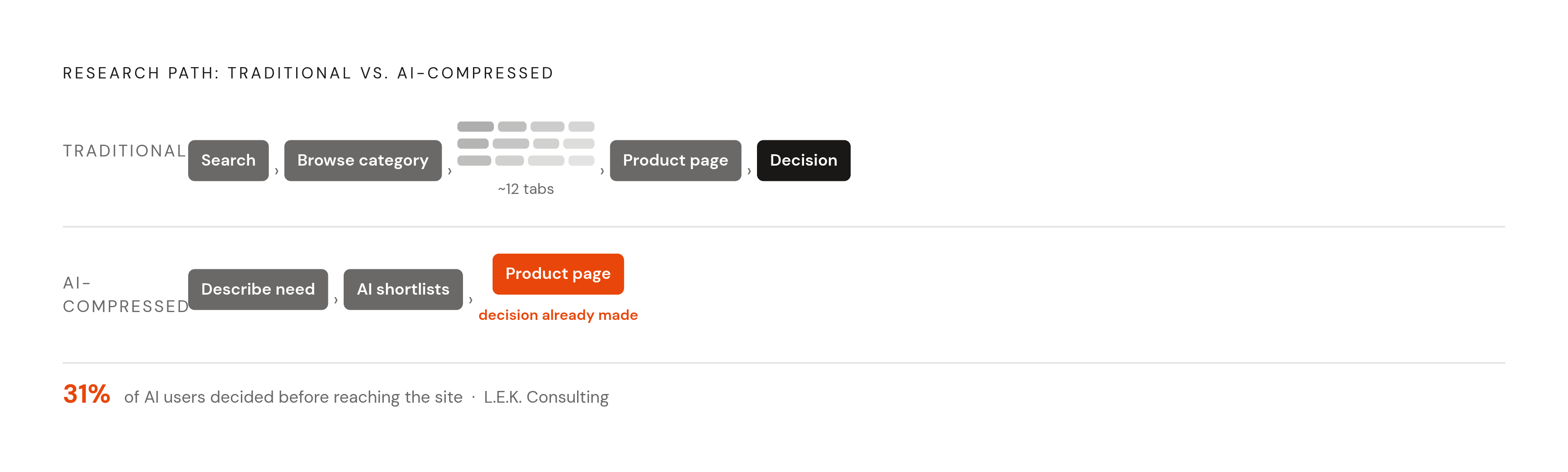
The cost of a static product page for a ready-to-buy returning shopper
A static page doesn't fail a returning shopper by saying anything false. It fails by saying the same thing to everyone. A pre-qualified returner needs the specific piece of proof, reassurance, or context that would close the gap between interest and purchase. A shopper who has already bought from a brand once doesn't need the brand's origin story repeated. A shopper who has already read the core product description during a prior visit doesn't need it again in the same words, framed for someone encountering the category for the first time.
The behavioral signals that would let a page distinguish these shoppers from first-timers already exist in most brands' data. Shopify's 2026 guide to AI personalization identifies the relevant inputs: what a shopper has viewed, what they've purchased, and when they last visited. A visitor who returns to the same product page three or four times across a week is behaving in a measurably different way than a visitor browsing five categories in a single session, and that distinction is visible in clickstream data long before a purchase happens. A static page has no mechanism for acting on that distinction. It shows the same hero image, the same review carousel, and the same offer to a shopper one click from buying as it shows to someone who just landed from a search result and is still deciding whether the category is even right for them.
The financial exposure here extends past the session in front of the brand. The page's job in that moment is to give the shopper a reason not to go back and take one of the other options the AI already put in front of them.
How AI personalization differs from rules-based systems
Many DTC brands believe they already personalize, because they have customer segments and merchandising rules built on top of them. Segmentation and rules-based logic operate on a different principle than AI personalization does, and the distinction matters most for exactly the shoppers who carry the richest signal: returners.
A rules-based system runs on logic a person wrote by hand. A merchandiser decides that customers in a given segment should see a given banner, or that a cutting board should be recommended alongside a chef's knife, and that pairing holds until someone manually revises it. Shopify's guide uses this exact example: a rules-based system pairs a cutting board with a chef's knife because a merchandiser wrote that logic, while an AI model generates the same kind of pairing by learning from behavioral data. The rules-based version works, but only within the scope someone thought to write a rule for. It can't act on a pattern nobody anticipated, and it can't update itself when shopper behavior shifts.
AI personalization draws on historical and real-time behavioral data and updates its predictions continuously as that data accumulates. Nobody writes the pairing logic by hand. The model finds non-obvious affinities across thousands of SKUs and millions of interactions, at a level of granularity no merchandising team could maintain manually. For a returning shopper, whose signal set is layered (purchase history, browsing depth, category drift over time, cart abandonment patterns), that granularity is the entire value proposition. A segment can tell a brand what a cohort of shoppers tends to do. It cannot tell a brand what this specific shopper, with this specific history, is likely to do in the next five minutes. Segmentation groups people into buckets and treats everyone in the bucket the same way. A returning shopper's richest signals, the ones most predictive of what converts them, live at a level of individual detail that a rules-based bucket structurally can't reach.
The four surfaces on a product page that personalization should adapt for returning shoppers
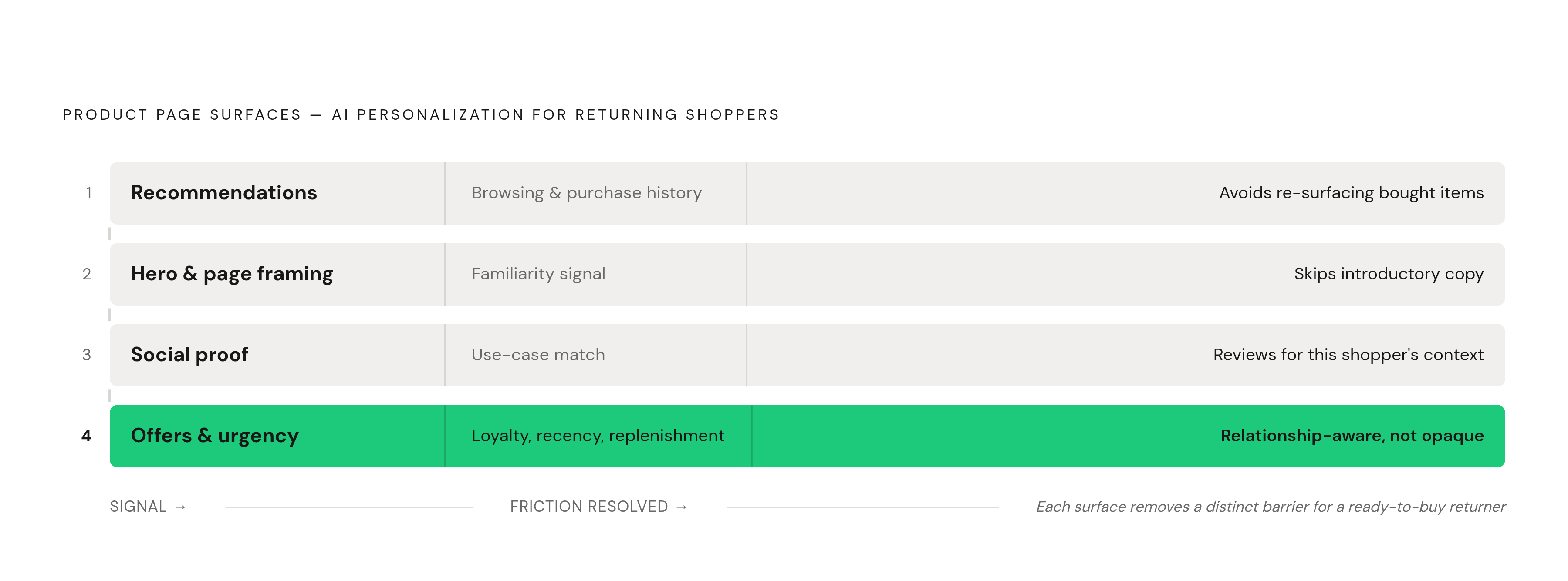
Dynamic personalization isn't one feature bolted onto a product page. It operates across four distinct surfaces, and each one responds to a different signal and resolves a different kind of friction for a returning shopper.
Product recommendations are the most familiar surface, but the mechanism behind them has changed. AI-powered recommendation engines surface items based on a given shopper's browsing and purchase history, the behavior of similar customers, and current cart contents, without a merchandiser writing manual pairing rules. For a returning shopper, this means the page should avoid re-surfacing something they've already bought and instead recommend what their behavioral pattern suggests they're ready for next, whether that's a complementary product, a size variant, or a replenishment of a consumable they bought weeks ago.
Hero content and page framing adapt the same way a homepage does. Shopify's guide describes two returning shoppers at the same athleisure brand seeing different homepages based on behavioral prediction: one is led with new yoga attire, the other with running gear. That same logic belongs on a product page's hero image and opening copy. A returning shopper who has already purchased in a category shouldn't see introductory copy written for someone encountering the product type for the first time. The framing should assume familiarity and move faster to the specifics that matter to an experienced buyer.
Social proof selection is where many brands assume a single sorting method (highest-rated first) is enough, but reviews and user-generated content don't persuade every shopper equally. A buyer who has already purchased once responds to different proof than a buyer still deciding whether to purchase. Reviews that match a returner's specific use case, inferred from their browsing history or prior purchase category, carry more weight than a generic top-rated review pulled regardless of relevance. Conversational AI on-site adds a layer here: when a shopper states their need directly in a chat interface, that stated intent should inform which reviews the page surfaces in response.
Offers and urgency signals are the most sensitive surface, and the one brands are most likely to get wrong. Loyalty status, replenishment timing, and purchase recency are all legitimate triggers for a contextually relevant offer, one accurate to where this shopper actually sits in their relationship with the brand. But personalized pricing carries a real trust cost: shoppers who sense they're being charged a different price than someone else disengage, and that erosion of trust can outweigh whatever short-term revenue the offer generates. The safer design frames offers as relationship-aware, a loyalty reward or a replenishment reminder, rather than as opaque, individualized price discrimination that a shopper could discover and resent.
Conversational AI on-site as a source of personalization inputs
An AI sales rep placed directly on the product page does more than field questions. It produces a category of signal that passive behavioral data cannot generate on its own: explicit, stated intent, in the shopper's own words.
Clicks, scroll depth, and time spent on a given section reveal where a shopper's attention is going, but they don't reveal why. A shopper lingering on an ingredients panel and a shopper lingering on the reviews section are working through different decision problems, and passive analytics can't distinguish the two. A conversational interface closes that gap. A supplement shopper who asks about subscription terms is working through a different objection than one who asks about dietary compatibility, and a page equipped to notice that difference can respond to each shopper differently rather than defaulting to the same static FAQ block for both.
Reporting on AI merchandising in 2026 describes chat-style interfaces that adjust to the specificity of a shopper's own query, handling something as particular as "I need a summer dress for the beach that isn't too expensive" by offering relevant options and adjusting as the shopper responds. The questions shoppers ask repeatedly, the objections that come up again across many conversations, are a direct record of what's actually blocking purchase, and that record should feed back into product data, page copy, and the AI's own working context. A brand that reviews its own conversation logs learns which objections are most common and can fix them at the structural level, in the product description or the page layout, rather than relying on a chatbot to patch the same gap one conversation at a time.
Product pages as a surface for AI shopping agents
A returning shopper increasingly delegates part of the purchase decision to a buyer agent acting on their behalf, which gives the product page a second audience that didn't exist a few years ago: the AI agent that may evaluate the page before any human does.
This isn't a hypothetical extension of agentic AI; it's already operating in production. Google has rolled out agentic checkout across Search, including AI Mode, with "Buy for me" functionality already live with selected US retailers, so an agent can evaluate a product and complete a purchase without a human directly clicking through the page in the traditional sense. Research into how these agents actually shop finds that they don't evaluate products the way humans do. Agents can scan a far broader assortment than a human would bother to compare manually, and they carry the potential to cut down search friction significantly, but they also carry their own biases and model-dependent quirks that make their choices neither fully rational nor fully predictable in the way a human shopper's might be.
The practical consequence is that a product page now has to perform for a reader that doesn't look at hero images or respond to persuasive copy the way a person does. Agents parse structured data, fact-based attributes, and explicit specifications. A page that leans entirely on visual storytelling and emotionally framed copy may convert a human shopper while giving an evaluating agent nothing usable to work with. And a brand's existing search ranking offers no guarantee of visibility here: many of the URLs cited by ChatGPT and by Google's AI Mode don't rank among Google's own top organic results, and only Perplexity shows high overlap with Google's top-ranked pages. A brand that has invested years into traditional SEO cannot assume that position protects it inside AI-mediated shopping channels. Both audiences, the human confirming a decision and the agent evaluating one, are reading the same page, and the page now has to work for both at once.
Measuring product page personalization for returning shoppers
Measuring the impact of product page personalization on returning shoppers calls for a different attribution logic than the channel reporting most brands already run, and brands that skip this step tend to overstate what's working and misdirect budget as a result.
Standard conversion rate, measured across all visitors regardless of history, hides the exact comparison that matters here: whether returning shoppers exposed to a personalized page convert at a meaningfully higher rate than returning shoppers who see the static version. That requires segmenting conversion data by visit history before looking at the personalization layer at all, not folding returners into the same aggregate number as first-time traffic. It also requires tracking what happens after the AI-mediated session that brought the shopper back: if a shopper engaged with an on-site conversational assistant, did that conversation correlate with completed purchases at a higher rate than sessions without it, and did the stated objections in that conversation log occur less often in later sessions after the page was updated to address them. A brand running this kind of measurement treats personalization as a hypothesis under ongoing test, which is the only posture that lets a pre-qualified, high-intent returning shopper actually be served by the page that's supposed to be built for them.