AI-Powered Upsell and Cross-Sell Timing on DTC Storefronts
AI reads shopper behavior to decide when upsells help rather than interrupt.
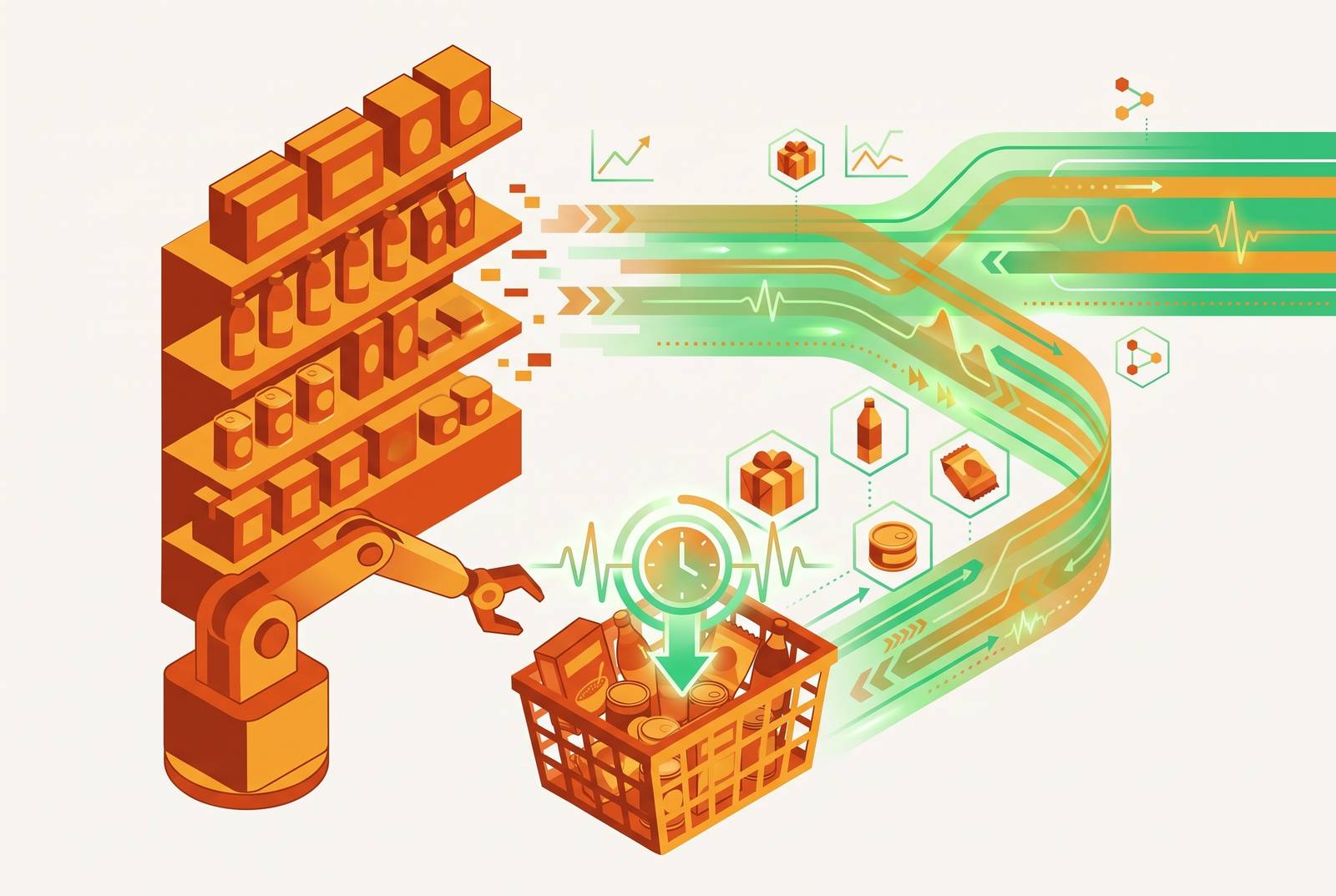
The difference between an upsell that converts and one that irritates is almost never which product was offered. It is when in the journey that offer appeared. AI-powered storefronts win because they read the signals that reveal where in the decision a shopper actually stands, and they time the ask accordingly.
That distinction does more work than most conversion tactics because it explains a pattern that confounds static optimization. The first feels like a second ask layered on top of an open one. The second feels like a natural next step with low stakes.
Static rule-based systems cannot solve this because they fire on a fixed event, a page load or a cart open, regardless of where in the decision the individual shopper actually is. Two shoppers can trigger the same cart rule within seconds of each other, one having deliberated for four minutes and one having clicked through on impulse, and the rule treats them identically. That is the structural ceiling of rules-based logic: it can answer what to show but never whether this shopper is ready to be shown anything at all.
This guide distinguishes the discovery mode of a pre-add-to-cart offer, where the case must lead with value, from the confirmation mode of a post-purchase offer, where low decision fatigue makes the same ask feel low-stakes. The distinction turns out to govern the entire upsell opportunity, far beyond checkout. What follows maps the shopper journey into its timing windows, shows why conventional triggers fail to serve them, and lays out the behavioral signals an AI system reads to decide not only what to offer but whether to offer at all.
The four moments in a shopper journey where timing is structurally different
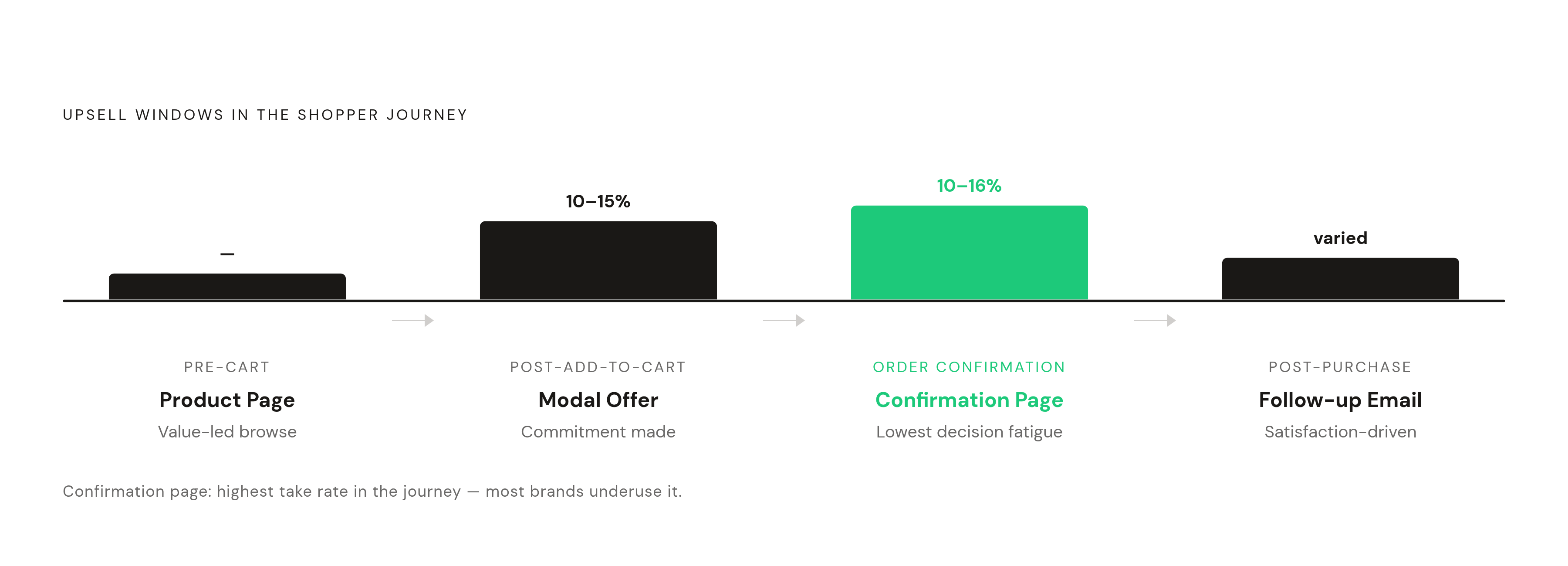
Not all upsell moments are interchangeable. Four distinct windows in the purchase journey each carry different psychological conditions that determine what kind of offer is appropriate and how likely it is to convert. Treating them as one surface with one logic is the foundational error behind most underperforming upsell programs. The first window is pre-add-to-cart, on the product page. The add-on should also stay well below the total cart value so the ask feels proportionate rather than opportunistic.
The second window arrives immediately after the shopper has committed, at the post-add-to-cart moment. Here the psychology inverts. One offer is the entire advantage.
The third window is the order confirmation page, and it carries the highest structural conversion advantage of any point in the journey. Take rates of 10–16% confirm what the psychology predicts. This is the moment to make an ask that requires nearly no new evaluation, because the shopper is no longer evaluating anything.
The fourth window is quieter than the rest and is governed by a different kind of trust entirely. Days or weeks after delivery, once the customer has used the product, the post-purchase email cross-sell operates on satisfaction with the original order rather than pre-purchase anticipation. This window is covered more fully later as part of the lifecycle strategy, but it belongs in the skeleton because it is structurally different from anything on-site: the offer is not riding the momentum of a decision but reprising a relationship that the product itself has now either strengthened or weakened.
What static rule-based triggers get wrong about shopper behavior
Rule-based upsell systems are designed around events: a page load, a cart open, an order complete. But shopper intent is shaped by behavior within those events, and behavior is exactly what rules cannot read. The gap is structural, not a matter of tuning a threshold or adding another condition.
A rule fires the same modal for every shopper who adds a product to cart, regardless of whether that shopper spent four minutes reading ingredient specifications or landed from a paid ad and added in seconds. A rule cannot distinguish the two because the trigger event, the add-to-cart, is identical. No number of segment definitions fixes this, since the distinguishing signal is not a profile attribute but an in-session behavior pattern that rules were never built to observe.
Rule systems also do not learn from rejection. The merchant may eventually notice the pattern in aggregate reporting, but the offer runs unchanged for months against audiences it will never convert. The cost compounds silently: a shopper who dismisses an upsell once is more likely to dismiss future offers from the same brand, and a rule will happily serve the same rejected product on the next visit as though nothing happened. Manual rule management adds a second, slower failure mode. Eventually the system is maintained by exception rather than by design, and the merchant is back to the generic default: the same products shown to every customer.
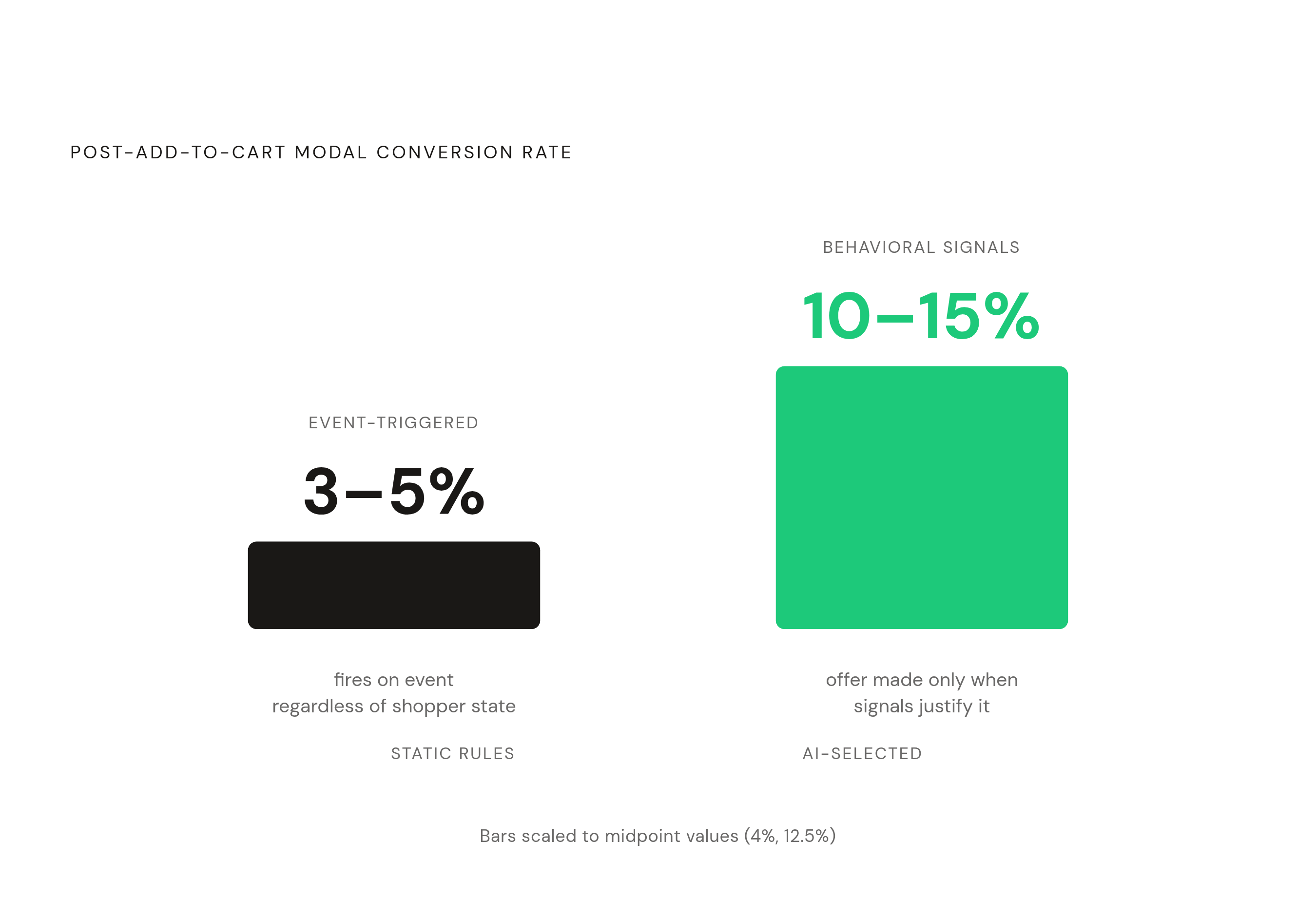
The practical result is measurable. Manually curated static post-add-to-cart modals convert at just 3–5%. The point is not that rules never work but that they are structurally incapable of addressing the variable that matters most: whether this shopper, at this moment, is in a state where an offer helps rather than interrupts.
The behavioral signals AI reads to decide not just what to offer, but whether to offer at all
The failure of rules sets up the mechanism that replaces them. An AI-powered upsell system reads the full session, the product selected, browsing history in session, purchase history, the behavioral profile of similar customers, current cart value, and prior offer rejections, to generate the upsell rather than merely matching on product category. The signals are specific and observable, and they determine not just the offer but the decision that precedes it: whether to make an offer at all.
The high-signal behaviors that indicate upgrade readiness are concrete enough to enumerate. Returning visitor status combined with prior purchase history lets the system match the new session against what was bought, what was returned, and what upgrade logic has applied to similar profiles. And prior rejection of a similar offer, whether in the same session or a previous one, is a signal to withhold rather than repeat.
The withhold decision is as important as the offer decision. A rule fires regardless. A system that asks only when the signals justify asking earns a response rate that a system that always asks can never achieve.
The optimization target shifts as a result. It is optimizing for the offer most likely to convert for this shopper at this moment. Those are meaningfully different problems, and the second is the one that produces the 10–15% post-add-to-cart modal conversion against the 3–5% static baseline. The second is a timing problem, solved with behavioral data.
Conversational AI on-site adds a layer that behavioral signals alone cannot reach. A statement like "I need something that works fast" or "I'm buying this as a gift on a tight budget" reframes the entire offer set in real time, because the shopper has just told the system what they are optimizing for. This layer matters enough to the timing argument that it deserves its own treatment.
How on-site conversational AI changes the upsell dynamic in real time
When a shopper engages with an on-site AI during a session, the upsell and cross-sell logic shifts from inferring intent through behavior to receiving it directly. That shift makes the timing decision dramatically more accurate because the system no longer has to guess what a signal might mean. The shopper says it.
A behavioral signal like viewing an SPF feature page requires inference. A conversational exchange where the shopper says "I want something that doubles as sunscreen" removes the inference entirely. The offer set rebuilds around a stated requirement rather than a probable one, and the ask lands in the context the shopper themselves established.
The conversation also allows clarifying questions that tighten the offer in ways no clickstream can. "Is this for daily use or occasional?" distinguishes a replenishment shopper from a travel shopper. "Do you want to stick with the same brand?" reveals whether the shopper is brand-loyal or category-shopping. This is the opposite of a modal, which presents an offer and invites a binary response.
Most consequentially, the conversation surfaces objections in real time that a modal cannot. If a shopper says "I already have a moisturizer, I just need SPF," the AI can redirect to a lighter product rather than upselling the full regimen bundle. The timing feels organic because it is part of an ongoing exchange the shopper initiated, not a break in the experience the merchant imposed. Every exchange also creates a data record. The conversation is simultaneously a conversion tool and an intent-capture mechanism, and the second function compounds in value with every session it records.
Building an upsell and cross-sell strategy across the full post-purchase lifecycle
Upsell and cross-sell timing does not end at order confirmation. The post-purchase window, when a customer has received and used the product, is structurally underused by most DTC brands despite being governed by the same timing logic. The discipline that applies on-site extends into the days and weeks after delivery, where a different kind of trust governs what should be offered and when.
The post-purchase email cross-sell operates on satisfaction with the original order rather than pre-purchase anticipation. The customer has lived with the product, and the relationship the brand now has is either reinforced by that experience or weakened by it. The timing is derived from how the product is actually consumed, which is exactly the kind of signal a fixed calendar interval cannot see. Adjacent-category cross-sells work on the same principle. The second shopper is still an open question, and an offer to them is a bet, not a response. The lifecycle view also clarifies what cross-sell is not. AI that knows order date and product category can enforce this discipline automatically, withholding the accessory pitch until the point when it would arrive as a helpful continuation rather than an early demand on a trust that has not yet formed. The emergence of AI shopping agents extends this timing argument into a new dimension. It is degrading the record that an agent will consult when the reorder decision comes.
None of this lifecycle timing works unless the underlying product data supports it. Attribute coverage matters concretely for upsell logic: price, availability, material, size, and formulation differences must be machine-readable for the AI to assess whether a premium variant is actually different in a way the shopper would value. Enriched product data, complete attribute fields, FAQs, feature bullets derived from actual product specs, also improves the quality of conversational AI answers on-site. A brand agent answering "is this worth the upgrade?" draws on whatever structured information exists about the premium variant. If that information does not exist, the agent guesses, and a guessed answer at the moment of highest intent is the most expensive kind of error.
What a timing-first upsell strategy looks like in practice for a DTC brand
The conceptual case for timing-first upselling compresses into a sequence of practical steps a DTC brand can execute in order of leverage. That finding alone explains most of the gap between current performance and what the windows promise. The second step is to prioritize by structural advantage. Start with post-purchase confirmation upsells, which have the highest structural conversion advantage and the lowest friction to add. There is no point arguing for a full-site personalization overhaul when a confirmation-page offer can demonstrate the timing effect within a month.
The third step layers in post-add-to-cart modal logic. Replace the static product assignment with an AI-selected single offer based on the most recently added item and session behavior signals. This is the approach that drives post-add-to-cart modal conversion of 10–15%, and it is where the behavioral signal reading described earlier first becomes operational. The offer is one item, chosen for this shopper at this moment, not a merchandising default. The fourth step deploys on-site conversational AI to handle the moments where behavioral signals are ambiguous. It is the tool for the moments the behavioral model cannot confidently classify, and those moments are numerous enough to matter. The fifth step builds the post-purchase email and replenishment sequence around AI-predicted consumption windows rather than fixed calendar intervals. Consumption rate is the signal, and it is derivable from data the brand already holds. Finally, measure upsell performance by window, not in aggregate. When the numbers are separated by window, the brands that understand when their shoppers are ready to hear an offer will be visible, and so will the ones still interrupting.