Measuring True Incrementality of AI Personalization Campaigns
Platform attribution systematically overstates AI personalization's true revenue impact.

If a campaign dashboard shows a strong ROAS on a given channel, that rarely means the campaign generated that many dollars for every dollar spent. Platform-reported ROAS is a systematically inflated number that measures what a platform is willing to claim credit for, not what the advertising actually caused. Meta, Google, and email each run their own attribution windows and their own models, and each one counts conversions on its own. When a shopper buys after seeing a Meta ad, clicking a Google search result, and opening an email, all three systems can claim that same sale as their own. Attributed revenue summed across every platform a brand runs will almost always exceed what the store actually took in, a structural double-counting problem that has nothing to do with how good any individual campaign is.
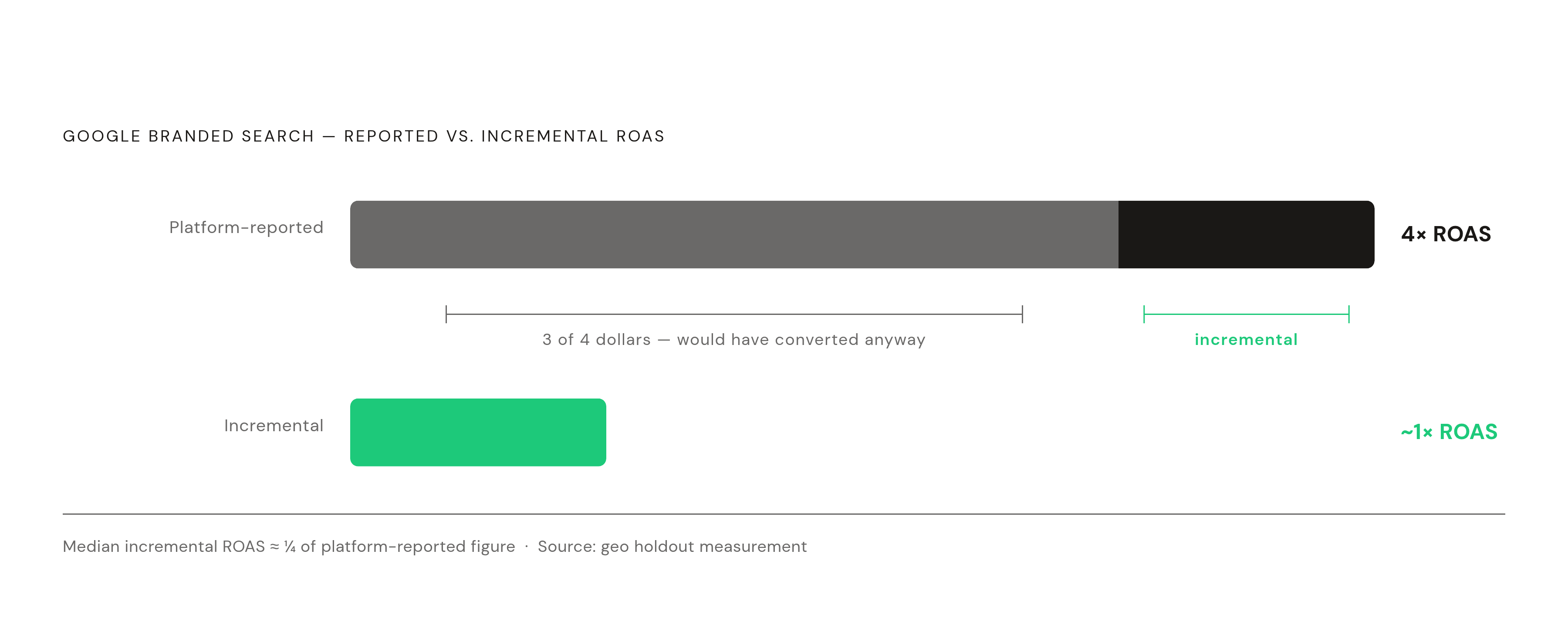
Brand search makes the distortion easy to see. A shopper who has already decided to buy types the brand's name into Google, clicks the paid result sitting above the organic one, and the platform logs a conversion it did nothing to cause. The Common Thread Collective geo-holdout database puts the median incremental ROAS of Google branded search at roughly a quarter of its platform-reported figure: three out of every four dollars of "performance" showing up on that line item would have converted anyway. The channels that look strongest on a dashboard tend to carry the widest gap between what they report and what they actually deliver, which makes the bias self-reinforcing: a team allocating next quarter's budget off platform numbers will keep pouring money into the channels most inflated by the measurement itself.
AI personalization does not fix this problem. It adds to it. AI-referred traffic to US retailers grew sharply year over year, but this channel sits almost entirely outside existing measurement frameworks, based on Adobe Analytics' retailer data. When an AI-personalized on-site experience or an AI-driven email flow then influences a shopper who arrived through that traffic, the AI platform, the ad platform, and the email platform can each record the same conversion, with nothing in place to decide which one, if any, actually caused it. Brands running AI personalization campaigns are stacking a new attribution claimant on top of a media mix that was already over-attributed before AI entered the picture.
What makes AI-referred and AI-personalized shoppers different from every other segment
AI-influenced shoppers arrive at the point of conversion already decided, and that is what makes them look, on any dashboard, like the most valuable segment a brand has ever acquired. Shoppers who engage with an on-site conversational AI convert at roughly four times the rate of shoppers who do not. That figure blends two separate effects that a dashboard cannot tell apart: causation and selection. High-intent shoppers are more likely to open a chat window in the first place, so some share of that four-times lift existed before the AI interaction ever happened. The conversational tool may be surfacing intent that already existed.
The same problem appears in AI-personalized email. A customer who opens a behavior-triggered, AI-timed send was already producing the purchase-intent signals that triggered the send to go out. The email may accelerate or confirm a decision already forming. That distinction matters: the same behavioral traits that make these shoppers valuable, namely pre-existing intent and a short path to purchase, are what causes standard attribution to overcount the campaign's actual contribution. A high counterfactual purchase rate means a large share of what would have happened without the campaign is baked into the number the campaign gets credit for.
Incrementality testing run against standard holdout groups shows that high-performing direct-to-consumer brands do see a real lift in revenue from AI personalization, but a bounded one: a share of total revenue that is genuinely additional, not the full revenue those shoppers generate. The gap between what gets attributed and what is truly incremental is widest precisely in the segments that look best on a dashboard, so a brand optimizing its spending toward AI personalization performance metrics is optimizing toward the part of its reporting most distorted by measurement.
A further complication comes from AI shopping agents, which can discover a product and complete a transaction on a consumer's behalf without the consumer ever seeing a personalized campaign. A conversion driven this way may register in analytics as direct or referral traffic with no campaign touchpoint attached to it, so it disappears from attribution. That produces an asymmetry running in two directions at once: AI-personalized campaigns get over-credited for high-intent shoppers who would likely have converted regardless, while AI-agent-driven purchases get under-credited or missed. Both are measurement failures, just opposite ones.
Why incrementality testing, not attribution modeling, is the right tool for this problem
Attribution and incrementality testing answer two different questions, and for AI personalization campaigns, only one of those answers tells you anything useful. Attribution takes conversions that already happened and distributes credit for them across the touchpoints a system recorded along the way. It is a backward-looking accounting exercise, built on the assumption that every conversion it logs was caused by something in the recorded journey. Incrementality testing asks a different, prior question: how many of those conversions would have happened anyway, if the campaign had not run? The delta between the two numbers is the only figure that actually justifies continued spend.
That gap is not a rounding error or a technical quibble between measurement vendors. Acting on the inflated number directs real budget toward spend that produces nothing new, pulling resources away from channels genuinely expanding the customer base. The risk runs higher for AI personalization specifically, because its target segment, high-intent AI-referred shoppers, has a naturally elevated baseline purchase rate. The counterfactual for these shoppers is not zero.
Two methodologies dominate incrementality testing in practice, and they suit different kinds of campaigns. Geo-holdout experiments divide geographic markets into treatment and control groups, measure how business outcomes diverge between them, and use synthetic controls to estimate what would have happened in the treatment regions without the tested activity. This is the standard approach used by platforms like Haus, and it requires withholding spend from a meaningful geography for several weeks. It works best for paid media channels that offer clear geographic targeting levers, because the whole method depends on being able to cleanly turn spend off in one place while leaving it running in another.
Causal inference paired with interrupted time-series analysis, the approach used by INCRMNTAL, works differently: it detects the impact of marketing changes without requiring advertisers to pause campaigns or carve out a deliberate control group. That makes it a better fit for always-on AI personalization programs, the kind that run continuously across every visitor and cannot be cleanly switched off for a subset of a market the way a paid media campaign can. For email specifically, a permanent holdout, a fixed share of the list that receives no marketing sends for a defined period, offers a clean baseline by comparing what that group buys against what the active list buys. It is low-cost relative to a geo-holdout and can run continuously without disrupting the rest of the program.
When incrementality testing is worth running
Incrementality testing is not something every brand should run at every stage, because the methodology carries real operational costs, and below certain thresholds those costs outweigh what the result is worth knowing. A statistically valid geo-holdout requires you to withhold spend from a meaningful geography, typically five to ten percent of total revenue represented by the holdout regions, though many designs call for withholding spend from regions that make up a substantial share of the addressable market. That spend has to stay withheld for long enough to detect a minimum effect. This is a genuine cost. The withheld spend simply does not run during the test window, and whatever revenue it might have generated goes uncollected for the sake of the measurement.
Google's practical threshold for geo-based incrementality testing requires meaningful spend on the channel being tested, and Meta needs enough conversion volume to hit a minimum detectable effect over a multi-week window. Below those levels, results come back too noisy to act on with any confidence. Incrementality testing stands as the single most important measurement upgrade a DTC brand can make above a certain annual revenue threshold in 2026. Below that threshold, the cost of running holdouts typically outweighs the decision value the results provide, a calibration worth taking seriously rather than a wall that shuts smaller brands out of honest measurement.
Brands below the geo-holdout threshold still have lower-cost proxies available that can separate correlation from causation in their AI personalization work. A permanent email holdout group, a small fixed share of the list kept out of all sends for a defined rolling period, costs nothing in withheld media spend and gives you a continuous baseline for measuring real email lift, following a three-step incrementality framework built for email programs. Time-series analysis applied to on-site AI personalization compares conversion rates before and after a feature activates while controlling for seasonality and traffic source, so it offers a lighter-weight alternative to a formal holdout, though it stays more exposed to confounding factors than a true experiment. Even without running a formal test, you can separate AI-referred traffic into its own cohort in analytics and compare its organic conversion rate against its conversion rate during active AI personalization campaigns. That comparison will not produce a precise incrementality figure, but it gives a directional read on whether the campaign is actually changing behavior or simply capturing shoppers who were already going to buy.
The most common objection to building out incrementality infrastructure is that it slows decision velocity, that teams can't afford to wait weeks for a geo-holdout to resolve before deciding what to do with next month's budget. Automated incrementality testing platforms answer this by designing and monitoring experiments continuously, feeding results directly into existing dashboards rather than requiring a separate vendor report or a spreadsheet reconciliation every time a question comes up. Acting on platform-attributed AI personalization metrics speeds up the wrong decisions, sending budget toward spend that looks productive and isn't.
How to structure a holdout test for an AI personalization campaign in practice
A defensible incrementality test for an AI personalization campaign comes down to four decisions, all of which need to be made before the test begins: what to measure, who makes up the holdout, how long the test runs, and what baseline the results get compared against. The outcome metric has to be a business outcome, incremental revenue, incremental orders, incremental contribution margin, not a platform engagement metric like click-through rate or session duration. Engagement metrics measure how much reach a campaign had. They say nothing about whether that reach caused anything.
The holdout group has to be defined before the campaign goes live, never selected afterward from the pool of shoppers who simply didn't convert. A control group assembled after the fact measures whoever the campaign failed to reach, something entirely different from what a real holdout measures. For email AI personalization, a workable structure sets aside a permanent holdout of a small slice of the list, withheld from all sends for a baseline period of at least three months, which gives a clean comparison without disrupting the active program running on the rest of the list. For on-site AI personalization, covering product recommendations, conversational AI, and dynamic landing pages, the holdout takes the form of a randomly assigned visitor segment that sees the standard, un-personalized experience instead. Running this kind of test requires the AI personalization tool itself to support a built-in holdout mode, a capability that should be treated as a condition of vendor selection.
The baseline a brand compares its results against has to come from its own historical data, not from an industry benchmark or a published average. Industry averages for AI personalization lift are built from a population of brands with different catalogs, different customer bases, and different traffic quality. Applying one of those averages to a specific brand's own campaign is an assumption dressed up as a finding. The only credible counterfactual is a brand's own pre-campaign conversion rate, segmented by traffic source and customer type. This means comparing an engaged-shopper cohort against that brand's own baseline rather than against a number published somewhere else. Seasonality needs to be built into the design explicitly: a test that runs during a promotional period or a seasonal peak will overstate lift if its baseline comes from a quieter stretch of the year, and it will understate lift if the comparison runs the other way around.
Reading the results correctly means pulling apart three distinct effects that AI personalization campaigns routinely blend into one number. The first is true incremental lift: conversions that would not have happened without the personalization, and the only figure that actually justifies the spend behind the campaign. The second is the halo effect: conversions in adjacent channels or product categories that the personalization influenced without getting direct credit, a real contribution that's easy to miss without visibility across the full customer journey, beyond just the channel where the campaign ran. Separating these two from the baseline conversions that would have happened regardless is the entire purpose of running a holdout in the first place, and it is the only way a brand running AI personalization at scale will know what that investment is actually returning.