First-Party Data and AI Personalization After Third-Party Cookie Deprecation
First-party data and AI tools now outperform the cross-site tracking they replace.

Third-party cookie deprecation did not break personalization for DTC brands. It exposed a foundation that had been cracking for years under the weight of its own design. Cross-site tracking never gave brands a stable record of their customers; it gave them a borrowed, inferred, and constantly decaying picture assembled from signals they did not own and could not fully control. A cleared cache, a new phone, a browser update: any of these could wipe out months of accumulated targeting history in an instant, and no amount of modeling sophistication could restore what was lost once the signal was gone.
The timeline matters here: Google spent years planning to phase out third-party cookies in Chrome, reversed that plan in July 2024, then abandoned its Privacy Sandbox replacement entirely in October 2025, citing low adoption, regulatory scrutiny, and resistance from across the industry. Chrome still supports third-party cookies today. But Safari blocks them by default, with only narrow exceptions through the Storage Access API, and Firefox partitions them by default, which prevents the cross-site linkage that made them useful for tracking.
That split means a brand building its personalization engine on third-party cookies was never building on solid ground to begin with. The "rich profile" DTC marketers believed they had built across Meta, Google, and their own retargeting pixels was, for a significant fraction of their audience, already an illusion: fragments stitched together inconsistently, missing for anyone on Safari, degraded for anyone on Firefox, and dependent on a chain of intermediaries whose data quality and consent practices varied so widely that no brand could really vouch for what it had. The infrastructure was unreliable at scale regardless of what Chrome ultimately did, and that instability is the real starting point for understanding why the shift toward first-party data is a correction, not merely a workaround forced by regulation.
The data loss for a DTC brand running AI personalization today
For a DTC brand running AI-driven personalization, the loss of cross-site signal causes a real, measurable drop in model performance, and operators deserve a clear-eyed account of its size and timeline.
Consider the asymmetry in volume. Feature stores do not transfer cleanly between the two paradigms. Downstream models need to be retrained around the new feature set entirely, and that process typically takes months rather than days, which is a planning problem as much as a technical one.
Cohort-based targeting groups users by aggregated behavioral signals rather than tracking them individually, and it holds onto a meaningful share of historical performance. It does so by trading individual precision for population-level accuracy, a tradeoff that works reasonably well for broad segments but falls apart for the hardest case: real-time personalization for cold users who have no first-party history on the site. That case degrades the most sharply of all, simply because the rich behavioral features that used to drive uplift are no longer there to draw on.
Attribution breaks in the same move. The practical consequence lands directly on budget decisions: brands running platform-native attribution on retargeting-heavy programs are seeing reported ROAS that substantially overstates their measured incremental ROAS, and the overstatement is worst precisely on the placements that look best on the dashboard. That is the honest ceiling DTC operators need to plan around before any claim about a "better model" can be taken seriously.
What first-party and zero-party data can do
First-party and zero-party data are not consolation prizes for what cross-site tracking used to provide. They offer properties that cross-site tracking was structurally incapable of delivering, no matter how much data it accumulated.
Start with the distinction between the two. Zero-party data is intentional: it is what a customer explicitly tells a brand, through a quiz, a preference center, an onboarding flow, or a conversation with an AI shopping assistant, about their size, their skin type, their budget, their style, and their goals. A third-party cookie profile, by contrast, was always an inference, a guess built from observed behavior scattered across sites the brand never owned and often never even knew about, while the other is intent, stated directly by the person who holds it.
That distinction carries directly into durability. First-party data is tied to identifiers a brand actually controls and a customer actually recognizes: an email address, a login, a customer ID. Those identifiers survive a browser update, a new device, or a change in platform policy. A cookie history offered none of that resilience; it could vanish overnight with a cleared cache, and frequently did.
Consent functions in this picture as a competitive asset. A brand that treats consent as part of its value proposition, giving customers a clear reason to identify themselves through loyalty programs, preference centers, and gated content, builds a dataset it can activate with confidence at scale. A brand that keeps relying on shadow profiles assembled without a clear legal basis is carrying regulatory exposure that compounds the longer it persists. GDPR, CCPA/CPRA, and emerging laws in the UK, Canada, and Brazil all require a documented lawful basis before behavioral data can be used to train models or serve personalized content, whether that basis is consent, legitimate interest, or another recognized ground. A clean first-party pipeline is the only architecture that scales without that exposure growing alongside it, and the consensual relationship it represents compounds in value over time in a way a surveillance-based profile never could.
The four-layer stack that makes AI personalization work without cross-site signals
Building AI personalization without cross-site signals takes four distinct layers working in sequence, and if one layer is weak, it limits what every layer above it can accomplish.
The first layer is first-party data capture itself. Behavioral instrumentation gives breadth; declared data gives depth. Consent gets logged at the moment of collection and stored as an immutable property attached to each data row, tied to the relevant jurisdiction, rather than bolted on afterward as a filter applied to an undifferentiated pile of data.
The second layer is the customer data platform, and it collects, cleans, and unifies signals from every owned touchpoint into governed user profiles. A CDP enforces consent flags and retention rules across the full dataset and produces the segment and audience definitions that the activation tools further up the stack depend on.
The third layer is where 2026 marks a genuine break from earlier first-party efforts: a semantic and intent layer built on vector databases and embedding models, representing user interests and content in a dense, machine-understandable space that did not exist at this scale even a few years ago. This layer does not recover the lost cross-site signal. It makes the signal a brand actually owns go further than it otherwise could.
Controlled A/B and multivariate testing then validates which personalization strategies actually move revenue, grounding lift claims in causal evidence.
Capturing zero-party data at peak purchase intent through conversational AI
On-site conversational AI captures something passive tracking was never built to capture: structured preference data, offered by a shopper with full awareness, at the exact moment they are deciding what to buy.
When a shopper tells an AI assistant their skin type, their budget, their size, or their specific use case, that statement is a declared signal more accurate than any behavioral inference a cookie-based system could have produced. It arrives with full consent, delivered in context, with no banner or pop-up required to secure it. That data becomes immediately useful in ways that compound through the rest of the customer relationship. CRM profiles enriched with these conversational preferences then feed smarter first-party audience targeting through Google Customer Match and Meta Custom Audiences, where declared intent replaces inferred behavioral segments, improving match rates and lowering acquisition cost in the process.
The same discipline that powers this on-site experience also shapes whether a brand gets found at all on AI shopping surfaces outside its own site. A large majority of e-commerce sites implement SKU schema incorrectly, which leaves most brands effectively invisible to AI discovery tools no matter how strong their products are. Brands locked out of AI discovery through broken schema are missing a fast-growing, high-converting source of traffic, and correct implementation fixes the problem.
Measuring AI-driven personalization's actual revenue contribution without inflating it
Platform-native attribution systematically overstates how much revenue a channel actually contributed, and the overstatement is worst on the exact channels and placements that look most impressive on a standard dashboard. Geo-holdout studies run by Haus found that platform-reported ROAS can overstate measured incremental ROAS by as much as 3x. Brands setting budgets from platform dashboards alone are misallocating spend at real scale. The pattern plays out differently by channel but points the same direction in each case: Meta retargeting-heavy programs overstate their contribution meaningfully, Google branded search over-attributes substantially (geo-holdout testing consistently finds that most of the revenue credited to branded search would have arrived without it), and another platform's view-through attribution inflates contribution significantly beyond what a holdout test would support.
AI-assisted discovery makes measurement harder. When a shopper asks ChatGPT or Gemini for product recommendations before ever touching a paid channel, that influence is invisible in a last-click report and goes uncaught by a standard geo holdout. AI's growing role in product discovery is, for most current measurement setups, structurally invisible. The very channel driving the highest-converting new traffic is the one least represented in the attribution model a brand is using to make decisions.
A credible measurement framework scales with the size of the brand running it. Smaller brands should start with server-side event matching to capture conversions accurately, then run periodic geo-holdout tests on their highest-spend channels before they scale further. Larger brands need a rolling incrementality testing calendar running across every major paid channel, with media mix modeling layered in to catch the long-window, cross-channel effects that geo tests miss on their own, reconciling the MMM output against holdout results to arrive at a trusted combined view. Two platforms built for exactly this kind of DTC measurement illustrate the two approaches available: Northbeam combines multi-touch attribution with media mix modeling in a single system, while Recast runs a Bayesian media mix model that returns a full probability distribution with an explicit uncertainty range, rather than a single point estimate, so a team understands not just what the model predicts but how confident it actually is in that prediction.
That same discipline needs to apply to measuring on-site AI personalization itself. The credible standard is an engaged-shopper cohort measured against a brand's own baseline, not an aggregate lift number reported using whatever metric an AI vendor happens to favor. Anything less invites the same over-attribution problem that already distorts paid media measurement, applied now to the personalization layer itself.
A first-party data and AI personalization migration in practice
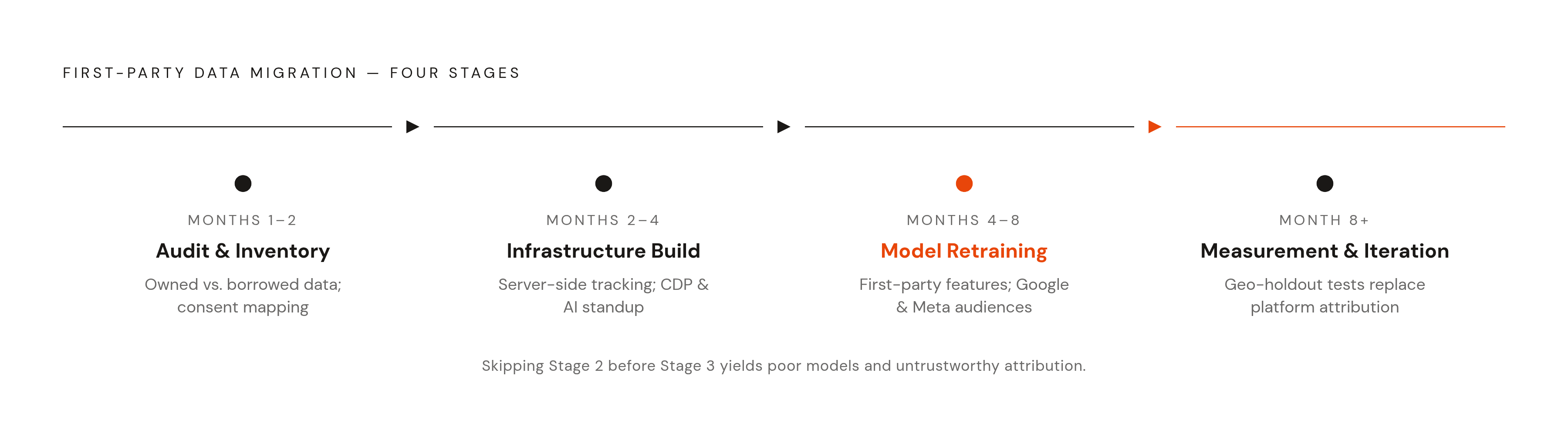
Moving from a cookie-dependent personalization stack to one built on first-party data and AI is a staged process, and the order in which the stages happen matters as much as the stages themselves. Brands that try to activate AI personalization before their data infrastructure is actually in place end up with poor models and attribution they cannot trust.
The first stage, running roughly through months one and two, is audit and inventory. This means identifying what data a brand genuinely owns versus what it has been borrowing from third-party sources all along, a gap most teams find larger than they expected once they look closely. It also means mapping consent status across all existing data: which users opted into which specific uses, and whether that consent is documented in a log that is both immutable and auditable.
The second stage spans roughly months two through four, and it covers infrastructure build. First-party event tracking gets instrumented server-side, and a CDP gets stood up or reconfigured to unify behavioral, transactional, and declared data into governed profiles. This is also the stage where an AI assistant gets connected to live store data, including inventory, pricing, and active promotions, so it never recommends an item that is out of stock or quotes a price that has since changed. An AI that gets basic product facts wrong destroys the trust that makes zero-party data collection possible in the first place, which makes this connection a prerequisite.
The third stage, running from roughly month four through month eight, is model retraining and activation. Personalization models get retrained on the new first-party feature set, with uplift degradation measured honestly and a cold-user performance gap planned for rather than denied, since contextual and cohort strategies only partially close it. First-party audience segments get activated through Google Customer Match, Meta Custom Audiences, and email and SMS flows triggered by conversation signals, replacing the old inferred behavioral segments with declared preference data.
The fourth stage, beginning around month eight and continuing on an ongoing basis, is measurement and iteration. Geo-holdout incrementality tests run across major paid channels to establish a true performance baseline, rather than leaning on platform-reported attribution to make budget calls. The brands that complete this sequence in order end up with a personalization system built on data they own, consent they can document, and attribution they can defend, a foundation considerably more durable than the one third-party cookies ever provided.