Personalized Product Recommendations on Shopify Without a Custom Build
Shopify apps now handle product recommendations without custom code.
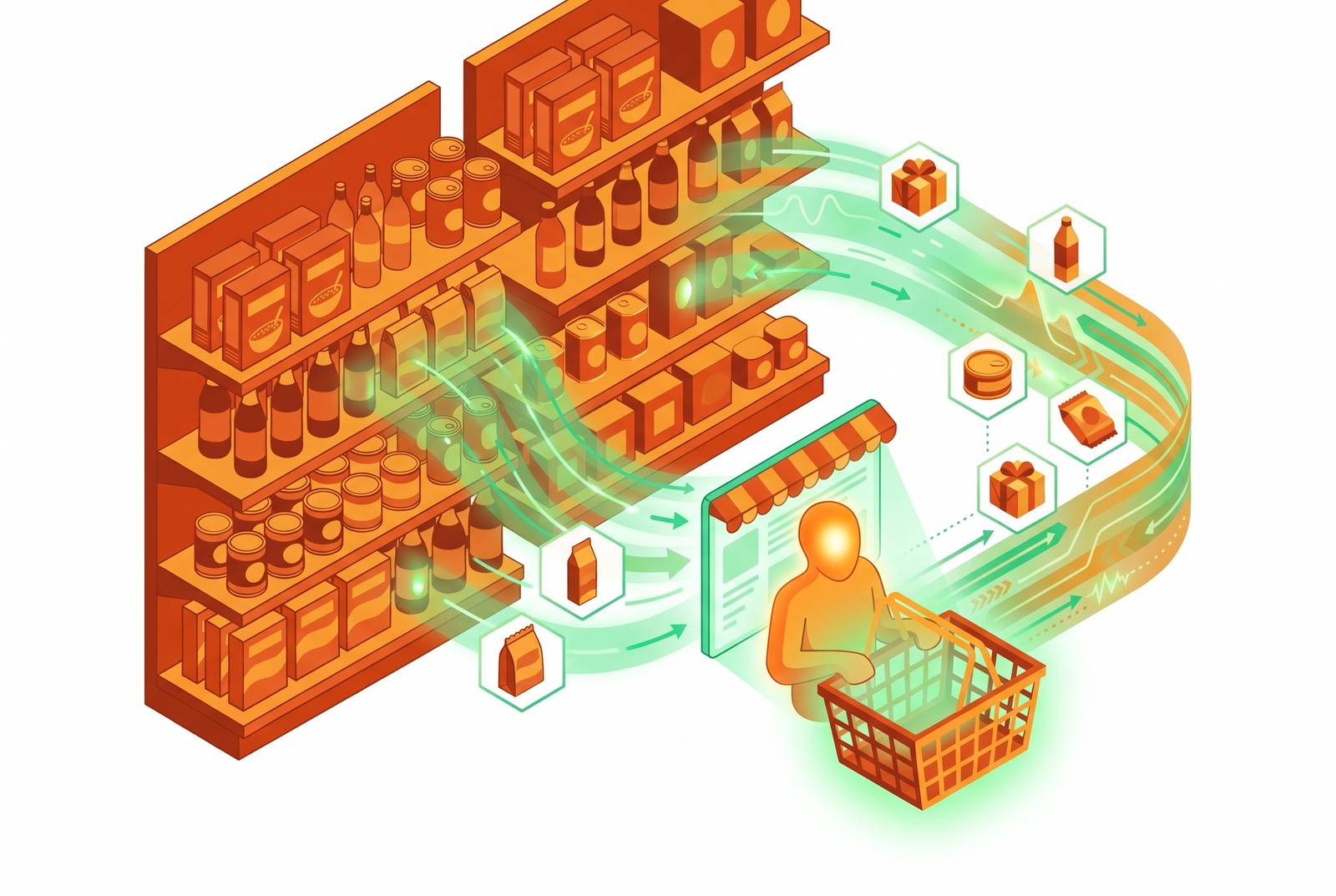
Shopify merchants can deploy behavior-driven product recommendations today without a developer sprint, a theme rebuild, or a custom codebase. The tooling has matured to the point where personalization that once required engineering investment is now configurable through the admin panel. What merchants are actually after is straightforward: surfacing the right product to the right shopper at the right moment across the homepage, product page, cart, and post-purchase flow, to lift conversion and average order value. The historical reason for building custom recommendation engines was equally clear. Off-the-shelf options were thin, placement was rigid, and the logic was rule-based rather than behavioral. A merchant who wanted recommendations that responded to what a shopper actually did on the site had to commission that capability. That gap has closed. The Shopify app ecosystem now offers installable tools with behavioral signals, A/B testing, and multi-placement logic, all configurable through the admin panel without touching theme code. The remaining case for custom development is narrow: heavily modified themes where default app placements genuinely don't fit, or recommendation logic so proprietary it cannot be expressed in any available tool's rule engine. Neither describes most DTC stores.
What Shopify's own native tools personalize — and where they stop
A useful way to anchor the discussion is to establish what already exists inside every Shopify account before any app is installed. Shopify's built-in AI features give merchants a functional starting point for content and store management, but they do not deliver on-site behavioral product recommendations without additional tooling. That distinction matters because it sets the zero-cost baseline and clarifies what the paid tools are actually adding.
Shopify Magic is the most visible native feature: AI tools built into the admin for product description generation, email and blog content drafting, and AI image editing. It is free and requires zero setup. Sidekick, Shopify's AI assistant for store management, goes further: it summarizes data, generates reports, executes admin actions, builds automations, generates content and images, and proactively surfaces optimizations through Sidekick Pulse. Both are genuinely useful for the merchant's own workflow. Neither is a shopper-facing recommendation engine.
What native personalization does not cover is the specific surface where recommendation value concentrates: real-time behavioral signals from the current session, cross-sell and upsell widgets on the product page or cart, post-purchase recommendation flows, or conversational product guidance for shoppers. The honest limit is that a merchant who stops at native tools has better store management and faster content production, but shoppers still see a static storefront with no personalized product surface. Installing an app is what closes that gap.
The installable app layer: what each tool personalizes, what it costs, and where it fits
Installable AI recommendation apps for Shopify now cover the full placement map: homepage, product page, cart, checkout, post-purchase, and email. Each tool takes a distinct approach to what it personalizes and for which store size or use case. The practical question for a merchant evaluating these options is not whether recommendation apps exist, but which one matches a specific situation without requiring a developer to run the evaluation.
LimeSpot is the broadest option in the traditional widget category. It covers more than 12 recommendation types across homepage, product pages, cart, checkout, post-purchase, and email, and the setup runs through the admin panel without touching theme code. A developer only becomes relevant on a heavily customized theme where the default placement conflicts. LimeSpot suits merchants who want broad placement coverage and want to start on a low fixed cost.
Zipchat takes a different route. It delivers recommendations inside an AI conversation rather than a static widget grid: the shopper states what they need and the agent surfaces matching products. The approach is stated-need recommendations, where the shopper's expressed intent drives what is shown, while browsing behavior and cart context are incorporated as additional signals. A free trial is available, with pricing on the company's site.
LiveChatAI distinguishes itself at the connection layer. It uses an MCP (Model Context Protocol) connection to read live product data, inventory levels, and pricing in real time, meaning the agent cannot recommend an out-of-stock item or quote a stale price. Setup is described as a 5-minute no-code process. The live inventory sync is the differentiator: recommendation accuracy depends on data freshness, and this is one of the few tools that resolves that at the connection layer rather than relying on a periodic feed. Maestra, identified in Zipchat's roundup as the strongest fit for mid-market and enterprise omnichannel use cases, suits stores with multiple channels and more complex segmentation needs. It is less relevant for early-stage or single-channel DTC brands, whose channel coordination constraints are simpler.
Not every tool in this space is a recommendation engine in the widget sense, and some deserve placement in this map because they address adjacent surfaces. Ringly.io, by its own evaluation, is a specialized AI phone agent for Shopify customer support: automated call handling, order lookups, returns, and escalation. It connects directly to store data, and if a customer calls from a number on file, the agent has their order details before the conversation starts. Its role is support-driven retention rather than browse-session recommendation, which makes it worth noting only for merchants where phone support is a real channel.
TxtCart is an AI-powered SMS marketing platform covering abandoned cart recovery, conversational text campaigns, and personalized SMS, with a free-to-install Starter plan subject to a minimum monthly spend and usage-based per-SMS pricing. The conversational AI engages shoppers in real time with human-like text interactions, and recommendations happen inside the SMS thread rather than on-site. It fits stores with an existing SMS list or a strategy to build one. It is not a substitute for on-site recommendation widgets. Tidio AI, through its Lyro agent, is more support automation than recommendation engine at this tier. It is relevant for small stores where support volume is consuming time that should go to merchandising, rather than for merchants seeking to improve on-site product discovery.
Where a brand intelligence layer fits alongside widget-based recommendation apps
Running alongside the widget apps is a different category of tooling that answers buyer agents from ChatGPT, Google, Perplexity, and Gemini with accurate, differentiated product data. This is not a widget render but a machine-readable response to an external query. The practical question for a merchant is whether the goal is solely to add a "you may also like" widget to the product page, in which case an app like LimeSpot is sufficient, or whether the goal is to own the AI conversation about the brand on-site and on external AI channels, in which case a brand intelligence layer does the work the widget apps were never designed to do. The decision is not either/or. A merchant can run a widget app for on-site human shoppers and a brand intelligence layer for AI discovery simultaneously, because the two solve different surfaces of the same problem.
How AI agents are already shopping on behalf of consumers — and what that changes for on-site recommendations
The shopper a recommendation system is optimizing for is increasingly not a human clicking a widget but an AI agent evaluating structured product data on a consumer's behalf. Those two audiences respond to different signals, and the distinction is beginning to reshape what it means for a product to be well presented. What buyer agents do is documented in research using the ACES evaluation framework, which audits agent decision-making across providers: they parse product pages or APIs, evaluate and choose products, and in some cases execute the purchase without the human returning to the store. Google's Agent Payments Protocol (AP2) and Coinbase's x402 micropayment protocol mean an AI agent can now autonomously negotiate and settle a purchase on its owner's behalf. The storefront is becoming an API.
What agents respond to is not what human-facing widgets surface. Agents need complete structured product data: GTIN, price, availability, material, size, and color, not copy embedded in images or PDFs. They need server-rendered JSON-LD Product schema on every detail page. They need real-time feed sync, because stale data produces wrong recommendations or agent refusal. The practical consequence for recommendation tooling is that an app rendering a widget for a human browser is not the same as an app whose underlying product data is structured well enough to answer an agent query, and most current recommendation apps were designed for the former.
The ACES research also documents that AI agents exhibit choice homogeneity, concentrating demand on a few modal products while ignoring others entirely, and that these preferences are unstable across model updates. A brand cannot optimize once and assume the result holds across providers or model generations. This has a direct implication for how merchants think about recommendation accuracy: the system must be able to represent products accurately to a moving evaluator, not just to a fixed algorithm or a human eye.
Every recommendation tool in this landscape is only as accurate as the product data it reads. Thin, incomplete, or unstructured catalogs produce poor recommendations regardless of which app is installed. Missing GTINs, absent size and color metadata, and inconsistent naming across variants degrade any engine's output. The absence of JSON-LD schema on product detail pages means AI systems reading the page get design rather than data. The consequence for recommendation logic is that a behavioral engine can surface "customers also bought" reliably from transaction data, but cannot recommend by fit, compatibility, or use-case match if those attributes are not structured fields the engine can read. For AI discovery channels, research on agentic e-commerce information markets frames the scarce resource in agent-mediated shopping not as matching products but as acquiring trustworthy, decision-relevant information about them, and that information has to come from structured, machine-readable data the seller has exposed.
The decision framework that follows from all of this is clear. Start with native Shopify tools for admin and content tasks, then add one app targeted at the specific placement that's underperforming. For stores where SMS or phone is a real acquisition and retention channel, TxtCart and Ringly.io address the channels that on-site widgets don't reach. For mid-market and enterprise stores with omnichannel complexity, Maestra suits situations where segmentation and channel coordination are the primary constraint. And for merchants whose ambition extends to being answerable by AI discovery channels, a brand intelligence layer runs alongside the widget apps rather than replacing them. The same-day deployment and absence of a theme rebuild requirement makes each of these additions practical, not aspirational. The limiting factor is no longer the tooling. It is the data.