Multi-Agent Commerce Workflows and DTC Brand Exposure
AI agents are already deciding which DTC brands shoppers see before they shop.
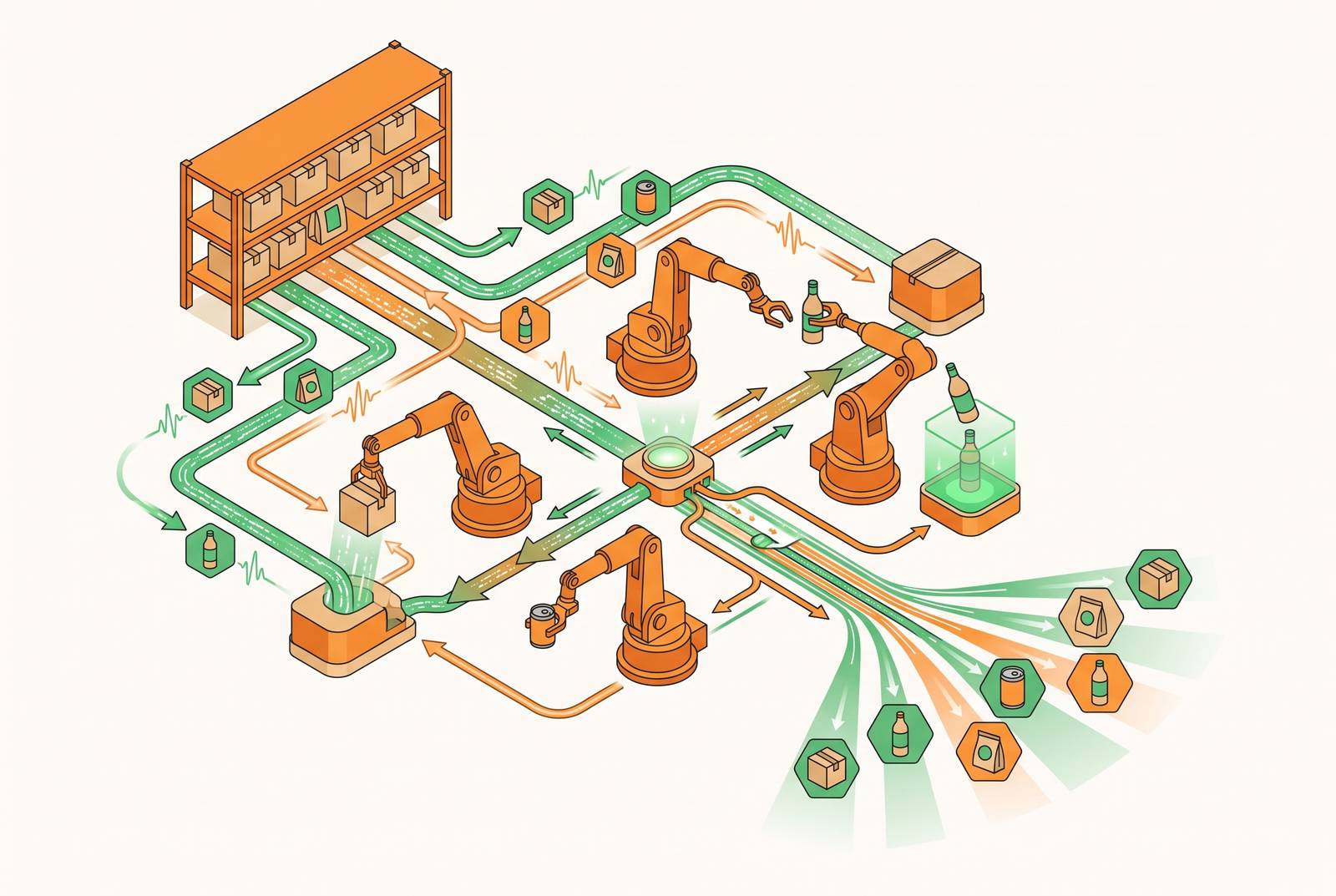
The competitive ground for DTC brands has shifted from ranking on page one to being chosen by an AI buyer agent before a shopper ever lands on a storefront. That selection happens inside a conversation the brand never sees, decided by criteria that have nothing to do with search rank.
The infrastructure behind this shift is already running. Google's AP2 and OpenAI and Stripe's ACP are live protocols, not pilot programs, and ChatGPT already walks U.S. shoppers through product discovery on Shopify merchants, then hands off to checkout on the merchant's own storefront. Shopify Agentic Storefronts, launched March 24, 2026, let people browse and buy inside conversations on ChatGPT and Microsoft Copilot, while AI Mode in Google Search and the Gemini app serve select brands with a wider rollout underway. Microsoft Copilot Checkout runs alongside these. The Universal Commerce Protocol, built with Google and developed jointly with Shopify, Etsy, Wayfair, Target, and Walmart, has drawn a growing list of backers including Stripe, Visa, and Mastercard, with Amazon and Meta joining the UCP Tech Council in April 2026. The practical effect of that coalition is straightforward: when a new AI platform adopts UCP, Shopify merchants sell there automatically, without a separate integration project for each new surface.
The pace of adoption on both sides of the transaction backs this up. Most consumers already use AI somewhere in their shopping process, and most ecommerce businesses are either integrating AI now or planning to in 2026. Orders coming from AI-powered searches on Shopify stores have climbed at a rate that far outpaces overall traffic growth. None of this is a forecast. It's a description of plumbing that is already installed and already carrying transactions. Brands treating this shift as a problem for next year are already behind on this year's version of it.
Why AI-referred traffic converts differently
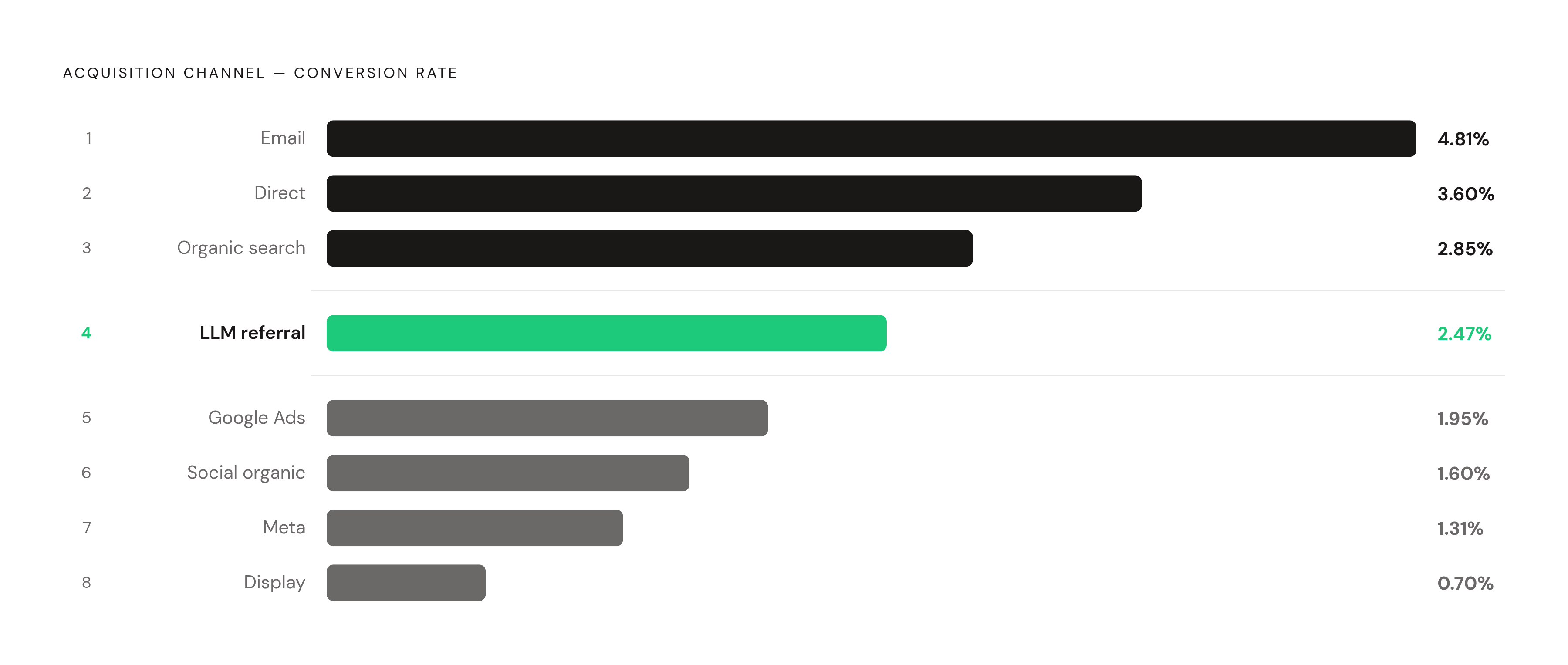
Shoppers who arrive through an AI agent convert at a different rate than those from search or social because they show up having already done the comparison shopping an agent does on their behalf. LLM-referred traffic converts at 2.47%, the fourth-highest rate among all acquisition channels, ahead of both Google Ads and Meta.
The reason sits in what already happened before the click. Someone who asks ChatGPT or Perplexity to find a product has, in that exchange, already had their questions answered, their options compared, and their constraints applied. Budget, size, color, delivery window, whatever mattered has usually been filtered out already. They don't land on a brand's site to start shopping. They land to finish a decision the conversation already shaped. That's why AI-referred shoppers also browse more pages and stay on site considerably longer than the average visitor: they're not scanning for relevance, they're confirming a choice. This is a different kind of visitor than one arriving from a paid social ad or a generic search query, and it behaves differently through the funnel as a result.
The scale behind that conversion number is growing year over year. AI referral traffic to U.S. retail sites rose sharply year-over-year in the first quarter of 2026, and Salesforce data on the 2025 holiday season found AI agents had a hand in a meaningful share of global online sales. A conversion rate that good, applied to a volume that's compounding, makes this the acquisition channel DTC brands can least afford to ignore. That premium reaches only brands an agent can find, read, and trust enough to cite. That's where the competition actually happens now.
Selecting Brands and Products
AI agents don't rank products the way Google does. They aren't weighing domain authority or counting backlinks. They read structured data, check citation signals from sources they consider authoritative, and factor in review volume. That means a brand's position on a Google results page says almost nothing about whether an AI agent will ever mention it.
Audit data bears this out starkly: most brands that rank well on Google go uncited by AI systems. The two systems run on separate logic, because they're built from different inputs and judged against different standards. Layered on top of that is a platform-by-platform asymmetry that breaks any plan built around a single playbook. Google AI Overviews cite retailers in only a small share of shopping-related responses, while ChatGPT cites them in more than a third. A brand optimized to show up in one of those surfaces gains no guarantee of showing up in the other.
Feed quality is now a hard gate, not a soft advantage. On May 12, 2026, OpenAI began running product feed ads inside ChatGPT, built to handle catalogs as large as a million SKUs per advertiser. Retailers whose feeds are thin, outdated, or poorly tagged don't rank lower in that channel. They don't appear in it at all until the data is fixed. No single feed format wins across every engine, so brands have to keep structured data legible across several AI surfaces at once, each with its own way of parsing and citing.
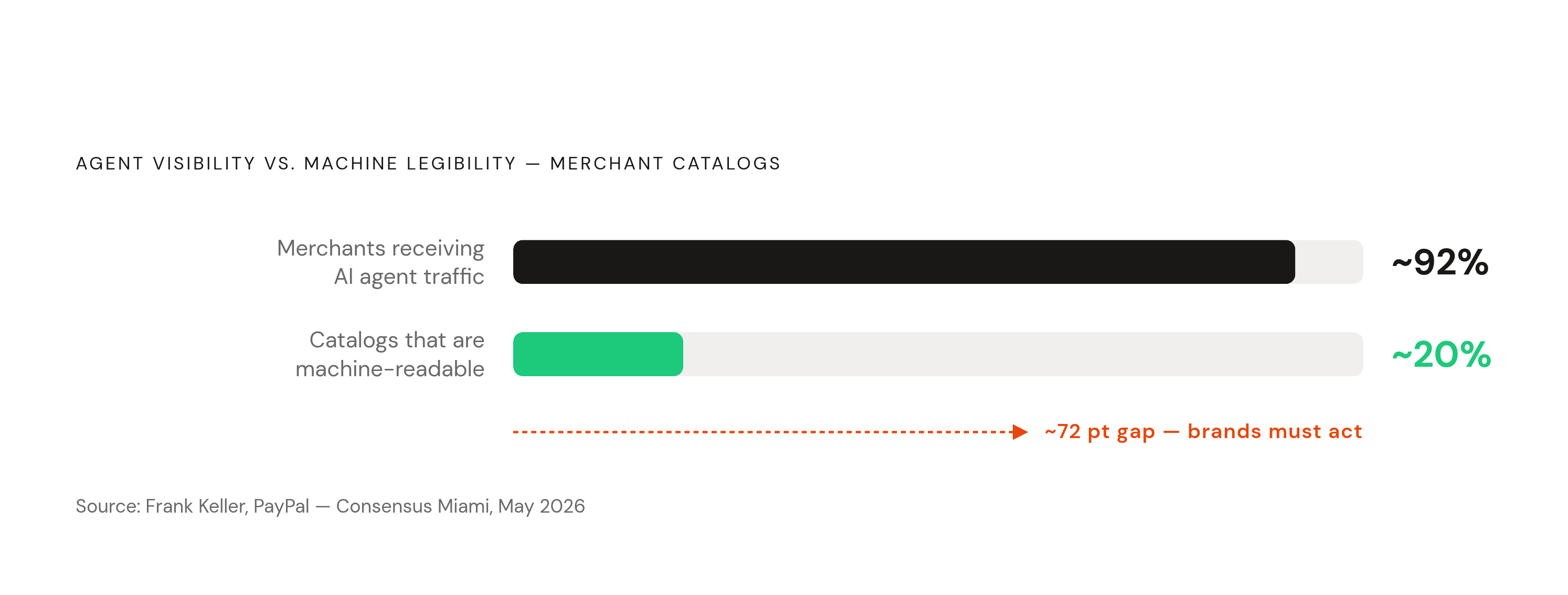
The gap between where merchants think they stand and where they actually stand appeared clearly at a Consensus Miami panel in May 2026, where PayPal's Frank Keller cited survey data showing that most merchants already see AI agent traffic hitting their sites, but only about a fifth have catalogs that are actually machine-readable. Most brands are being visited by a buyer they're structurally unequipped to be seen by.
The commoditization risk AI agents pose to brands that rely on storytelling
When agents compare products on structured facts alone, they strip away the narrative layer that many DTC brands have built their entire identity around. An agent assembling a recommendation works from whatever data it can parse: specs, price, materials, shipping terms, review scores. If a brand's real differentiation lives in brand voice, lifestyle photography, or founder story, none of that factors into the agent's comparison, because none of it is legible to the system making the decision.
This doesn't mean agentic discovery replaces the brand's own site, and the Walmart partnership inside the Universal Commerce Protocol shows how the labor divides. Walmart, Target, Etsy, and Wayfair helped build UCP alongside Shopify specifically so that agents can surface and route purchases without forcing every brand through a single retailer's storefront. The agent's role is to identify a qualified buyer and hand that buyer to the right destination. Closing the sale, building loyalty, and capturing margin still happen on a brand's own site, where its story, pricing, and experience are fully in its control.
That division points to the actual competitive strategy for DTC brands: trying to out-cite Amazon across every AI surface is not a fight most brands can win, and it's not the fight that matters. What matters is being included among the sources an agent trusts enough to mention, then making sure that when a shopper's intent lines up with what the brand does well, the agent routes them to the brand's own site rather than a marketplace listing. Conversion from there is the brand's job.
Post-purchase support factors into this cycle more than most brands realize. Agents weigh how well past orders were handled, meaning fast, accurate, automated support on order tracking, returns, and refunds increases the odds a brand gets recommended again in a future purchase cycle. A brand's operational reliability has become a visibility input alongside being a satisfaction metric.
None of this works without the underlying data being in shape. Structured, enriched product data is the single biggest factor determining which brands get cited, recommended, and bought through AI channels, and the gap between brands that have invested in it and brands that haven't is already measurable in the audit data cited above. Machine-readable catalogs let an AI engine extract and compare product facts accurately. Without that foundation, a product can be excellent and still be invisible to the system deciding what gets recommended. Only around a fifth of merchants currently have catalogs built to that standard, even though most are already seeing agent traffic arrive. That gap is the opening for brands willing to move on it now, before the readiness bar rises along with it.
The review prompts, referral programs, and community touchpoints a brand builds after a sale do double duty in this environment. They build loyalty in the near term, and they generate the reviews and user content that become tomorrow's AI training data and citation signals, feeding directly back into whether the brand gets recommended in the next cycle.
Converting AI-referred shoppers on the brand's own site
Getting a pre-qualified buyer from an external AI agent is only half the transaction. What happens once that shopper lands on the brand's own site decides whether the warmth an agent built up turns into revenue, and brands running their own on-site AI layer close a meaningfully higher share of those visitors than brands without one.
AI chat on-site lifts conversion rates by a wide margin over unassisted browsing, and if shoppers get AI help, they complete purchases faster than those left to navigate a site alone. Proactive chat also recovers a real share of carts that would otherwise be abandoned, by stepping in at the right moment with a relevant offer instead of letting the shopper leave.
Feastables, the snack brand founded by MrBeast, built this case concretely. Its AI assistant, FeastyBot, developed with Certainly, drove purchases that converted at a substantially higher rate than the site average and lifted average order value by a meaningful margin. The chatbot ended up responsible for a material share of total revenue, and shopper satisfaction with it came in above the industry benchmark. That result didn't come from a flashy feature. It came from the assistant doing, on-site, the same kind of pre-qualification work the external AI agent had already started doing upstream.
Who benefits most from this layer skews generational. Gen Z shows the highest likelihood of converting after an AI recommendation, with Millennials close behind, so brands courting younger audiences know exactly where to put their investment first and heaviest.
What the on-site AI layer produces beyond the sale itself may matter just as much as the sale. Every conversation is a record of what a customer was unsure about, which objections came up again, and which product details actually swayed the decision. That's zero-party behavioral data, and no traditional analytics platform can surface it, because it only exists inside the conversation itself.
Using the customer intelligence AI conversations surface
The behaviors an on-site AI layer captures happen before the purchase, which makes them invisible to the kind of post-purchase analytics most DTC teams rely on. Virtual try-on sessions and chat interactions reveal which styles a shopper actually tried, which fits they weighed against each other, and which objections they raised before deciding. That data is absent from a standard order record. It only exists in the interaction logs of the AI layer that handled the conversation.
That data has a second life beyond informing merchandising decisions. Shoppers who convert after an AI referral go on to write the reviews, post the user-generated content, and generate the forum mentions that become the citation signals future AI systems draw on when deciding what to recommend. A post-purchase engagement program, in this light, is as much an investment in next year's AI visibility as it is a loyalty tactic today.
If you build review prompts, referral incentives, and community programs with that cycle in mind, ordinary customer satisfaction turns into structured input for the next generation of AI models. And the generational skew in AI-assisted conversion gives brands a clear signal for where to focus those programs first: Gen Z and Millennial shoppers are the segments most likely to convert off an AI recommendation, which makes them the natural priority for AI-native post-purchase design.
Why most DTC brands measure AI-driven revenue inaccurately
Most DTC brands cannot currently tell how much revenue their AI channels are actually generating, because their attribution stacks were never built to distinguish AI-agent traffic from direct traffic. That blind spot means real returns on AI investment either get credited to the wrong channel or disappear from reporting altogether, and multi-touch attribution models only make the confusion worse.
Every marketing channel tends to claim credit for the same sale, and platforms collectively report more revenue as theirs than their combined share could possibly account for, a distortion that predates AI and would exist even without it. AI agent traffic makes this distortion sharper because it's a new channel, and most attribution stacks haven't been updated to tag it correctly. If traffic arrives through an AI agent but can't be identified as such, it typically gets logged as direct or credited to whatever channel the shopper touched last before converting, so the AI channel's real contribution gets understated every time this happens.
Closing that gap takes triangulation rather than a single dashboard number. Marketing mix modeling, incrementality testing (geo-based holdout experiments comparing revenue in markets where a channel ran against matched markets where it didn't), and post-purchase surveys, used together, produce a confidence range instead of one falsely precise figure. Attribution tools including Northbeam and Haus are both built on that incrementality principle, and even their output is presented as an estimate, not a settled fact. Brands that keep relying on last-click attribution to judge their AI investment are making decisions on numbers that were already wrong before the AI channel existed, and the growth of that channel is only widening the error.