AI Personalization vs Email Segmentation for DTC Revenue
AI and email work different stages of the customer journey.
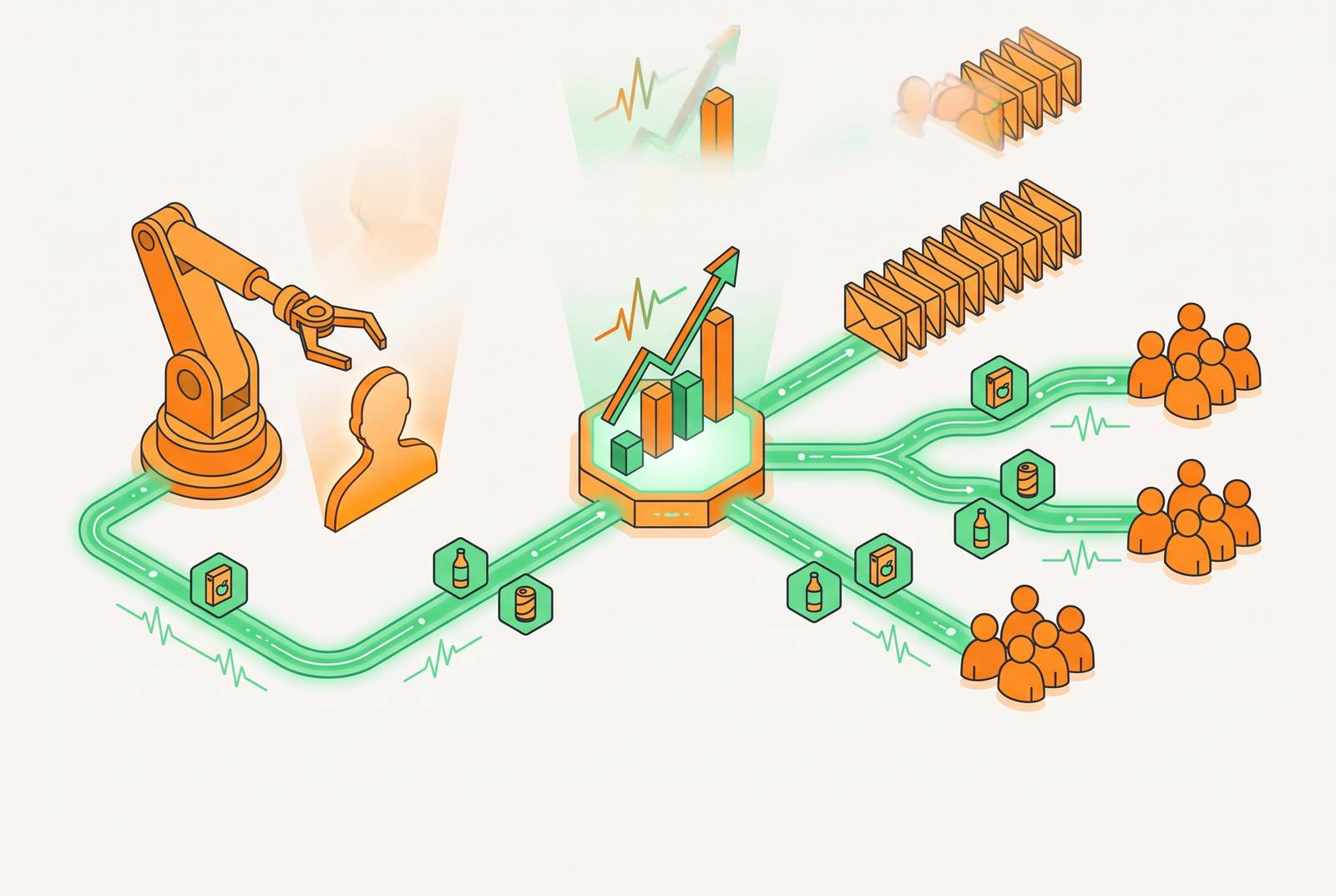
The question most DTC marketing teams are asking in 2026, whether AI personalization beats email segmentation, assumes the two mechanisms compete for the same job, but they don't. Email, whether segmented by behavior or personalized by an AI model, works on subscribers a brand already has on its list. Shoppers ask AI-driven discovery tools for help before they ever land on a site, and this separate layer shapes purchase intent earlier, outside the list. A third layer sits between those two: what happens on the storefront itself once a shopper arrives, whether through email, discovery, or a direct visit, and whether that storefront meets them with an intelligent sales experience or a static product page. If brands treat AI and email as rivals, they over-engineer the layer they already control and stay invisible where intent actually forms.
What email segmentation does
Email segmentation earns its revenue through triggering, not through volume. Segmented email campaigns generate 760% more revenue than non-segmented broadcasts, with the lift coming overwhelmingly from automated flows fired by purchase history, browse behavior, and engagement recency. A small fraction of total sends are triggered by a specific behavioral event, but they produce a disproportionate share of total email revenue.
A subscriber who abandoned a cart an hour ago, a subscriber who just completed a purchase, and a subscriber who hasn't opened an email in four months occupy three distinct conversion states. Sending all three the same message wastes margin in both directions: a loyal buyer gets a discount she didn't need to convert, and an at-risk subscriber gets a generic nudge when urgency was the only thing that would have worked. A brand like Bloom & Root illustrates the mechanism at work among its VIP segment: holding back unnecessary discounts for customers who would have purchased anyway preserved margin that a blanket discount policy would have given away.
Segmentation has a ceiling, though, and it's a structural one. Segment logic sorts people into buckets by past behavior, but everyone in a bucket still gets the same message. Two subscribers can land in the same RFM segment and still differ completely in what would actually move them to buy. Segmentation cannot see that difference. It can only see the bucket.
AI Personalization: From Segment to Individual
AI personalization doesn't replace the behavioral logic segmentation runs on. It picks up exactly where that logic runs out of resolution. Two subscribers sitting in the same bucket, same recency, same frequency, same monetary value, may have entirely different price sensitivity, different category affinities, and different optimal send times, and only individual-level modeling can tell them apart.
AI-powered offer optimization is where that distinction shows up most clearly, in offer design. AI-powered offer optimization can identify which customers will convert at full price, which respond better to free shipping than to a percentage discount, and what the minimum incentive is for a genuinely price-sensitive customer. Segment logic can't make that call, because it only averages across the group. Getting it right is a margin-protection function as much as a conversion-lift function, since it stops a brand from discounting its way into a sale it would have closed anyway.
AI personalization also cuts the time and cost of producing personalized campaigns at scale, which frees up team capacity that would otherwise go into execution. Most DTC email teams spend the bulk of their hours on execution, building and QA-ing campaigns. Freeing up that capacity changes how many campaigns a small team can run in parallel, not just how good any single campaign is.
None of this means every brand should rush to layer AI on top of its flows immediately. If AI personalization models don't have enough data volume, they can't outperform a well-built set of behavioral rules. A brand below a certain size may find that sophisticated segmentation alone captures most of the available lift, and that AI adds little incremental margin over what the rules already deliver until the list and order volume grow large enough to feed the model properly.
The attribution problem that makes both email tactics look better than they are
Standard last-click attribution inflates email's apparent share of revenue, and it does so by giving zero credit to whatever influenced the shopper before the final click. That distortion skews the baseline beneath every comparison brands draw between email tactics and anything else, before the comparison even starts.
The mechanism is simple to trace. A shopper who asks ChatGPT or Gemini for a product recommendation, settles on a brand, and later clicks an email to complete the purchase will show up in the reporting as an email-driven conversion. The AI tool that actually did the recommending gets nothing. Email receives credit for conversions it assisted, and AI-driven discovery receives credit for conversions it caused.
The Bloom & Root VIP case from the previous section is a small-scale preview of the same blind spot. The margin that brand kept by withholding unnecessary discounts never showed up as a line item in its email attribution reports. It was real revenue improvement that the standard measurement simply couldn't see, because the reporting was built to count sends and clicks, not avoided discounts.
The industry is starting to build around that gap. Slingwave, unveiled at CES 2026, represents a new category of measurement tooling built to address it directly, combining Bayesian MMM+, agile marketing attribution, and experimentation into a single system. Its entry-level Diagnostic tier delivers incrementality insights across Amazon, Google, Meta, and TikTok, with higher tiers expanding into additional channels. Tools like it exist because last-click reporting can no longer account for where a purchase decision actually began.
Brands optimizing email segmentation and AI personalization purely against platform-attributed revenue are competing inside a measurement system that doesn't reflect actual incremental margin. When a shopper queries an AI assistant before touching a paid channel, that influence never appears in last-click numbers, leaving brands invisible to one of the highest-converting traffic sources, one that operates outside email's reach. Making pre-visit influence visible to AI shopping assistants gives brands a way to measure the revenue their own AI presence is actually driving rather than assuming it's zero because attribution says so.
The pre-visit discovery layer email cannot reach
AI-driven discovery isn't a faster version of search or a smarter version of social. It compresses the research phase into a conversation, so by the time a shopper lands on a product page, much of the comparison shopping that used to happen across five open tabs has already happened inside a chat window. That compression changes the shape of the traffic itself, not just its source.
Shopify's Q1 2026 commerce data puts numbers to the effect. AI-referred shoppers convert at nearly 50% higher rates than organic search shoppers, and they carry higher average order values too. More than half of AI-referred sessions start directly on a product page, compared to roughly a fifth of organic search sessions. The AI-referred shopper has typically already decided what they want before they arrive. Shopify describes this as "journey compression," a term it attributes to the practitioner community.
The conversion advantage isn't uniform across categories, and that unevenness matters for how urgently a given brand needs to respond. Spec-driven subcategories like watches and jewelry convert from AI referral at multiples well above the baseline, because shoppers there benefit most when specifications, comparisons, and recommendations arrive pre-digested. A brand selling in one of those categories is further behind if it isn't structured for AI discovery than a brand selling a more straightforward commodity good.
Enrollment in an AI shopping surface is not the same thing as being visible on it. Shopify auto-enrolled millions of stores into ChatGPT Shopping, but most of those stores' products still don't appear in results because their catalogs aren't structured in a way AI agents can parse and recommend from. Industry conversation has centered on exactly this distinction between enrollment and actual recommendation.
The split described earlier in this piece is visible here in concrete form. Email still only works on a list the brand already owns, whether that list is segmented or AI-personalized. AI-driven discovery through shopping assistants works on intent before that list ever enters the picture, and a third layer, the storefront itself, determines what happens once a shopper lands regardless of which of those two channels brought them there. An on-site AI sales experience, trained on a brand's own product and policy data, can meet that shopper in the brand's own voice instead of leaving them with a static page that doesn't know why they came.
How far agentic purchasing has gone
You don't need AI tools to complete the purchase to get the conversion lift described above. Consumer trust in autonomous checkout remains limited, and humans still make the final decision and complete checkout in the overwhelming majority of transactions. When you look at assessments of agentic shopping experiences through mid-2026, they generally find them mostly conversational rather than transactional: the AI does the research and recommendation work, but the human still drives the purchase.
That limitation doesn't undercut the case for acting on AI-discovery readiness now. The conversion and order-value lift in Shopify's Q1 2026 data is happening in exactly that conversational regime, before autonomous checkout plays any meaningful role. The research and recommendation phase is already AI-mediated in a growing share of shopping journeys, and that's the phase generating the measurable advantage. A brand doesn't need agents to transact autonomously to benefit from showing up well when an agent is asked for a recommendation.
Two kinds of misreading appear on opposite ends of this picture. A brand that dismisses AI discovery as "not yet real" because checkout isn't autonomous is misreading what the conversion data already shows. A brand that treats autonomous checkout as already dominant is misreading what consumers currently trust an AI agent to do on their behalf. The accurate read sits between those two positions: the research phase is substantively AI-mediated now, and the purchasing phase mostly isn't yet.
The readiness gap this creates isn't a future problem to plan for later. The brands currently surfacing in AI shopping results are largely the ones whose catalogs happened to be structured correctly when these surfaces scaled, and Shopify's Spring '26 release made AI commerce part of its default infrastructure, so for most brands, the risk isn't failing to be enrolled, since enrollment is now close to automatic. A brand whose product data says different things across different AI surfaces, different prices, different descriptions, different availability, can't be recommended consistently by any of them, and it loses the recommendation even in cases where it technically appears. As agent-mediated discovery grows as a share of total shopping traffic, the window for fixing that incoherence narrows.
Sequencing investment across the DTC revenue stack
Put together, the three layers map onto three distinct moments in the shopper journey, so they don't compete for the same marketing budget. AI-driven discovery operates before a shopper ever reaches a brand's list or storefront, shaping intent while the research phase is still conversational. The storefront itself, met by an on-site AI sales experience or a static page, determines what happens the moment a shopper actually arrives, regardless of whether they came from a discovery conversation, an email, or a direct visit. Behavioral email segmentation and AI personalization then operate on subscribers the brand already holds, retaining and re-engaging people who've already entered the list.
Just as AI personalization resolves individual-level differences that segment logic can't see, agent-ready storefront infrastructure resolves a shopper's intent at the exact moment of arrival, deploying a brand-trained AI sales rep that understands product nuance, pricing strategy, and customer policy at the level of a single transaction.
Sequencing investment across these three layers means treating them as dependent stages. Underinvesting in any one creates a leak the others cannot patch. The strongest AI-discovery presence still can't retain a customer if the post-purchase experience has no behavioral triggers waiting to catch them. A brand evaluating where its 2026 marketing dollars should go first needs to ask not which mechanism performs better in isolation, but which moment in the journey it's currently leaving unattended.